
A US stationery brand approved a handmade quilling card sample in March, released a 12,000 piece order in June and rejected close to a third of the delivery in September. Nothing in the workshop had changed. What had changed was the reference. The approved card had sat on a shelf in a sunlit meeting room for five months and lost two or three shades of coral, and the receiving QC team compared the shipment against a card that no longer looked like the one the artisans had been working from. There was no sealed reference, no signed approval record and no written tolerance. The dispute closed at a nine percent credit and both sides lost the Q4 window.
Sampling is the cheapest stage of a handmade greeting card programme and the one buyers most often compress. A full sample round costs a few hundred dollars and three to five weeks. A failed first production run costs a season. For paper quilling specifically, where every coil is rolled by hand and no two cards are mechanically identical, the sampling stage is not a formality before the real order. It is where the specification is actually written, because the sample is the specification. This guide sets out the sample stages global buyers should insist on in 2026, what each one proves, realistic lead times and costs, and how to write an approval that survives contact with a 15,000 piece production run.
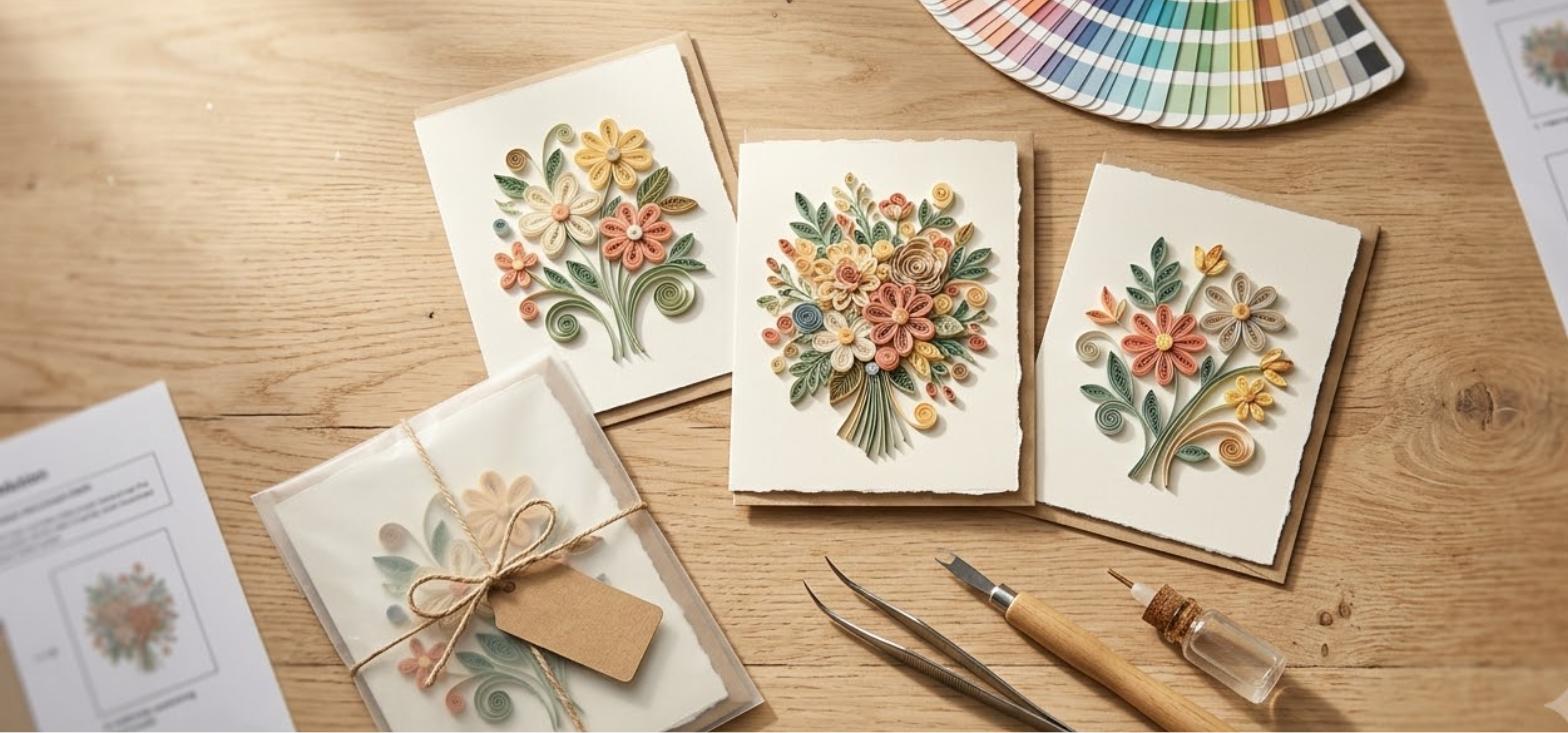
Why Handmade Cards Need a Different Sampling Discipline
Most sourcing teams carry a sampling process built around moulded, printed or machined goods. That process assumes a tool, a plate or a programme sits between the design and the output, so once the first article is right, repeatability is largely a machine question. Handmade quilling has no tool. The repeatability sits in the hands of individual artisans, in the paper batch, in the glue and in how a supervisor interprets the word acceptable.
Three consequences follow, and they shape everything below.
- Variation is inherent, not a defect. Two cards from the same design will differ in coil tightness, petal spacing and the exact angle of a stem. An approval that does not define how much variation is acceptable is an approval that can be weaponised later by either side.
- The sample teaches the workforce. In a quilling workshop the approved card is physically placed at the workstation and copied. A sample that was made by the workshop owner personally, over two days, cannot be copied by twenty artisans at production speed. That gap is the single most common cause of quality drift.
- Paper and colour are batch goods. Quilling strips are dyed in lots. A colour approved from one lot can shift on the next. Approving a card without locking the paper reference is approving a moving target.
A sampling process designed around these three facts costs no more than a careless one. It simply front loads decisions that would otherwise be made under pressure, by a QC inspector, at the port.
Stage Zero: The Artwork Brief That Makes Sampling Cheap
Sampling rounds multiply when the brief is thin. The workshop guesses, the buyer reacts, and each guess costs a week of transit. A brief that removes guesswork usually fits on two pages per design and contains the following.
- Finished card dimensions and orientation, stated in millimetres, with the fold position and whether the card is flat or folded. Inches are fine as long as one unit is authoritative.
- Card stock weight and finish for the base card and the backing, typically 250 to 350 gsm, with deckle edge or cut edge specified.
- Quilling coverage area, meaning the maximum footprint the paper work may occupy, so the artisan does not drift toward the fold or the edge where it will crush in packing.
- Maximum relief height, which decides whether the card fits a standard envelope and how it must be packed. Anything above about 8 mm needs a packing decision before approval, not after.
- Colour references as physical swatches or a named commercial colour system, never as a screen render alone.
- Design complexity tier, expressed as an approximate element count, because element count is the honest driver of both price and capacity.
- Text policy, including whether the card carries greeting text, in which language, and whether the inside is blank.
- End market and channel, because a card going to a European retail chain carries labelling and safety obligations that a corporate gifting run does not.
Ownership of the artwork should be settled in the same document rather than after the first sample lands. Where a buyer commissions original designs, the commission terms, exclusivity scope and the right to reuse motifs need to be explicit. That subject is covered in more depth in our guide to custom artwork, IP ownership and design exclusivity for Vietnam quilling cards.
The Four Samples, and What Each One Actually Proves
Buyers frequently collapse this into one step called the sample. Keeping the four separate is what allows a problem to be caught while it is still cheap.
1. Concept sample: proves the design is makeable
The first physical card answers one question only. Can this artwork be built in coiled paper at a sensible labour time, and does it read well from arm length on a retail spinner. Concept samples are usually made by a senior artisan and are deliberately not costed as production. Expect proportions to shift here. A bouquet that looked balanced on screen often needs fewer, larger elements to survive at 100 mm width.
Do not approve colour at this stage and do not ask for pricing to be fixed from it. The useful output is a revised artwork and a first honest labour estimate.
2. Pre-production sample: proves the design is makeable at production speed
This is the sample most programmes skip, and skipping it is the mistake. A pre-production sample must be made by a regular production artisan, working to the target cycle time, using the paper and glue that will be bought for the order. Ask for three to five pieces of the same design rather than one. A single card tells you what is possible. Five cards tell you what is repeatable, and the spread between the best and worst of those five is the real tolerance you are buying.
If the five pieces are visually inconsistent, the fix is almost never to press harder on quality. It is to simplify the design, raise the cycle time allowance, or both. Both have price implications, which is exactly why this conversation belongs before the purchase order rather than after.
3. Counter sample: proves both sides hold the same reference
Once the buyer marks up a pre-production sample, the workshop produces a corrected card, the counter sample, and returns it for sign off. The point of a counter sample is not politeness. It closes the loop on whether written comments were understood. Comments such as warmer pink or slightly fuller centre are interpreted differently in two languages and two workshops, and the counter sample is the cheapest place to discover that.
Keep the marked up sample. When a counter sample is approved, the pair of cards, the marked up original and the corrected version, becomes a far stronger record than either card alone.
4. Golden sample: the reference production is measured against
The golden sample, also called the sealed sample or shipment sample, is the approved article that governs the order. Good practice is three identical sealed pieces per design. One stays at the workshop and sits on the production floor. One goes to the buyer. One is held by the inspection party, whether that is a third party agency or the exporter. All three are made at the same time, from the same paper lot, and all three carry the same signed tag with design code, date, paper lot reference and the names of the people who approved it.
Seal them in opaque or UV resistant sleeves and store them away from daylight. The faded reference described at the start of this article is an avoidable failure and it is avoided at the cost of a sleeve.
Realistic Lead Times and Sample Costs in 2026
The figures below reflect typical handmade quilling workshops in Vietnam working on custom designs for export buyers. They are planning benchmarks, not quotations, and they assume the brief arrives complete.
| Stage | Workshop time | Typical courier transit | Indicative sample charge |
|---|---|---|---|
| Concept sample, new design | 4 to 7 days | 4 to 7 days | USD 25 to 60 per design |
| Pre-production sample, 3 to 5 pieces | 5 to 8 days | 4 to 7 days | USD 40 to 90 per design |
| Counter sample after markup | 3 to 6 days | 4 to 7 days | Often waived or at cost |
| Golden sample set, 3 sealed pieces | 3 to 5 days | 4 to 7 days | USD 30 to 70 per design |
| Full round, brief to sealed golden sample | Realistically 4 to 7 weeks for a range of 6 to 12 designs | ||
Two planning notes matter more than the individual numbers. First, courier transit is roughly half the elapsed time in a sampling cycle, so consolidating several designs into one shipment rather than sending cards as they are finished saves more calendar time than pushing the workshop. Second, sample charges are normally credited against the first production order, so negotiating them down is usually a poor use of goodwill. A supplier who samples free of charge for everyone tends to sample carelessly.
Colour Approval: Where Handmade Card Programmes Break Down
Colour causes more rejected quilling shipments than construction quality, and the reason is structural. Quilling strips are dyed paper, sold in lots, and the visible colour of a rolled coil differs from the same paper lying flat because the edge is what the eye sees. Approving a colour from a flat swatch and then judging a coil against it invites disagreement.
A workable colour protocol looks like this.
- Approve colour on the coil, not the strip. Ask the workshop to supply a small board of rolled coils in the candidate colours and approve from that board.
- Lock the paper lot for the first order and require written notice before the workshop switches supplier or lot mid programme.
- Agree a tolerance in plain language, for example that a shade difference visible only when two cards are held edge to edge under daylight is acceptable, while a difference visible at arm length is not.
- Define the lighting used for judgement. Daylight or a D65 daylight equivalent lamp, at both ends. Cards judged under warm office light in one country and cool workshop light in another will never agree.
- Test lightfastness before the range is locked. A simple window test, one card exposed and one sealed in a drawer for four weeks, separates pigments that hold from dyes that do not. Retail cards sit on spinners near shop windows for months.
Paper specification, adhesive behaviour and colourfastness testing are treated in detail in our companion guide to quality control for Vietnam quilling cards. Where a programme involves FSC certified stock, the chain of custody claim needs to be verified at the sampling stage rather than assumed, and the certificate can be checked directly against the public database maintained by the Forest Stewardship Council.
Writing a Tolerance Sheet for a Product Made by Hand
An approval that says the shipment must match the golden sample is unusable, because no handmade card matches another exactly. What protects both parties is a short tolerance sheet attached to the approval, written in measurable terms. A practical sheet for quilling cards covers six lines.
| Attribute | Typical acceptable tolerance | How it is judged |
|---|---|---|
| Finished card size | Plus or minus 2 mm | Steel rule, 5 cards per carton sampled |
| Motif position on the card face | Plus or minus 3 mm from the approved position | Overlay against golden sample |
| Relief height | Plus or minus 1.5 mm | Depth gauge or calliper at the tallest point |
| Element count per motif | Plus or minus one element, no missing focal element | Visual count against golden sample |
| Colour | No difference visible at 50 cm under daylight | Side by side with golden sample |
| Adhesive | No visible glue residue, no lifting coil under light thumb pressure | Visual and touch check |
Pair the tolerance sheet with an agreed inspection standard, commonly an AQL based sampling plan with separate limits for major and minor defects, and define which of the lines above count as major. Most buyers treat missing focal elements, lifting coils and visible glue as major, and small positional drift as minor. Writing that down converts an argument into an arithmetic check.
Linking Sampling to Capacity and the Season
A sample approval is also a capacity commitment, and this is the connection buyers most often miss. The pre-production sample establishes a cycle time. Multiply that cycle time by the order quantity and divide by the number of trained artisans and the available working days, and you have the real production window. If the arithmetic does not fit the ship date, the answer is found in the design, not in the schedule.
A worked example. A detailed design at 26 minutes of artisan time, an order of 8,000 pieces, gives roughly 3,470 artisan hours. With 18 trained artisans on a 7.5 hour day, that is about 26 working days of pure production, before drying, inspection and packing. Add a realistic 20 percent for training new hands and for the learning curve on a new motif and the window is closer to 32 working days. A buyer who approves that sample four weeks before the required ship date has already lost.
The related planning questions, how quickly a workshop can add trained hands and how a range should be phased across a year, are covered in our guides to artisan capacity planning and volume ramp and seasonal range planning and the order calendar.
Sample the Packaging, Not Only the Card
A quilling card is a three dimensional object in a category that is normally flat, and the packaging decision has to be approved alongside the artwork. Approving the card and leaving the presentation to be sorted later is how relief height, envelope size and retail sleeve dimensions end up in conflict two weeks before production.
- Retail sleeve or wrap, with the material specified. Buyers selling into the EU and UK increasingly require recyclable or compostable film rather than conventional polypropylene.
- Envelope size and stock, checked against the approved relief height, plus whether the envelope is supplied inside or outside the sleeve.
- Backer board or insert, which is what actually protects the paper work in transit.
- Barcode and label artwork, including who supplies the EAN and where it is applied, because a label applied over a deckle edge looks wrong and cannot easily be moved later.
- Inner carton count and master carton count, with a drop test on a packed inner before approval.
Ask for one fully packed retail unit as part of the golden sample set. It is the only way to see the product the way the end customer will. Transit protection, carton construction and the humidity question are covered in our guide to packaging and protection for exporting Vietnam quilling cards.
Compliance Items to Settle During Sampling
Several regulatory questions are far cheaper to answer at sample stage than at customs. Which apply depends on the destination market and the way the card is sold.
- General product safety. Cards sold to consumers in the EU fall under the General Product Safety Regulation, which since December 2024 requires a responsible person established in the EU and traceability information on the product or packaging. Confirm at sampling who that entity is and what must be printed.
- Children and toy adjacency. A card marketed for children, or one with detachable decorative parts, can be pulled into toy safety scope and tested to EN 71-3 for migration of certain elements. Decide this before the artwork is approved, not after a retailer asks.
- Glitter and microplastics. The EU restriction on intentionally added synthetic polymer microparticles has already removed loose glitter from many ranges. If a design depends on sparkle, approve a paper or mineral based alternative at sample stage.
- Paper claims. Recycled content, FSC and compostable claims all need documentary backing. Approve the claim wording on the packaging sample, not just the packaging itself.
- Social compliance evidence. Handmade card production is frequently distributed across small workshops and home based artisans, which does not fit a standard factory audit. Our guide to social compliance and homeworker due diligence sets out the file most EU and UK buyers now request.
Seven Failure Points, and the Fix for Each
| What goes wrong | Why it happens | Fix at sampling stage |
|---|---|---|
| Production quality below the approved sample | Sample was made by the owner or best artisan, off the clock | Require the pre-production sample to be made by a line artisan at target cycle time |
| Colour dispute on arrival | Faded reference, no lighting standard, unlocked paper lot | Sealed golden samples, D65 daylight judgement, paper lot locked in writing |
| Cards crushed in transit | Relief height approved before packing was designed | Approve a fully packed retail unit and drop test an inner carton |
| Ship date missed | Sample approved without converting cycle time into a production window | Run the capacity arithmetic before signing the approval |
| Endless revision loops | Feedback given as adjectives across a language gap | Mark up a physical card, require a counter sample, approve against the pair |
| Retailer rejects the packaging | Label, barcode and claim wording left until production | Approve packaging artwork and claim wording in the same round |
| Design cannot scale past the first order | Complexity tier never tied to capacity | Agree an element count band per tier and price and plan against it |
A Sampling Timeline That Fits a Q4 Launch
Working backwards from a European or Middle East retail on shelf date in early November, for a range of eight designs shipped by sea, the calendar looks roughly like this.
| Milestone | Latest date |
|---|---|
| Artwork brief issued to workshop | Mid January |
| Concept samples received and artwork revised | Mid February |
| Pre-production samples received, 3 to 5 per design | Mid March |
| Counter samples approved, golden samples sealed | Early April |
| Purchase order released, paper lot secured | Mid April |
| Production window | Late April to late June |
| Final inspection against golden sample | Early July |
| Sea freight departure | Mid July |
| Arrival, customs clearance, warehouse intake | Late August to mid September |
| Retail distribution | Early October |
Air freight compresses the shipping leg from roughly five weeks to under a week, and for a lightweight, high value product like greeting cards the cost penalty is smaller than most buyers assume. It does not, however, compress the sampling leg, which is why a programme that starts sampling in April is in trouble regardless of freight mode.
Checklist Before You Release the Purchase Order
- Golden sample sealed in three identical pieces per design, tagged and signed
- Tolerance sheet attached to the approval and countersigned by the supplier
- Paper lot and glue type recorded on the approval record
- Inspection standard and AQL limits agreed, with major and minor defects defined
- One fully packed retail unit approved, including sleeve, envelope, backer and label
- Cycle time confirmed from the pre-production sample and converted into a production window
- Compliance items closed for the destination market, including responsible person details where required
- Artwork ownership and exclusivity terms signed
- Written notice obligation agreed for any change of paper supplier, subcontractor or production location
Frequently Asked Questions
How many sample rounds should a new quilling design need?
Two to three. A concept sample, a pre-production sample and, where markup was needed, one counter sample. A design still in revision after four rounds usually has a brief problem or a complexity problem rather than a workshop problem, and the honest move is to simplify the artwork.
Should sample charges be refundable?
Credited against the first production order is the normal and fair arrangement. Insisting on free samples across a range of ten designs tends to get the range sampled by whoever is least busy, which is not who you want.
Can colour be approved from photographs?
Photographs are useful for construction, position and proportion. They are not reliable for colour, because screen calibration, white balance and workshop lighting all shift the result. Use photographs to shorten revision loops and physical cards to approve.
What happens if the paper lot changes mid programme?
The supplier should notify in writing and supply a new coil board for approval before the new lot enters production. Handled that way it costs a few days. Discovered at final inspection it costs the shipment.
Do we need a third party inspection if we have golden samples?
The golden sample makes third party inspection possible. Without an agreed physical reference and a written tolerance sheet, an inspector is applying personal judgement to a handmade product, which rarely ends well for either side.
Working With Viet Farm Vision
Viet Farm Vision is a Vietnamese OEM manufacturer and exporter supplying handmade paper quilling and 3D pop-up greeting cards to importers, wholesalers, retail chains and corporate gifting programmes across the Middle East, Asia and other global markets. We run sampling as a documented process rather than a courtesy, because the approval record is what an inspection, a retailer audit and a dispute all eventually rest on.
- Pre-production samples made by line artisans at target cycle time, supplied in sets of three to five so buyers can see real variation before approving
- Golden sample sets of three sealed, tagged and signed pieces per design, with paper lot and glue type recorded on the approval
- Tolerance sheets issued with every approval and countersigned, covering size, motif position, relief height, element count, colour and adhesive
- Cycle time converted into a stated production window at quotation stage, so the ship date is agreed against arithmetic rather than optimism
- Packed retail unit approval including sleeve, envelope, backer board and label placement
- Written notice on any change of paper supplier, subcontractor or production location during a programme
If you are planning a 2027 greeting card range and want a sampling schedule that ends with a sealed reference rather than an argument, send us your artwork brief or your target on shelf date and we will work the calendar backwards with you. Contact Viet Farm Vision at info@vietfarmvision.com or through the enquiry form at vietfarmvision.com/contact.