
To import quilling cards into South Korea from Vietnam, you need a Korean importer of record, a correct HS classification for the cards, a VKFTA certificate of origin (form VK) if you want preferential duty, and Korean-friendly origin marking on the packaging. Plan your order around Korea’s own gifting calendar, especially May Family Month, rather than a Western Christmas-only cycle, and leave enough lead time for sampling and handcraft production.
This guide walks Korean stationery stores, design shops, gift importers and corporate gifting teams through each step, from first sample to customs clearance in Busan or Incheon. It also covers what is different about the Korean market compared with the other markets we have written about, such as importing quilling cards into Japan.
Why Import Quilling Cards to South Korea from Vietnam?
Korean stationery retail is detail-driven. Shoppers in design stores and museum shops look closely at finish, colour and the story behind a product, which suits hand-rolled paper quilling: every petal is a coiled paper strip shaped by hand, and the texture is obvious the moment a customer picks the card up.
Trade conditions also help. Vietnam and Korea have had a bilateral free trade agreement, the Vietnam–Korea FTA (VKFTA), in force since 20 December 2015. Its rules of origin are summarised on the Vietnam Ministry of Industry and Trade FTA portal. Both countries are also members of the ASEAN–Korea FTA and RCEP, so an importer can usually choose which agreement to claim on each shipment. Your customs broker should confirm which preference gives the best result for the specific HS code.
For a Korean buyer, working with Viet Farm Vision as an OEM and export partner means one English-speaking contact who coordinates the partner workshop, quality checks, packing and export documents, with replies within one business day.
Step-by-Step: How to Import Quilling Cards into South Korea
The table below summarises the full process. Each step is explained in more detail afterwards.
| Step | What happens | Who is responsible | Documents or output |
|---|---|---|---|
| 1. Brief and RFQ | You share designs, sizes, branding and target season | Buyer | Design brief, quantity range, delivery window |
| 2. Quotation and samples | Partner workshop produces samples to your brief | Viet Farm Vision | Quotation, sample photos, physical samples |
| 3. Pre-production approval | You approve the final sample, which becomes the reference | Buyer + Viet Farm Vision | Approved sample record |
| 4. Production and mid-production check | Cards are made by hand; an inspection is done at the workshop mid-run | Viet Farm Vision | Progress photos, inspection notes |
| 5. Card-by-card check and packing | Every card is checked before it is packed | Viet Farm Vision | Packing list, carton count, photos and video |
| 6. Export documents | Commercial invoice, packing list and C/O form VK prepared | Viet Farm Vision | Invoice, packing list, certificate of origin |
| 7. Import declaration in Korea | Importer or customs broker files the declaration electronically | Korean importer / broker | Import declaration, duty and VAT payment |
| 8. Release and delivery | Goods clear at Busan, Incheon or another port and move to your warehouse | Importer / forwarder | Delivery to store or fulfilment centre |
Who acts as importer of record in Korea?
Someone in Korea must be the importer of record: the company that files the import declaration, pays duties and VAT, and is responsible for compliance. Most Korean retailers either import directly with their own business registration or use a licensed customs broker (관세사) to file on their behalf. Korea’s customs system is fully electronic through UNI-PASS, as described by Invest Korea’s customs clearance overview, so documents should be clear and consistent before the cargo leaves Vietnam.
How should handmade greeting cards be classified?
Greeting cards are generally classified under HS heading 4909 (printed or illustrated postcards and cards bearing personal greetings). Quilled cards with no printed message, or cards sold in gift sets, can raise classification questions, so ask your Korean broker to confirm the 10-digit HSK code before the first shipment. A consistent product description on the invoice, such as “handmade paper quilling greeting card with envelope”, reduces queries at clearance.
Certificate of Origin and FTA Duty Preference for Korea
To claim VKFTA preferential treatment, the Korean importer needs a valid certificate of origin. For goods exported from Vietnam under VKFTA this is the C/O form VK, issued by the authorised Vietnamese body. The WTO Center overview of procedures for importing into South Korea explains how preferential claims fit into the Korean import declaration.
Practical points we see buyers miss:
- The product description and HS code on the C/O must match the commercial invoice exactly.
- Decide which FTA you will claim before the C/O is issued; switching agreements later means new paperwork.
- Keep copies of all origin documents. Korea Customs can verify origin after clearance, and the importer must be able to respond.
Viet Farm Vision prepares the commercial invoice, packing list and certificate of origin for every export order. For a wider view of export paperwork, see our guide to packaging protection and export shipping for quilling cards.
Labelling and Origin Marking Requirements for Korea
Korea requires imported goods to carry a country of origin mark in a way consumers can see, and the rules allow marking on the packaging for some product types. The U.S. Commercial Service guide to South Korea labelling and marking notes that Korean-language labels can often be added locally, but the country of origin mark must already be shown at the time of customs clearance. For quilling cards, the usual approach is a “Made in Vietnam” mark on the cello sleeve, header card or back of the card, agreed at sample stage.
If you sell under your own brand, we can apply your logo and private label packaging, so the card arrives in Korea shelf-ready. Because the origin mark has to be in place before clearance, we apply it in Vietnam. Many Korean retailers then add a Korean-language sticker with importer details after arrival; plan the sticker position on the packaging design so it does not cover the artwork.
When Should Korean Buyers Order? Planning Around the Korean Gift Calendar
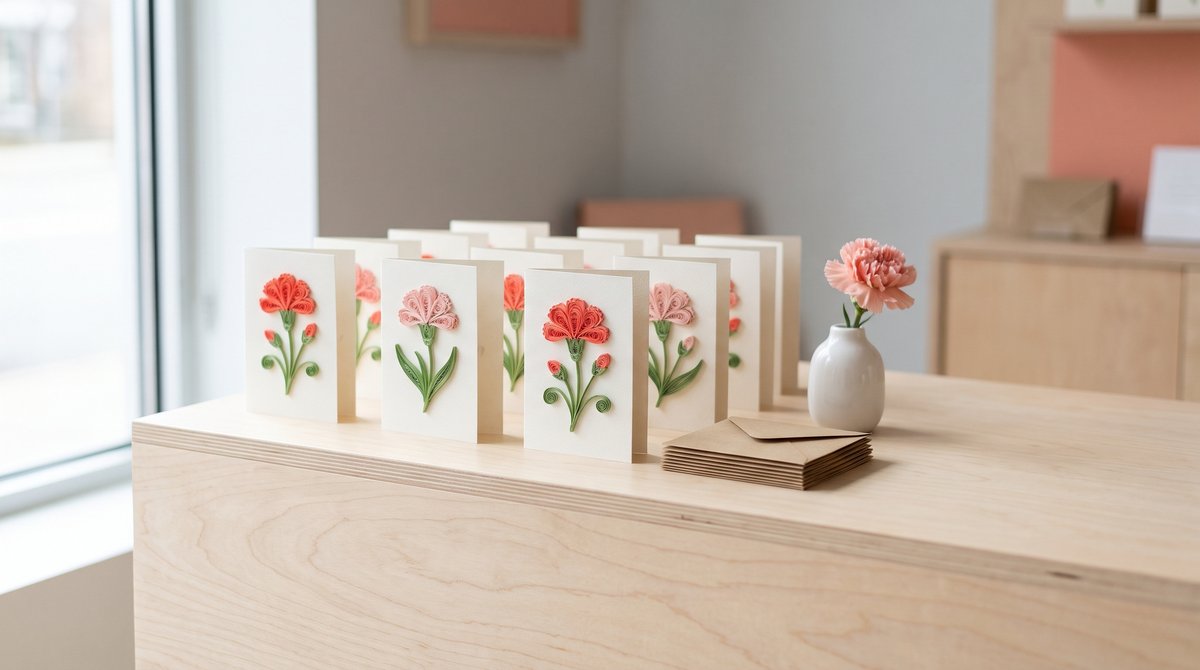
Korea’s biggest card-giving moment is not Christmas. May is known as Family Month, with Parents’ Day on 8 May, when children traditionally give their parents red carnations, and Teachers’ Day on 15 May (see Parents’ Day on Wikipedia). Carnation designs, which are a natural fit for quilling, sell strongly in this window. Our wholesale Mother’s Day cards guide covers similar floral ranges for Western markets.
| Korean selling season | Popular quilling motifs | When to brief and approve samples |
|---|---|---|
| Seollal (Lunar New Year) | Plum blossom, cranes, auspicious colours | Around four to five months before the holiday |
| White Day and spring | Cherry blossom, pastel florals, hearts | Late autumn of the previous year |
| Family Month (May) | Red and pink carnations, thank-you designs | November to January |
| Chuseok (autumn) | Full moon, persimmons, autumn leaves | Spring of the same year |
| Christmas and year-end | Wreaths, poinsettias, winter birds | Spring to early summer |
Lead time depends on design complexity, order size and the number of custom elements, so treat these windows as planning guides and confirm a schedule with us when you request a quote.
Which Korean Buyers Are a Good Fit for Quilling Cards?
- Design stationery stores that curate handmade and imported paper goods.
- Museum and gallery shops looking for craft-led products with a story.
- Corporate gifting teams that need cards with a printed or attached company logo for Chuseok and year-end gifts.
- Online sellers on Korean marketplaces and their own stores, where clear product photos of the paper texture help conversion.
- Wedding and event planners who want custom quilled designs for invitations or thank-you cards.
How Viet Farm Vision Protects Quality for Korean Orders
Korean buyers expect consistency across a run. Every order follows our four-step quality process:
- Pre-production sample approval, so the approved sample becomes the standard (see our sampling and golden sample guide).
- Mid-production inspection at the partner workshop.
- Card-by-card inspection before packing.
- Carton count with photos and video sent to you before the goods are handed over.
The cards are made by hand at a partner workshop by skilled craftspeople, mostly local women who live near the workshop. We accept custom designs from your own artwork, add your logo on request, and supply private label packaging. Browse current styles on our handmade greeting cards page.
Frequently Asked Questions
Do I need a Korean company to import quilling cards into South Korea?
Yes, a Korean importer of record is needed to file the import declaration and pay duties and VAT. This can be your own registered business or an import agent. Most small retailers work through a licensed customs broker.
Can quilling cards from Vietnam get preferential duty in Korea?
They may qualify under VKFTA, the ASEAN–Korea FTA or RCEP if the origin rules are met and a valid certificate of origin is presented. We issue a C/O form VK for VKFTA claims. Your Korean broker should confirm the best agreement for your HS code.
Does each card need a “Made in Vietnam” mark?
Korea requires visible country of origin marking on imported goods, and packaging marking is often acceptable. We agree the exact position and wording at sample stage so your shelf presentation stays clean.
When should I order cards for Parents’ Day in May?
Brief your designs and approve samples between November and January. Handmade cards need more production time than printed cards, and shipping plus customs clearance also need to be built into the schedule.
Can you make cards with our brand and Korean text?
Yes. We can print or attach your logo, use your own artwork and supply private label packaging. Send your Korean text as final artwork files so it is reproduced exactly.
Request a Quote for Your Korean Order
If you are planning a Family Month, Chuseok or year-end range for Korea, send us your designs, target quantities and delivery window through our Request a Quote page. We reply within one business day with questions, sample options and a production plan.