
To import quilling cards into Canada from Vietnam, you need a Canadian Business Number with an import-export (RM) account, a CARM Client Portal registration, a customs broker who classifies the cards correctly, and packaging that meets Canada’s labelling rules. The good news for greeting card buyers: as of 8 November 2026, Canada’s 2026 Customs Tariff lists printed greeting cards (tariff item 4909.00.00) as duty-free under the MFN rate, so your landed cost is driven more by freight, GST and paperwork than by duty.
This guide walks Canadian gift shops, stationery retailers and online sellers through the practical steps, from the first sample to the carton arriving at your warehouse. It reflects how we coordinate orders with our partner workshops in Vietnam, and where Canadian buyers most often lose time.
Why Canadian buyers are looking at handmade quilling cards
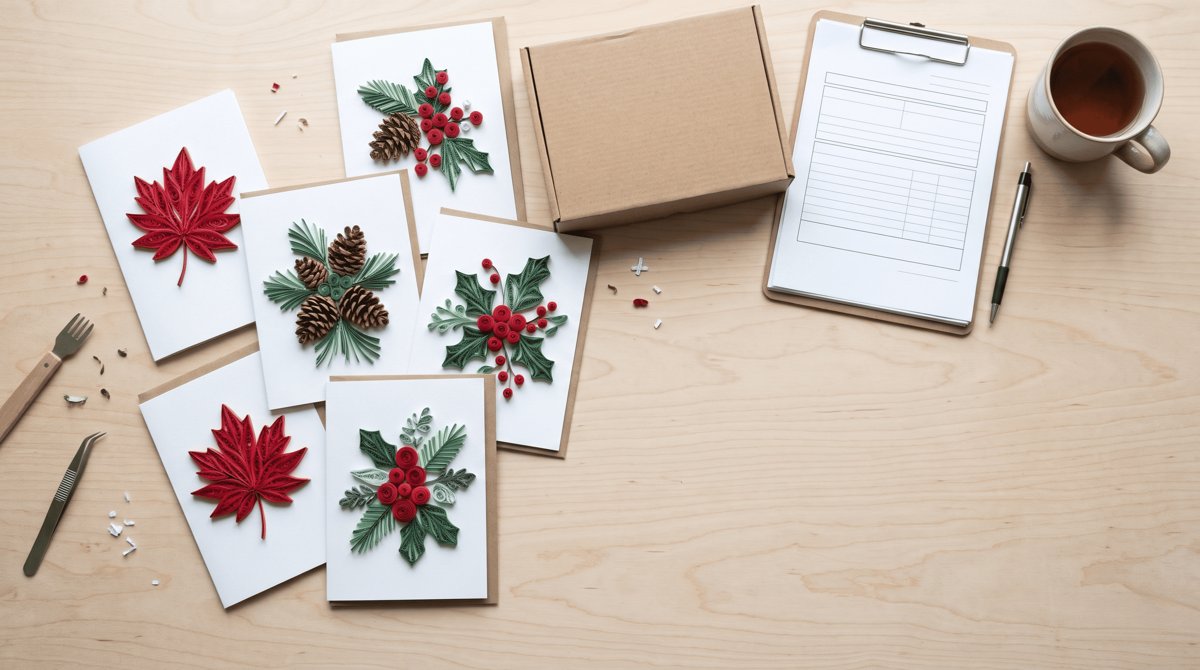
Canadian card racks lean heavily on printed cards. A quilling card, built by hand from coiled and shaped paper strips, stands out on a shelf because the design has real depth and texture. For independent gift shops, museum stores and online sellers, that difference is easy to explain to a customer and supports a higher shelf price than a flat printed card.
Canada also has a gifting calendar that rewards planning: Christmas and the winter holidays, Valentine’s Day, Mother’s Day and Father’s Day, graduation season in late spring, and Canadian Thanksgiving in October. Motifs that sell well here include maple leaves, winter berries, pinecones, northern birds and botanical florals. Our partner workshops can produce custom designs from your own artwork, so you are not limited to a generic catalogue.
What do you need before you import quilling cards into Canada?
Most delays we see are not about the cards. They are about the importer not being set up before the goods ship. Canada’s Assessment and Revenue Management system (CARM) has been mandatory for commercial importers since October 2024, and every business importing commercial goods, even once a year, needs an account (CFIB, CARM guide).
| Requirement | What it is | Who usually handles it |
|---|---|---|
| Business Number (BN9) + RM account | Your CRA business number with an import-export program account (for example RM0001) | You, through the Canada Revenue Agency |
| CARM Client Portal registration | CBSA’s online system for duties and taxes on commercial imports | You, then you delegate access to your broker |
| Release Prior to Payment (RPP) security | A surety bond or cash deposit so goods are released before you pay duties and taxes | You and your broker or surety provider |
| Tariff classification | Confirming the right tariff item for your exact card format | Your customs broker |
| Commercial invoice and packing list | Value, description, quantities and carton details | Your supplier (we prepare these with every shipment) |
| Proof of origin | Certificate of origin or a CPTPP origin statement, where useful | Your supplier, reviewed by your broker |
| Bilingual retail labelling | Mandatory consumer information on retail packaging | You approve, the workshop prints or applies |
According to the Canadian Federation of Independent Business, since 20 May 2025 importers need financial security and RPP enrolment for goods to be released automatically; occasional importers can instead pay in person at the port of entry (CFIB). If you are a first-time importer, talk to a licensed customs broker before you approve the production sample, not after the shipment leaves Vietnam.
Duty and taxes on quilling cards imported into Canada
Tariff item 4909.00.00 and the MFN rate
Canada’s 2026 Customs Tariff, Chapter 49 describes tariff item 4909.00.00 as printed or illustrated postcards and printed cards bearing personal greetings, messages or announcements, with or without envelopes or trimmings. As of 8 November 2026, the MFN rate for this item is listed as Free, and the CPTPP tariff treatment for it is also Free.
One caution: classification depends on the actual product. A card with a printed greeting inside is a different case from a blank card, a framed quilled artwork or a card sold as part of a gift set. Blank or decorative formats may fall under another heading. Do not assume the rate; send your broker a sample photo and product description and ask them to confirm the tariff item before you finalise your costing.
Does CPTPP still matter if the duty is already free?
Canada and Vietnam are both members of the CPTPP, which took effect for Vietnam in January 2019, and origin can be self-certified by the importer, exporter or producer rather than through a government-issued form (Cosmo Sourcing overview). For cards classified under 4909.00.00, the preference saves nothing on duty because the MFN rate is already free. It becomes useful if your broker classifies a product under a heading that carries duty, or if you mix cards with other gift items in the same order. We can provide origin documentation either way, so your broker can choose the simplest route.
GST and provincial HST
Duty-free does not mean tax-free. Imported goods attract 5% federal GST on the value for duty plus any duty, and buyers in HST provinces pay the harmonised rate instead (Cosmo Sourcing). GST-registered businesses can usually recover it as an input tax credit, but you still pay it at import, so build it into your cash flow plan. Your accountant or broker will confirm how it applies to your business.
Labelling and origin marking for the Canadian market
For prepackaged non-food consumer products, the Competition Bureau lists three core label items: the product identity declaration, the net quantity, and the dealer name and principal place of business (Competition Bureau Canada). The identity and quantity generally need to appear in both English and French. If you sell in Quebec, ask your broker or a compliance adviser whether additional French-language rules apply to your packaging and point-of-sale material.
Country-of-origin marking is a separate question. Under CBSA Memorandum D11-3-1, only goods listed in Schedule I require marking for non-CUSMA origins such as Vietnam. Greeting cards are not named explicitly, and the closest category covers printed paper products, so the safest commercial choice is to mark “Made in Vietnam” on the back of each card or on the retail sleeve. Our partner workshops can print this alongside your logo and barcode as part of a private label package.
How the ordering process works, step by step
- Brief and artwork. Share your designs, sizes and target retail positioning. We can work from your artwork or develop new quilling designs for the Canadian calendar.
- Pre-production sample approval. The workshop makes samples; you approve design, colours and finish before production starts.
- Labelling sign-off. You approve the bilingual sleeve or back-of-card text, logo placement and origin marking.
- Mid-production inspection. We check work in progress at the partner workshop against the approved sample.
- Card-by-card check before packing. Every card is inspected for loose coils, glue marks and alignment.
- Carton count with photos and video. We count cartons and send you photos and video before the goods leave.
- Documents to your broker. Commercial invoice, packing list and certificate of origin go to your broker ahead of arrival.
Quilled designs are three-dimensional, so packing matters as much as the card itself. Our recent guide to greeting card packaging for retail covers sleeves, inner boxes and export cartons in more detail.
Shipping options from Vietnam to Canada
Most card orders move by sea freight to a West Coast port, then by rail or truck to the rest of the country, while samples and urgent top-ups usually go by air express. Which option suits you depends on order volume, your selling season and how much warehouse space you have. Two principles help: confirm the Incoterm early (FOB and CIF are common for first orders), and make sure your broker has the documents before the vessel arrives so the cargo is not held at the terminal.
| Factor | How it affects your landed cost or timing |
|---|---|
| Design complexity | More coils and colours mean more handwork per card |
| Custom versus existing design | New designs add sampling rounds before production |
| Private label packaging | Printed sleeves, inserts and bilingual labels add lead time and unit cost |
| Order size and SKU mix | Fewer designs in larger runs are more efficient than many small runs |
| Freight mode and Incoterm | Sea is cheaper per unit, air is faster; the Incoterm decides who pays which leg |
| GST and broker fees | Paid at import even when duty is free |
If you also sell into the United States, keep the two markets separate in your planning. US duties on Vietnamese goods have changed several times in 2026, so read our guide to importing quilling cards into the USA and confirm current rates with a US broker.
When should Canadian buyers order for each season?
Handmade cards need more lead time than printed stock because each card is assembled by hand. As a rule, plan to approve samples for Christmas ranges by late spring, for Valentine’s Day and Mother’s Day by late summer or early autumn of the previous year, and for graduation and Father’s Day by the turn of the year. Add sea freight and inland transit on top, and leave a buffer for customs. We will give you a realistic production window with every quotation.
Frequently Asked Questions
Is there duty on greeting cards imported into Canada from Vietnam?
As of 8 November 2026, Canada’s 2026 Customs Tariff lists tariff item 4909.00.00, printed cards bearing personal greetings, at a Free MFN rate. Blank cards or other formats may be classified differently. Always ask your customs broker to confirm the tariff item for your exact product.
Do I need a CARM account to import quilling cards into Canada?
Yes. Commercial importers must register in the CBSA CARM Client Portal, and without an account shipments cannot be released. You will also need a Business Number with an RM import-export account, and financial security if you want goods released before you pay.
Do quilling cards need French on the packaging?
Mandatory consumer information on prepackaged retail products generally needs to be in English and French. We can produce bilingual sleeves or back-of-card printing as part of your private label packaging. Quebec may have additional French-language rules, so confirm with a compliance adviser.
Can you make custom quilling designs for the Canadian market?
Yes. Our partner workshops make custom designs from your artwork or brief, including Canadian motifs such as maple leaves and winter botanicals. You approve a pre-production sample before any order goes into production.
Ready to plan your first order?
If you are planning a Canadian range of handmade cards, browse our handmade quilling greeting cards and send us your designs, quantities and target season through our Request a Quote page. We reply within one business day, and every shipment comes with a commercial invoice, packing list and certificate of origin for your broker.