
To launch a private label clothing line, you need four things in place before a single garment is sewn: a clear customer for your first drop, a deliberately small range, branded touchpoints (neck labels, hang tags, packaging) that carry your identity, and a manufacturing partner who will sample and produce under your name. Get those right and your first collection becomes a test you can learn from, not a warehouse of stock you cannot move.
This guide is written for founders, creators and small businesses planning their first apparel drop. It follows the order in which decisions actually need to be made when you work with a garment sourcing partner, and it draws on how we coordinate custom garments orders with vetted garment manufacturers in Vietnam.
What does it take to launch a private label clothing line?
Private label means the garments are produced by a manufacturing partner but sold entirely under your brand: your neck label, your hang tag, your packaging, your story. You do not need to own a factory or hire a sewing team. What you do need is to own the decisions: who you are selling to, what each garment should feel like, how it is branded, and how much stock you are willing to hold on day one.
The brands that launch smoothly usually treat the first drop as a focused experiment. They pick a narrow range, make every detail of that range feel intentional, and keep enough flexibility to reorder what sells. The brands that struggle tend to launch too many styles at once, finalise branding after samples are already made, or skip the sample stage to save a few weeks.
Step 1: Who is your first drop for?
Before you think about fabrics or colours, write a one-page brand brief. It does not have to be polished. It simply needs to answer the questions your manufacturing partner will ask anyway:
- Who wears it? A running club, a café’s regulars, an online community, a corporate team, fans of a creator.
- Where will they wear it? Gym, office, weekend, events, travel. This drives fabric and fit choices.
- What should it feel like? Crisp and structured, soft and relaxed, heavy and cosy, light and breathable.
- How will it be sold? Your own web shop, pop-ups, wholesale to boutiques, merch tables, or a mix.
A clear brief saves rounds of sampling, because your partner can recommend constructions and fabrics that suit the use case instead of guessing. It also keeps your own decisions consistent when you are choosing between ten shades of navy.
Step 2: How many styles should a first clothing line have?
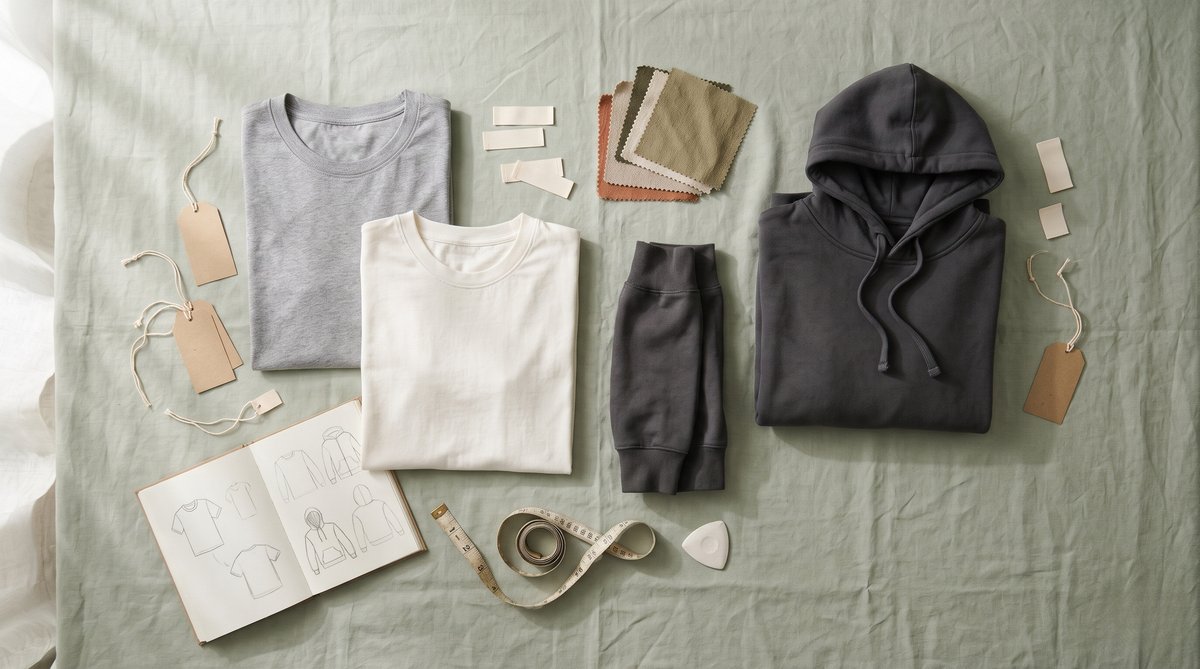
Fewer than you think. Most first drops work best with two or three core garments, each doing a different job. A classic trio for a new brand is a T-shirt, a polo shirt and a hoodie or sweatshirt, because together they cover price entry, smart-casual and cold-weather wear without overlapping.
| Garment | Role in a first collection | Branding options to consider |
|---|---|---|
| Custom T-shirts | Entry item; easiest for new customers to buy and gift | Screen print or embroidered chest mark, printed or woven neck label |
| Custom polo shirts | Smart-casual piece; works for teams, clubs and corporate buyers | Embroidered logo, custom buttons, woven neck label, side-seam label |
| Custom hoodies and sweatshirts | Higher-value “hero” item; strong for community and merch drops | Large print or embroidery, branded drawcords or tips, hang tag |
Within each style, limit colourways and keep the size run sensible for your audience. A smaller range lets you invest in better details, such as a nicer collar, a well-placed embroidery or a premium hang tag, rather than spreading the same budget thinly across many options.
Step 3: Which brand touchpoints make private label feel like your own?
Customers rarely notice who made a garment, but they always notice how it is branded. The touchpoints below are where a private label clothing line earns its identity:
- Neck labels. Woven labels feel classic and durable; printed (tagless) labels feel cleaner on tees and sportswear. Decide early, because it affects how the neckline is finished.
- Care and content labels. These are not decorative. Many markets regulate them. In the United States, the FTC explains fibre content, country of origin and identity requirements in its guide Threading Your Way Through the Labeling Requirements Under the Textile and Wool Acts. In the EU, fibre names and labelling are governed by Regulation (EU) No 1007/2011. Confirm the exact wording for your market before labels are produced.
- Hang tags. The first thing a buyer reads in-store. Use it for your story, not just a price sticker.
- Packaging. Folded in branded polybags, wrapped in tissue, or boxed for gifting. Packaging choices also affect carton sizes and shipping volume.
- Logo application. Printing and embroidery each give a different look and hand-feel. Test both on samples if you are undecided.
Send final artwork files for every touchpoint together. Labels and tags that arrive late are one of the most common reasons a first order waits on the cutting table.
Step 4: From tech pack to approved sample
A tech pack is the instruction sheet for your garment: flat sketches, measurements by size, fabric and colour choices, stitching details, trims, label positions and artwork placement. It does not need to be produced by a professional designer for a first drop. A clear document with photos of reference garments, your measurements and annotated sketches is often enough for a partner workshop to make a first sample.
Treat the sample as a decision tool. Wear it, wash it, ask people in your target audience to try it on. Check how the print or embroidery holds up, whether the collar keeps its shape, and whether the fit matches your brief. Write your comments directly against the tech pack so the next sample, or the production run, follows one agreed reference.
Step 5: Can you start a clothing line with a small order?
Yes. Many of our partner sewing workshops welcome small orders for custom garments, which is how most new brands should begin. The trade-off is that a smaller run usually means a higher cost per piece, because setup work such as pattern making, sampling, screens or embroidery programming is shared across fewer garments. Your fabric choice, the number of colours, decoration methods and packaging also influence both cost and lead time, so exact figures are confirmed at the quotation stage.
A practical way to plan is to split your first order by what you are most confident in. Put more units into the core colour and the most common sizes, and treat extra colourways as a test. When those test pieces sell through, you have real data for your second order.
A first-drop launch plan at a glance
| Phase | What you decide | What to send your sourcing partner |
|---|---|---|
| 1. Brand brief | Customer, use case, feel, sales channel | One-page brief and reference photos |
| 2. Range plan | Styles, colourways, size run | Range list with priority order |
| 3. Branding | Neck labels, care labels, hang tags, packaging, logo method | Vector artwork, label wording, packaging specs |
| 4. Tech pack and quote | Fabric, construction, measurements, trims | Tech pack or annotated sketches; request a quote |
| 5. Sampling | Fit, hand-feel, decoration quality | Written sample comments and approval |
| 6. Production and shipping | Final quantities, delivery terms | Purchase order, shipping address, import details |
| 7. Launch | Story, photos, pricing, channels | Feedback for the reorder |
Step 6: How do you tell your brand story at launch?
A new clothing brand competes on meaning more than on volume. Use every touchpoint to say why the line exists: the community it was made for, the details you obsessed over, the way it should be worn. Keep the story consistent across hang tag, product page and social posts, and photograph the garments the way your customer will actually use them.
Be accurate about how the garments are made. If you work with a sourcing partner in Vietnam, saying so clearly, alongside correct country-of-origin labelling, builds more trust than vague claims. Shoppers respond to transparency, and so do the boutiques and corporate buyers you may want as wholesale customers later.
Common mistakes when launching a private label clothing line
- Too many styles in the first drop. It dilutes your budget and makes it hard to see what customers actually want.
- Branding finalised after sampling. Label and tag changes late in the process often mean another sample round.
- Skipping wash and wear tests. A sample that looks perfect on the table can shrink, twist or fade in the first wash.
- Ignoring labelling rules. Missing fibre content or origin information can delay customs clearance or retail listings.
- No reorder plan. Decide in advance which items you will restock first if they sell well.
Frequently Asked Questions
What is the difference between private label and white label clothing?
White label usually means buying an existing blank garment and adding your logo. Private label means the garment is produced to your specifications, with your own labels, tags and packaging. Private label takes more planning but gives you control over fit, fabric and details.
Do I need a finished tech pack before asking for a quote?
No. A brief, reference photos and your logo files are enough to start a conversation. Your sourcing partner can help you turn those into a workable specification, and the quote becomes more precise as the details are confirmed.
Which fabrics can I choose for T-shirts, polos and hoodies?
Common options include cotton, CVC blends, piqué for polos and cool-touch sports fabrics. For hoodies and sweatshirts, fleece and French terry options are confirmed at the quotation stage based on your brief. Ask for fabric swatches before sampling if hand-feel matters to your brand.
Can I add my logo with both printing and embroidery?
Yes. Many brands embroider a small chest logo on polos and print larger artwork on tees and hoodies. Mixing methods across a range is common, and samples are the best way to compare how each looks on your chosen fabric.
How quickly will I get a response to a quote request?
We reply to quote requests within one business day. Export orders are shipped with full documentation, including commercial invoice, packing list and certificate of origin.
Ready to plan your first drop?
If you are preparing to launch a private label clothing line, send us your brief, logo files and the styles you have in mind. We will work with our partner sewing workshops in Vietnam to suggest fabrics, branding options and a sampling plan for your first collection. Request a quote here and we will get back to you within one business day.