
Textile and garment businesses are bracing themselves against the shock from the Middle East.
7:57 | 04/04/2026 | vnexpress.net
Input costs and logistics have surged following the Middle East crisis, while global purchasing power has slowed, leaving textile and garment businesses caught between high costs and competition with major markets.
Mr. Tran Ngoc Liem, Director of the Vietnam Federation of Commerce and Industry’s Ho Chi Minh City branch, stated that geopolitical fluctuations, particularly the conflict in the Middle East, have driven up fuel prices, leading to escalating transportation costs. For the textile and garment industry – which heavily relies on imported and exported raw materials – this impact quickly spreads throughout the entire production chain, from input to delivery.
The pressure is not just a prediction but is already clearly reflected in businesses. Mr. Pham Van Viet, Chairman of the Board of Directors of Viet Thang Jean Company, said that raw material prices have increased by approximately 8-18%, while shipping costs have increased by an additional $4,000-$5,000 per container. These fluctuations have significantly increased production costs, while the ability to pass on this increase to customers is limited due to weak purchasing power. In this context, many businesses have been forced to adjust their operational strategies, such as splitting orders into smaller units, limiting air freight, and proactively seeking new markets to diversify risk. However, the export structure of many businesses still heavily relies on key markets, with the US and EU potentially accounting for 55-60% of orders.
On an industry-wide scale, the level of dependence has become more diversified but remains high. According to customs data, textile and garment export turnover in 2025 is projected to reach approximately US$46 billion, a 5.6% increase compared to the previous year, helping Vietnam continue to be among the top three largest textile and garment exporting countries in the world.
Vietnamese textiles and garments are present in 138 markets, but the export structure remains concentrated in a few key markets. The US continues to be the largest market, accounting for 38-40% of export value, equivalent to over $18-20 billion, followed by the EU (12-15%), Japan (approximately 10%), and South Korea (nearly 9%). This dependence makes the industry vulnerable to fluctuations in global demand.
Beyond rising costs, a bigger problem lies in the instability of orders. With constantly fluctuating input prices, businesses face difficulties in production planning and securing long-term contracts. Increased caution from both manufacturers and international brands slows down order confirmation and shortens order cycles.
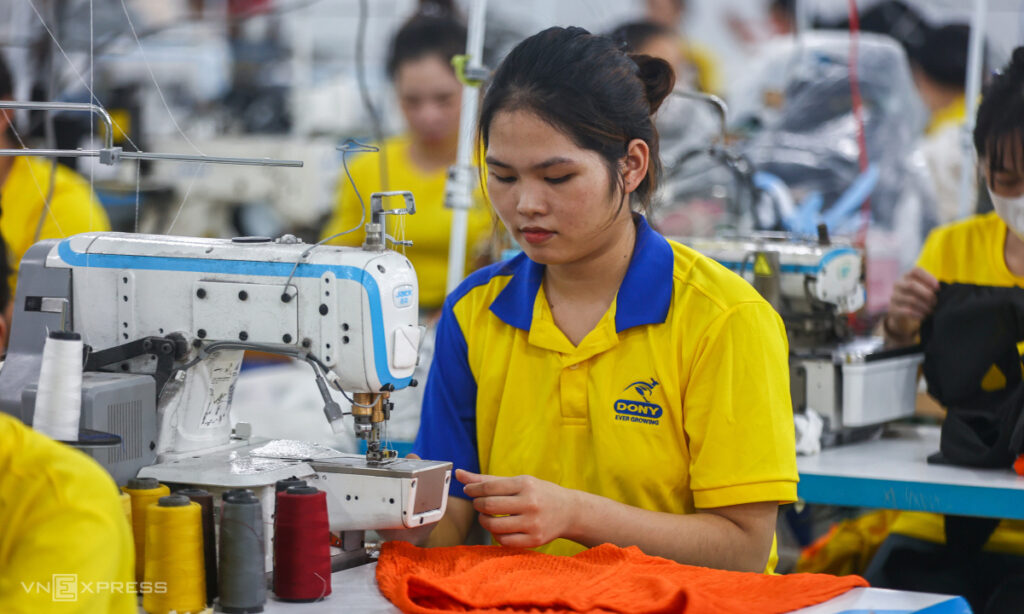
Cost pressures, demand, and competition are all intensifying.
According to Mr. Vu Duc Giang, Chairman of the Vietnam Textile and Garment Association, in 2026 the industry will continue to face prolonged geopolitical risks, while input, production, and transportation costs remain high.
On the demand side, global consumption is recovering slowly, increasing by only about 2-2.5% per year. This makes international brands and buyers more cautious in placing orders, prioritizing small, short-term orders instead of long-term contracts as before.
At the same time, competitive pressure is increasing as regional competitors continue to expand their advantages. Mr. Cao Huu Hieu, General Director of Vietnam Textile and Garment Group, said the industry still maintains its role as a major exporter with a large turnover but is facing increasing pressure from Bangladesh, India, and Indonesia.
In particular, Bangladesh continues to attract orders due to its low labor costs and large-scale production, especially in the low-cost processing segment. India has emerged with the advantage of abundant domestic raw materials and the ability to absorb orders when supply chains fluctuate, while Indonesia competes directly in the mid-range segment thanks to more flexible costs and support policies.
Simultaneously, requirements for sustainable development are becoming increasingly stringent. From 2025, many major markets will adopt higher standards on traceability and emissions, forcing businesses to invest more in technology, energy, and management systems. Meanwhile, the shrinking room for cost savings makes the efficiency challenge more difficult.
The combined effect of high costs, weak demand, and increased competition is eroding business profit margins from multiple angles, while also increasing the risk of maintaining stable orders.
Finding a ‘way out’ in restructuring and connecting
Under mounting pressure, businesses say they are forced to adjust both short-term and long-term. Besides cutting costs and optimizing operations, many businesses are accelerating market diversification to reduce dependence on a few major regions.
According to Mr. Vu Duc Giang, the industry needs to improve its adaptability through the application of technology, automation, and digital transformation to improve productivity and reduce costs. At the same time, green transformation is no longer a trend but has become a mandatory requirement if it wants to maintain international orders.
From a positive perspective, Mr. Pham Xuan Hong, Chairman of the Ho Chi Minh City Textile, Garment and Embroidery Association, believes that the stable foundation of the Vietnamese economy and its highly skilled workforce remain advantages that help the industry maintain its growth momentum. Based on surveys, he expects the textile and garment industry to grow by about 15% in 2026.
In this context, Mr. Hong also believes that the need for supply chain connectivity and access to technology has become urgent. The SaigonTex – SaigonFabric event, held from April 8th to 11th at SECC, is seen as a channel to help businesses find sources of raw materials and components, access new technologies, and expand partnerships. Specialized seminars within the event also help businesses update production trends and shape long-term strategies.
According to the Vietnam Textile and Garment Association’s orientation, starting this year, the industry will focus on three pillars: diversifying markets, customers, and products; developing domestic sources of raw materials and components; and promoting automation and digital transformation. The export turnover target is $48-49 billion in 2026 and aiming for $64.5 billion by 2030.
In the medium term, the core challenge remains increasing the localization rate of raw materials and components to reduce dependence on imports – a factor that makes businesses vulnerable when the supply chain is disrupted. At the same time, there is a need to quickly shift to high value-added orders that are less price-sensitive. In the long term, “greening” production and optimizing energy will be crucial for mitigating risks from oil price fluctuations and maintaining a position in the global supply chain.
By Thi Ha