
Wooden Serving Boards from Vietnam: A Fast-Growing Wholesale Category
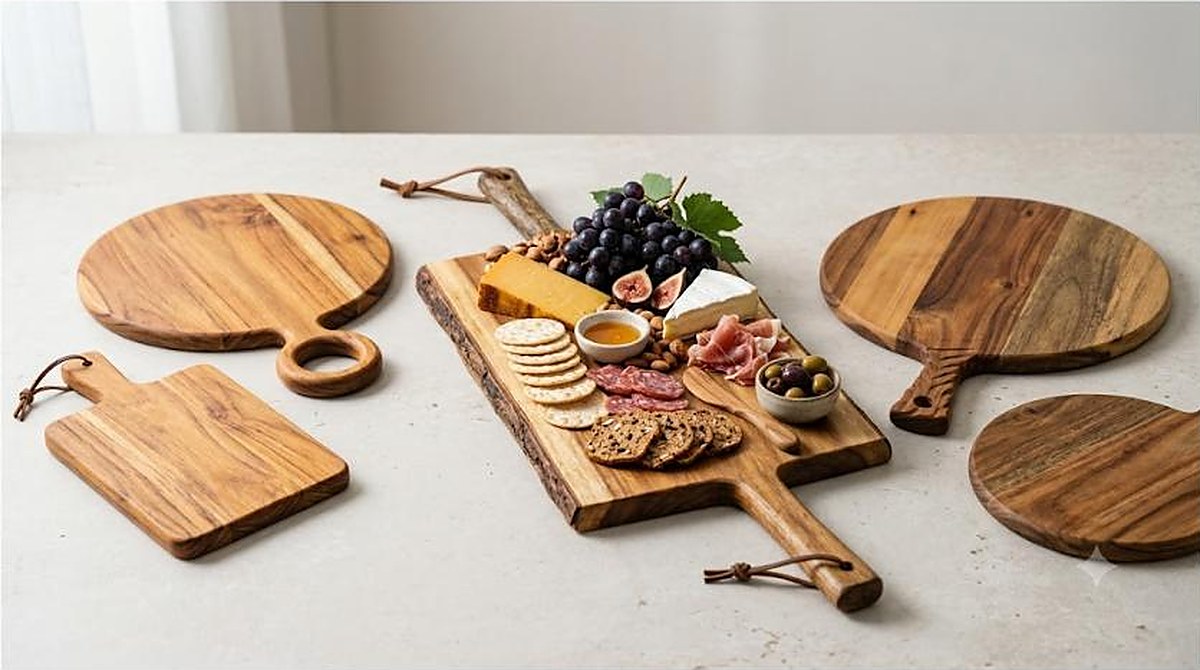
Wooden serving boards, charcuterie boards and grazing platters have moved from a passing food trend into a permanent line for restaurants, hotels, cafés and premium retail. For importers and wholesale buyers, they are one of the most attractive product categories to source: high perceived value, strong repeat demand, and light regulatory friction compared with food or cosmetics. In 2026, an increasing share of these boards is being manufactured in Vietnam — and this guide explains why, and how to source them well.
If you already stock kitchenware, this category pairs naturally with your existing range. See our companion guide on Vietnam wooden kitchenware OEM for the broader product family.
Why Buyers Are Choosing Vietnam in 2026
Vietnam has become the default alternative to China for wood-based houseware, and the 2026 trade landscape has accelerated that shift:
- Tariff advantage: US tariffs on Vietnamese goods sit around 20%, versus 100%+ on many Chinese categories — a decisive gap for price-sensitive wholesale buyers.
- New market access: the Vietnam–UAE CEPA, signed in February 2026, lowers duties for Middle East importers, while RCEP keeps Vietnam tariff-competitive across 14 Asia-Pacific partners.
- Manufacturing depth: record FDI of roughly US$36B in 2025 has expanded Vietnam’s woodworking and finishing capacity, shortening lead times.
- Genuine origin: buyers increasingly need verifiable Vietnamese origin to avoid trans-shipment risk. Read our guide on verifying genuine Vietnamese origin.
Wood Species: Acacia, Rubberwood and Mango
The board material drives cost, appearance and durability. The three species that dominate Vietnamese export production are:
- Acacia: the premium choice — rich, varied grain, high density and natural water resistance. Ideal for charcuterie boards, live-edge platters and retail gift lines.
- Rubberwood (Hevea): a sustainable by-product of latex plantations. Uniform, pale, cost-effective and excellent for high-volume foodservice boards and private-label programs.
- Mango wood: attractive golden tones and eco-credentials, popular for boutique and lifestyle retail buyers.
Product Range for HORECA and Retail
A capable OEM factory should be able to supply a full assortment, not just one shape. Typical export items include rectangular and paddle serving boards with leather-loop handles, round pizza and cheese boards, live-edge charcuterie platters, two-tier grazing stands, and matching accessories such as cheese knives and handled trivets. For food-service clients, boards can be produced to standardized dimensions for consistent plating.
Buyers building an eco-positioned assortment often combine these boards with disposables — see our overview of eco-friendly and compostable products from Vietnam.
Food-Contact Safety and Quality Standards
Serving boards are food-contact articles, so finishing matters as much as joinery. Reputable Vietnamese manufacturers finish boards with food-safe mineral oil or natural wax rather than industrial lacquers, control moisture content to prevent warping and cracking, and can certify compliance with international food-contact rules. If you sell into the EU, confirm conformity with the EU food-contact materials framework (Regulation EC 1935/2004); for the US market, food-grade mineral oil finishes are the norm.
MOQ, Pricing and Lead Times
Indicative terms for wooden serving boards from Vietnam in 2026:
- MOQ: typically 500–1,000 pieces per design for OEM orders; lower for stock designs.
- Pricing: driven by species, size, thickness, finish and branding — acacia commands a premium over rubberwood.
- Lead time: around 30–45 days for production after sample approval, plus sea freight.
- Samples: confirm grain, finish, weight and moisture before committing to a bulk order.
OEM and Private-Label Customization
The margin in this category comes from branding. Vietnamese factories routinely offer laser engraving or branding of your logo, custom shapes and dimensions, gift-ready packaging with sleeves and hang tags, barcoding and retail-ready labeling, and mixed-assortment cartons. This lets distributors launch a private-label grazing collection without holding manufacturing risk.
Certifications to Request
For a smooth import, ask suppliers for FSC or legal-timber documentation, a food-contact/safety statement for the finish used, and social-compliance audits such as BSCI or Sedex if you sell to large retail chains. Our detailed breakdown of Vietnam OEM certifications explains what each one covers and how to verify it.
How to Choose the Right Supplier
Shortlist factories that own their finishing line (not just assembly), can show export references to your target market, provide clear moisture-content and finish specifications, and issue a verifiable Certificate of Origin. A supplier that manufactures across multiple wood categories — kitchenware, houseware and eco packaging — can consolidate your orders and reduce freight cost per unit.
Frequently Asked Questions
Are Vietnamese acacia boards suitable for daily restaurant use? Yes — with food-safe oil finishing and correct moisture control, acacia is dense and durable enough for HORECA service. Provide care instructions to end buyers to maximize lifespan.
Can I mix species and shapes in one order? Most OEM factories accept mixed-assortment orders above the combined MOQ, which is ideal for building a retail range.
How do I confirm the boards are genuinely made in Vietnam? Request a Certificate of Origin and, where possible, a factory audit or video verification. See our origin verification guide.
Source Wooden Serving Boards with Viet Farm Vision
Viet Farm Vision is a Vietnam-based OEM manufacturer and exporter of wooden kitchenware, houseware and eco packaging, supplying B2B buyers across the Middle East, Asia and global markets. We support private-label programs, mixed assortments and full export documentation. Contact our team to request a quote or product catalog.