
A stationery brand in Rotterdam spent eleven weeks developing a quilled peony card with a Vietnamese workshop. They paid for four sample rounds, approved the artwork, placed 14,000 pieces and launched it as the anchor of their spring range. Fourteen months later a buyer sent them a photograph from a trade fair in Guangzhou: the same peony, the same four-colour strip palette, the same fold, sitting on a different company’s stand at a lower wholesale price. Nothing illegal had happened. The brand had paid for samples and for production. It had never once put in writing who owned the design that came out of those eleven weeks.
Three kinds of artwork, three completely different ownership positions
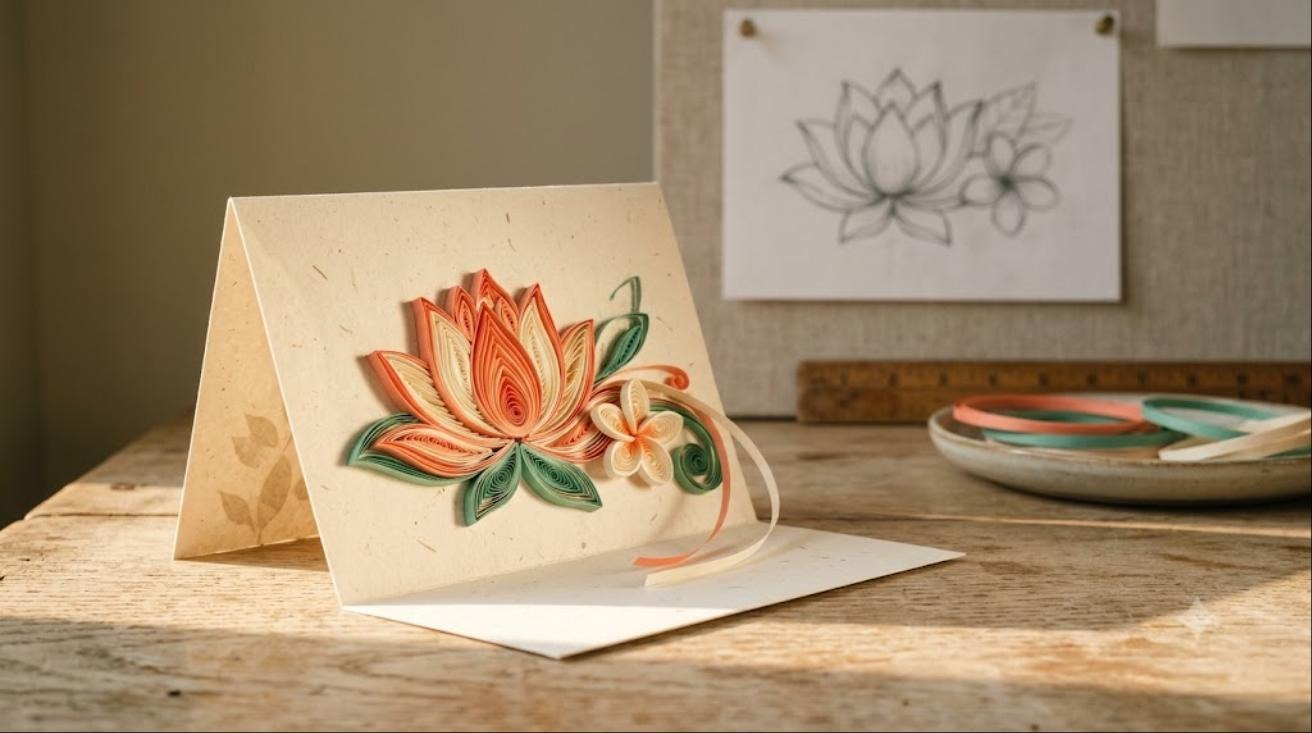
Almost every dispute over a quilling card design traces back to one unexamined assumption: that paying for a product means owning the design of that product. In handmade paper craft it usually does not. Before you discuss price, work out which of these three categories your card actually sits in, because the answer changes what you can demand later.
| Artwork type | Who owns the design | Can the workshop sell it to others | Typical price index | Typical minimum |
|---|---|---|---|---|
| Open catalogue design, unchanged | The workshop | Yes, and it already does | 1.00 (baseline) | Lowest, often 300 to 500 pieces per design |
| Catalogue design adapted to your brief (colours, greeting, size) | Usually the workshop, unless agreed otherwise | Yes, in its original form. Your variant is the grey area | 1.05 to 1.20 | 500 to 1,000 pieces per design |
| Original design developed to your brief, or your own artwork | Negotiable, and it must be negotiated | Only if your agreement is silent | 1.25 to 1.60 before exclusivity | 1,000 to 3,000 pieces per design |
The middle row causes most of the trouble. A buyer asks for an existing lotus card in their own four brand colours with their own inside greeting, and reasonably assumes the result is theirs. The workshop equally reasonably regards the lotus as its own design, since it drew the coil layout years ago. Both positions are defensible. That is exactly why it has to be settled in writing before the first sample, not after the reorder.
What “exclusive” actually means in a quilling quotation
Exclusivity is a commercial term, not a legal status. When a workshop writes “exclusive for you” in an email it may mean anything from a permanent worldwide restriction to a promise not to show the card to the next buyer who walks in this month. An exclusivity clause only has meaning once you have pinned down four dimensions.
- Scope of design. The exact card, or the whole motif family? If you commission a quilled lotus, can the workshop produce a different lotus for someone else next season? Name the SKU codes the clause covers.
- Territory. Country, region or worldwide. A European buyer rarely needs worldwide, and asking for it raises the premium. Exclusive in the EU and UK costs far less than exclusive everywhere.
- Time window. Rolling 12 or 24 months is standard, renewed on a minimum annual volume. Permanent exclusivity without a volume commitment is the request workshops decline most often, and they are right to.
- Channel. Retail only, or retail plus online marketplaces, or including corporate and promotional gifting. Marketplace leakage is where most “exclusive” designs resurface.
Write these four as a short paragraph in the order confirmation itself. An exclusivity promise living only in a WhatsApp thread tends to evaporate when the sales manager who made it changes job.
The four clauses worth settling before the first sample, not after
None of these need a long contract. Four short clauses in the purchase order or in a one page development agreement cover the realistic risks for a card programme.
- Ownership of paid development work. State plainly that artwork, colour layouts and coil maps developed against your brief and paid for by you belong to you on payment of the development or sampling fee. If the workshop will not assign ownership, ask instead for a perpetual exclusive licence, which is often easier for them to accept and gives you most of the same protection in practice.
- Non-reproduction of templates and jigs. A quilling card is reproduced from a physical template: a coil placement map, a cutting die for the base card, sometimes a shaped jig. Say that these were paid for by you, are held for your orders only, and are not used for any other customer. This clause matters more than the artwork clause, because the template is what makes a copy cheap.
- Confidentiality with a time limit. Seasonal ranges leak when a workshop photographs attractive samples for its own catalogue. A simple clause saying your designs are not displayed, photographed for promotion, or shown to other buyers until your launch date, plus 12 months, solves it without needing a formal NDA.
- Mutual warranty on third-party rights. Each side confirms that the artwork it supplies does not infringe anyone else’s rights, and indemnifies the other if it does. This protects you from a workshop quietly reusing a design it copied, and protects the workshop from you, which is why it is usually accepted without argument.
This is general commercial guidance rather than legal advice. For a programme of any size, have your own counsel look over the wording before you sign it.
The bigger risk is usually the artwork you supply
Buyers worry about the workshop copying them. In practice the costlier failures run the other way. A buyer sends a reference image pulled from a search engine and asks the workshop to “make something like this”. The workshop does. Six months later a customs officer in Hamburg or a marketplace takedown notice puts the whole shipment on hold, and the liability sits with the importer of record, not with the workshop in Ho Chi Minh City.
- Licensed characters and franchise imagery. Cartoon characters, film and sports properties need a licence. A quilled interpretation is still a derivative work. No Vietnamese workshop can grant you that licence.
- Greeting text copied from existing cards. Short greetings are generally free to use. Longer verses and poems inside cards frequently are not.
- Reference images as “inspiration”. If you cannot say where a reference came from, do not send it. Describe the effect you want in words instead, or commission original artwork.
- Public domain is safer than it looks, with one caveat. Classical botanical plates and traditional motifs are a good well to draw from, but a modern photograph or redrawing of a public domain subject can carry its own rights.
The cheapest insurance in the whole programme is commissioning original artwork at the start. On a 5,000 piece order the design fee typically lands somewhere between a few cents and a little over ten cents per card, and it removes an entire category of risk from the file.
What exclusivity realistically costs
Workshops price exclusivity against opportunity cost: how much business they give up by not selling the design to anyone else. The narrower your ask, the smaller the number. Indicative ranges for handmade quilling card programmes in 2026:
| What you ask for | Typical commercial form | Indicative cost |
|---|---|---|
| Your greeting and packaging only, shared motif | Usually free | No premium |
| Exclusive in one country, 12 months, retail channel | Annual minimum volume commitment | Often no price premium if the volume is met |
| Exclusive in a region such as the EU, 24 months | Volume commitment plus small uplift | Roughly 3 to 8 percent on unit price |
| Worldwide exclusive, 24 months, all channels | Volume commitment plus uplift, or one-off buyout | Roughly 8 to 15 percent, or a fixed design buyout |
| Full ownership assignment of original artwork | One-off development and assignment fee | Commonly a few hundred US dollars per design |
Treat these as negotiating anchors rather than a price list. The most efficient structure for most mid-size buyers is a modest volume commitment with a one-country or one-region exclusivity, renewed annually. It costs little, it is easy for a workshop to honour, and it is easy to verify.
Writing an artwork brief a workshop can both quote and protect
A brief that can be costed is also a brief that can be defended, because it records exactly what was created for you and when. Include all of it in a single document, dated, and sent as one file rather than across eight messages.
- Finished card dimensions, fold type, and the depth available for raised quilling inside the envelope
- The motif described in words, plus your own sketches or brand assets with their source stated
- Colour targets as Pantone or printed swatch references, not as screen colours
- Paper weight and finish for the base card, strip width, and whether metallic or pearlescent strips are used
- Inside greeting text, language versions, and print method
- Envelope specification and any barcode, back-of-card or display requirements
- Who is paying the development fee, and the ownership position that fee buys
- The exclusivity scope, territory, term and channel you are asking for
Evidence worth keeping on file
If a design is ever copied, your position depends almost entirely on what you can show and date. Keep these from the first week of development, not from the moment a problem appears.
- The dated artwork brief as originally sent, and every revision
- The development or sampling invoice, which proves you paid for the work
- Dated photographs of each sample round, including the rejected ones
- The signed order confirmation carrying the ownership and exclusivity wording
- Your first commercial use: launch date, catalogue page, listing screenshot
- Registration of the design in your main market, if the range justifies the cost
A short checklist before you approve the first sample
- Is this an open catalogue design, an adaptation, or an original? Say which, in writing.
- Who owns the artwork and the coil template once the development fee is paid?
- If exclusivity was promised, is the scope, territory, term and channel written in the order confirmation?
- Can I state the source of every reference image I have sent?
- Is there a mutual third-party rights warranty in the document?
- Do I have a dated copy of the brief, the invoice and the sample photographs?
Six questions, perhaps an hour of work, almost always before any money moves. It is the cheapest hour in a card programme.
If the range is large enough to justify it, design registration is handled nationally. Buyers usually register in their own market, while protection on the Vietnamese side runs through the Intellectual Property Office of Viet Nam, and the WIPO Hague System allows a single international application covering multiple countries. Pair this with a clean RFQ pack so the design position and the commercial position are agreed at the same moment.
How Viet Farm Vision handles artwork and exclusivity on quilling card orders
Viet Farm Vision works as a manufacturing network and export partner rather than a single workshop, which means artwork questions are settled before an enquiry is placed with any producer. Each development brief is classified as catalogue, adaptation or original at the outset, and the ownership position that goes with it is written into the quotation rather than left to be discovered at reorder.
Where a buyer asks for exclusivity, the scope, territory, term and channel are agreed with the producing workshop in writing, together with the volume on which it renews. Development invoices, dated sample records and the template holding arrangement stay in the same file as the compliance and inspection documents, so the design position and the production position are never in two different places.
Buyers planning an original quilling card range for 2027 are welcome to send a brief, or simply a description of the motif and volume in mind, to info@vietfarmvision.com. A first response with the artwork classification, indicative pricing and a realistic development timeline usually follows within two working days.