
A gift wholesaler in Dubai spends eleven weeks developing a range of twenty handmade quilling cards with a Vietnamese workshop. The samples are beautiful. The costing works. The first container sells through in a single season. Fourteen months later the same buyer finds three of those designs — the same lotus, the same dragonfly, the same colourway — on a competitor’s shelf two streets away, imported by someone else, from the same workshop. Nothing was stolen. Nothing was even breached. The buyer simply never asked the one question that decides who owns a handmade design: who commissioned the artwork, and what did the contract say happened to it afterwards.
This is the most expensive gap in handicraft sourcing, and it is almost never a manufacturing problem. Buyers of wooden kitchenware or compostable tableware negotiate hard on specification, certification and AQL, because those categories are governed by testable standards. Handmade paper cards have almost no testable standards. What they have instead is artwork — and artwork is intellectual property, which behaves nothing like a moisture-content spec. This guide covers what gift, stationery, museum-shop and greeting-card buyers should settle in writing before the first purchase order on a custom quilling card programme from Vietnam: the ownership models, the exclusivity language, the development timeline, the costing logic, and the clauses that decide whether your range stays yours.
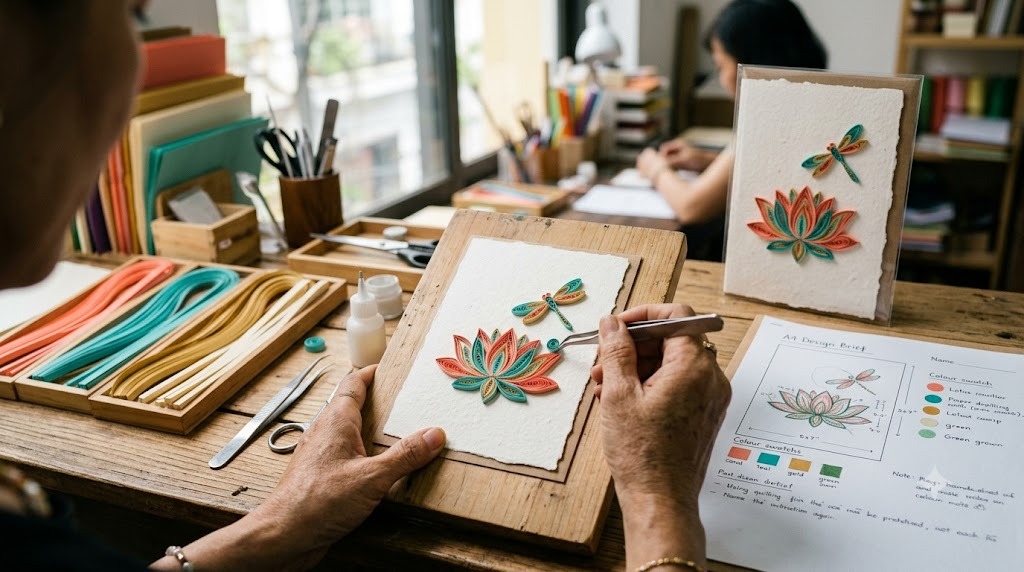
What “Custom” Actually Means in a Quilling Card Programme
The word custom covers four very different levels of work, and the ownership question is answered differently at each one. Buyers who do not separate them end up paying development prices for catalogue goods, or catalogue prices for work they believe they own.
- Catalogue design, custom packaging. The card is an existing workshop design. You change the sleeve, the backing card, the barcode and the brand mark. Fast, cheap, low MOQ — and you own nothing but the packaging artwork. Any other buyer can order the same card tomorrow.
- Catalogue design, custom colourway. Same shapes and same construction, different paper palette. Development is a matter of days. Exclusivity on a colourway is possible but weak: the underlying design is not yours, and a near-identical variant is trivially easy to produce.
- Adapted design. The workshop reworks an existing motif to your brief — a different flower, a different animal, a different frame. This is where most disputes start, because both sides can reasonably claim the result. Who owns an adaptation depends entirely on what the development agreement says, not on who had the idea.
- Original design to your brief. Artwork created specifically for you, from your concept, moodboard or supplied illustration. This is the only tier where full ownership is a realistic ask — and the only tier where you should expect to pay a development fee and accept a longer lead time.
Decide which tier your programme sits in before you request a quotation. A supplier quoting an original-design price against a catalogue-adaptation brief is not overcharging; they are pricing risk you have not defined. Our broader Vietnam handcrafted quilling cards OEM guide covers the production basics that sit underneath all four tiers.
Three Ownership Models, and What Each One Costs
Every custom handicraft programme resolves into one of three arrangements. There is no universally correct one — there is only the one that matches how long you intend to sell the range and how much you are willing to pay up front.
Model 1: Supplier retains ownership, buyer gets non-exclusive supply. The workshop owns the design and sells it to anyone. You pay the lowest unit price and no development fee. Appropriate for volume seasonal lines, promotional gifting and price-led channels where design ownership adds nothing to your margin. Do not build a brand story on it.
Model 2: Supplier retains ownership, buyer gets time-and-territory exclusivity. The workshop still owns the artwork, but contracts not to supply the same designs to any other buyer in a defined territory for a defined period, usually tied to a minimum annual volume. This is the most common commercial outcome and, handled properly, the best value. The exclusivity is only as strong as three details: the territory definition, the volume trigger, and what happens to the designs when the term ends.
Model 3: Buyer owns the artwork outright. Copyright in the design is assigned to the buyer, in writing, on payment. The workshop becomes a manufacturer of your property and cannot produce the design for anyone — including for itself — after the relationship ends. You pay a development fee per design, and usually a higher unit price, because the supplier can no longer amortise the design across other customers. Correct for own-brand ranges, licensed collaborations, and any programme you expect to run for more than two seasons.
The Assignment Clause: Why “We Paid For It” Is Not Ownership
This is the single most common misunderstanding in handicraft sourcing, and it is worth being blunt about. Paying a development fee does not transfer copyright. In Vietnam, as in most Berne Convention countries, copyright arises automatically in favour of the author — the person who actually made the work — and passes to a commissioning party only where a contract says so. Vietnam has been a party to the Berne Convention since 2004, and its Law on Intellectual Property, as amended in 2022, follows the same logic: the author owns the moral rights, and the economic rights sit with whoever the contract puts them with.
So if your development agreement is silent, the default is that the workshop owns the design you paid to develop. A purchase order that says “design development fee: USD 120 per SKU” and nothing else buys you a sample, not a copyright. What you need is an express assignment: language stating that all economic rights in the artwork, sketches, working drawings and the finished design are assigned to the buyer on payment, worldwide, for the full term of protection, together with the right to register, license and sub-license.
Three practical additions that buyers routinely forget:
- Rejected concepts. A development round typically produces four to six concepts per approved design. State whether the rejected ones are assigned too. If they are not, the workshop is free to sell your second-favourite concept to your competitor — legally, and often within the same season.
- Source files. Ownership of a card is not much use without the working artwork. Ask for the dieline, the paper specification sheet, the colour reference list and photographs of the assembly stages. On a handmade product these documents are the design.
- Moral rights and attribution. Moral rights cannot generally be assigned. What you can obtain is a waiver of the right to be named on the product, so your card does not have to carry the artisan’s signature if your retail programme does not want it. Many buyers actually want the opposite and pay for a maker’s mark — decide deliberately.
Exclusivity Is Not Ownership, and the Territory Wording Matters
Most buyers do not need Model 3. Most buyers need Model 2 written properly. An exclusivity clause that says “supplier will not sell these designs to other customers in the Middle East” will fail the first time a distributor in a neighbouring market re-exports. Four elements make the clause enforceable in practice:
- Territory by country, not by region. List the countries. “GCC”, “Southeast Asia” and “Europe” all mean different things to different parties. If you sell online into markets you do not have stores in, say so explicitly.
- Channel as well as geography. Exclusivity in a country but not on cross-border marketplaces is worth very little in 2026. Name the channels: physical retail, own e-commerce, third-party marketplaces, duty-free, corporate gifting.
- A volume trigger with a defined measurement period. Exclusivity that is not earned will not be honoured indefinitely. Agree an annual minimum in units or value, a twelve-month measurement window, and what happens if you miss it — conversion to non-exclusive is fairer and more durable than termination.
- A tail period and a sunset. When exclusivity ends, can the workshop sell the design immediately, or after six months? Can it sell it in your territory at all? A six-to-twelve-month tail is normal and protects your remaining stock from being undercut on the same shelf.
One more clause worth its space: a non-substantial-similarity undertaking. Sophisticated buyers do not only prohibit the same design; they prohibit designs that are confusingly similar to it. Without that line, the lotus becomes a water lily, the dragonfly becomes a butterfly, and the exclusivity clause is technically intact while your range is commercially copied.
Licensed Characters, Museum Collections and Third-Party Artwork
A meaningful share of quilling card demand comes from museum shops, botanical gardens, heritage sites and licensed gift programmes — buyers who want a card that interprets a specific painting, building, animal or character. This is the highest-risk brief a workshop can receive, and the risk sits almost entirely with the buyer.
A Vietnamese workshop has no way to verify whether the illustration you supplied is licensed, whether your licence covers handmade three-dimensional reproduction, or whether it extends to the territories you intend to sell in. Standard practice — and the position any competent supplier should take — is a warranty and indemnity running from buyer to supplier: you warrant that you hold the rights to the supplied artwork, and you indemnify the supplier against third-party claims arising from it. Expect to be asked for it. If a supplier does not ask, that tells you something about how carefully they handle everyone else’s artwork, including yours.
Three specific traps in this space:
- Public domain is not a global status. A painting out of copyright in one country may still be protected in another, and photographs of public-domain works can carry separate rights. Museum reproduction rights are frequently contractual rather than copyright-based, which means they bind you even when copyright does not.
- Licence scope rarely mentions handicraft. Most illustration licences contemplate printing. A quilled card is a three-dimensional derivative work in a different medium. Check that your licence covers derivative works and non-print formats before you brief a workshop.
- Architecture and landmarks. Some jurisdictions restrict commercial images of modern buildings and monuments. If your card range is city-themed, verify before you develop, not after you ship.
The equivalent set of questions for three-dimensional paper engineering is covered in our Vietnam 3D pop-up cards OEM sourcing guide, which shares much of the same rights logic with a different production process.
The Design Brief a Workshop Can Actually Quote Against
Development delays in this category are almost always brief failures, not capability failures. A quilling workshop quotes on labour minutes, and it cannot estimate labour minutes from a moodboard. A brief that gets a firm quote in one round rather than four contains:
- Finished card dimensions and orientation, closed and open, plus the envelope size you intend to use. Envelope availability constrains card size more often than buyers expect.
- Depth budget. The single biggest cost and freight variable. A 6 mm quilled relief and a 20 mm one are different products with different cartons, different packing densities and different damage profiles.
- Coverage. What percentage of the card face is quilled? A corner motif and a full-bleed design can differ by a factor of five in labour.
- Component count and complexity. Tight coils, loose coils, fringed flowers, husking, layered petals — name the techniques if you know them, or supply a reference sample if you do not.
- Paper specification. Weight (commonly 120–160 gsm for strips), strip width (3 mm and 5 mm are the workhorses), finish, and whether recycled or FSC-certified stock is required.
- Colour references. Supply physical references or a defined colour system. Screen colours do not survive the trip to a paper mill.
- Backing card, insert and greeting text, including languages and whether text is printed, foiled, embossed or blank.
- Packaging format. Sleeve, cello bag with or without recyclability marking, rigid box, hang-tag or shelf-ready display.
- Target landed price and target retail. Suppliers who know the ceiling design to it. Suppliers who do not will quote something beautiful and unsellable.
From Brief to Golden Sample: A Realistic Timeline
Indicative development timings for an original range of fifteen to twenty-five SKUs, assuming responsive feedback from the buyer. These are working ranges from handicraft programmes, not guarantees; a licensed or heavily technical range runs longer.
- Brief review and feasibility feedback: 3–5 working days. The workshop should come back with technique proposals and any dimension or depth problems before quoting.
- Concept sketches and indicative pricing: 7–10 working days.
- First physical samples: 12–18 working days after concept sign-off, plus courier transit.
- Revision round: 7–12 working days each. Budget for two. Programmes that need four are usually suffering from a colour-reference problem.
- Golden sample approval and counter-sample retention: 5–7 working days.
- First production run after PO and deposit: typically 35–55 days for a mixed range, extending materially in the pre-Christmas window.
Total, brief to shipment: plan on four to five months for an original range. Buyers targeting a Q4 gifting season should be briefing in Q1 and approving golden samples by early Q2. Buyers who start in July are buying catalogue designs with custom packaging, whatever the enquiry says.
One discipline worth insisting on: sign, date and photograph the golden sample, and keep a sealed counter-sample at both ends. On a handmade product the approved sample is the specification. There is no drawing that can settle a dispute about whether a coil is too loose.
Where the Cost Actually Sits
Paper is a rounding error in a quilling card. Understanding this changes how you negotiate. On a typical mid-complexity card, the cost stack looks broadly like this:
- Skilled assembly labour: the dominant line, frequently 55–70 per cent of ex-works cost. A detailed card can absorb 40–90 minutes of artisan time.
- Paper, adhesive and backing board: often under 10 per cent.
- Packaging and presentation: 8–18 per cent, and rising fast if you specify rigid boxes.
- QC, rework and yield loss: 3–8 per cent. Handmade means a reject rate, and it should be priced openly rather than hidden.
- Amortised design development: only if you have not paid a separate fee.
The practical consequence: asking for a lower price without changing the design is asking someone to work faster on a product where speed and quality are the same variable. The productive conversation is about design decisions that remove minutes — reducing component count, simplifying the background, standardising a colour palette across the range so the workshop is not resetting the bench for every SKU, or moving two or three of the twenty designs to a simpler construction so the range average lands where you need it.
MOQ, Development Fees and the Range-Level Minimum
Quilling is one of the few export categories where MOQ is driven by training rather than tooling. There is no mould to pay for; there is a team that has to learn a design well enough to make it consistently. That learning curve is the real minimum.
Consequently, per-SKU minimums are usually modest — often in the hundreds rather than the thousands — but the range-level minimum matters more. A workshop can absorb a 300-piece SKU inside a 6,000-piece range order. It cannot absorb a single 300-piece SKU as a standalone shipment. When you negotiate, negotiate the total, and ask explicitly whether the quoted price assumes a range commitment.
On development fees: a per-design fee is normal and healthy. It pays for the artisan time that produced concepts you did not choose. Two structures are common — a fee that is retained regardless, or a fee credited against the first production order above an agreed volume. The second is more buyer-friendly and perfectly negotiable. What is not reasonable is a supplier charging a development fee and retaining ownership of the resulting artwork without saying so. Ask which model the fee buys.
Quality Control on a Product That Is Supposed to Vary
AQL sampling was built for products where every unit should be identical. Handmade cards are not, and a buyer who applies a rigid cosmetic AQL to quilling will either reject good product or teach the workshop to hide variation rather than manage it. The workable approach is to split the defect schedule in two.
Zero-tolerance defects — treat these as critical or major, no negotiation: adhesive visible on the card face, adhesive bleed-through or staining, components detached or lifting, crushed relief, coils flattened out of shape, card not closing flat, backing card misaligned, wrong greeting text or wrong language, dirt or handling marks, envelope missing or mismatched, and any card that fails a simple drop-and-open handling test.
Acceptable craft variation — define this in writing, and define it against the golden sample rather than against an idea: minor differences in coil tightness, petal angle within a stated tolerance, a small variance in relief height, and slight asymmetry that reads as handmade rather than as error. The honest way to specify this is with a boundary sample set: one approved, one borderline-accept, one reject. Three physical cards settle more arguments than three pages of text.
Two category-specific checks worth building into the inspection protocol. First, a compression and transit check: stack cartons to shipping height and confirm the relief survives, because quilled cards are damaged in transit far more often than in production. Second, a humidity note — Vietnamese workshops operate in high ambient humidity, and paper adhesives cure differently in a Gulf summer than in a European autumn. Ask how the finished goods are conditioned and packed, and whether desiccant is used in the master carton.
Packaging, Barcodes and What You Can Legally Print
Packaging is where a custom card programme either becomes retail-ready or generates a repack bill at the destination. Settle these before the golden sample, not after:
- Barcode ownership. Use your own GS1 prefix. Supplier-issued barcodes are a recurring source of listing problems and make switching suppliers unnecessarily painful.
- Sleeve versus cello. Cello bags are cheap and protect against handling, but several markets now scrutinise single-use plastic in gift packaging. A paper belly-band or a recyclable film with correct marking is increasingly the safer specification.
- Rigid protection. Quilled cards need a depth-appropriate inner. Confirm the inner carton and master carton dimensions early, because relief depth drives cubic metres, and cubic metres drive freight.
- Country of origin marking. Made in Vietnam on the product or its packaging as required by your destination market, correctly and consistently applied.
On environmental claims, the ground has moved. Buyers selling into the European Union should note that the Empowering Consumers Directive tightens what may be printed on packaging from late September 2026, and generic wording such as eco-friendly or environmentally friendly without substantiation becomes a compliance exposure rather than a marketing choice. If you want a recycled-content or FSC claim on a card sleeve, get the mill documentation and the certificate scope from your supplier at development stage, while the artwork is still editable. Our note on eco-friendly and compostable products from Vietnam covers the substantiation logic in more detail, and the same discipline applies to paper.
Classification, Duty and Documentation
Greeting cards are one of the friendlier categories at the border. Printed and illustrated cards bearing personal greetings generally fall in heading 4909 of the Harmonized System, and printed matter of Chapter 49 attracts nil or very low most-favoured-nation duty in the European Union, the United Kingdom, the United States and most Gulf markets. That is a genuine advantage for the category — but three qualifications matter.
- Classification is not automatic. A heavily three-dimensional card, a card sold as part of a gift set, or a seasonal article can be argued into a different heading, and the rate can change with it. For a programme of any size, obtain a binding tariff ruling in your destination market rather than relying on a supplier’s proforma.
- Preferential origin still needs paperwork. Where Vietnam has a trade agreement with your market, the duty saving depends on a valid origin declaration and on the goods meeting the rule of origin. Vietnam’s agreement network — including the EVFTA, RCEP, the UK agreement and the comprehensive economic partnership signed with the United Arab Emirates in February 2026 — is only useful if the documentation is issued correctly and matches the invoice.
- Paper due-diligence rules turn on classification too. The European Union’s deforestation regulation covers certain pulp and paper products in Chapter 48; finished printed cards in Chapter 49 sit outside that scope. Because the treatment differs by heading, confirm how your specific product is classified before assuming either position, and keep the mill and certification documentation regardless — retail customers increasingly ask for it whether or not the law does.
The standard export document set for a card shipment is unexceptional: commercial invoice, packing list with carton dimensions and weights, bill of lading or air waybill, certificate of origin in the applicable form, and any fumigation or phytosanitary paperwork required for the pallets rather than the goods. Confirm early whether your market requires ISPM 15 treated pallets and whether the workshop ships palletised or floor-loaded.
Registration and the Enforcement Reality
Copyright protection does not depend on registration. Enforcement, in practice, often does — because the party with a registration certificate is the party that does not have to prove authorship from scratch. Buyers running a serious own-brand range should consider three registrations, none of them expensive relative to a container of stock.
- Copyright registration in Vietnam, with the national copyright office, once the assignment is signed. It is voluntary and creates a strong evidentiary presumption of ownership in the country where the goods are made — which is exactly where you would need to stop a second production run.
- Copyright or design registration in your principal selling markets, in whichever form that market offers. Registered designs are the more useful instrument in the European Union and the United Kingdom.
- Customs recordation in the markets where counterfeiting is a live risk, so border authorities can act on your behalf. The WIPO country resources are a reasonable starting point for what is available where.
The honest counsel is this: contracts and registrations do not stop copying in a craft category. What they do is decide who has leverage in a conversation. A buyer with a signed assignment and a Vietnamese registration can make a phone call and be taken seriously. A buyer with an email thread and a beautiful sample cannot.
The Workshop Behind the Card: Subcontracting and Home Working
Quilling is a craft-village industry. A significant share of assembly in Vietnam is done by trained home workers, often women, working in or near their own households, coordinated by a central workshop that does design, quality control, packing and export. This is a legitimate and long-established model, and for many artisans it is the reason the work is accessible at all.
It does, however, mean two things for a buyer. First, your social-compliance framework has to be designed for it rather than surprised by it. A social audit conducted only at the central workshop describes a fraction of the labour in your product. Ask where assembly happens, how home workers are paid — piece rate versus hourly, and how that compares to the regional minimum — how many households are engaged, and whether any part of the process is subcontracted to a second village. Suppliers who answer these questions plainly are the ones you want.
Second, the dispersed model is exactly why the ownership clauses in this article matter. A design that has been taught to forty households is, practically speaking, in circulation. That is not a reason to avoid the model; it is a reason to have the assignment, the exclusivity term and the substantial-similarity undertaking in place with the party who coordinates it, and to work with a coordinator who treats those obligations as their own rather than as your paperwork.
Keeping a Range Yours Over Time
Ownership is a state you maintain, not a document you file. Programmes that stay proprietary for several seasons tend to share four habits.
- They refresh. Six to eight new designs a year keeps the range current and keeps the workshop’s best artisans on your bench rather than someone else’s.
- They retire deliberately. Agree in advance what happens to a discontinued design. Reversion to the supplier after a stated period is a fair trade for better development pricing — provided it is a decision rather than a discovery.
- They keep the paper trail current. Every new design needs its own assignment reference. An annual master agreement plus a signed design schedule per season is far more robust than one contract signed in year one and never updated.
- They audit the shelf. Someone on the buying team should be checking marketplaces and trade fairs for near-identical product twice a year. Exclusivity clauses are only enforced by buyers who notice.
A Pre-PO Checklist for Custom Quilling Card Programmes
Before the first purchase order is issued, confirm that each of the following is settled and in writing.
- Which of the four custom tiers this programme sits in, agreed by both parties.
- Which ownership model applies, stated explicitly — not implied by the presence of a development fee.
- An express assignment clause if you are buying ownership, covering economic rights worldwide, for the full term, including rejected concepts and source documentation.
- An exclusivity clause naming countries and channels, with a volume trigger, a measurement period, a tail period and a substantial-similarity undertaking.
- A buyer warranty and indemnity for any artwork you supply, and confirmation that your licence covers three-dimensional derivative works in your territories.
- Development fee amount, and whether it is credited against production.
- Per-SKU and range-level minimums, stated separately.
- Signed, dated, photographed golden samples with counter-samples held at both ends.
- A two-tier defect schedule with a physical boundary sample set for craft variation.
- Transit compression testing and finished-goods conditioning agreed.
- Packaging specification including barcode ownership, plastic policy, origin marking and any substantiated environmental claim.
- HS classification confirmed for your destination, with a binding ruling for programmes of scale.
- Origin documentation form agreed and matched to the applicable trade agreement.
- Copyright or design registration filed where the range justifies it.
- Labour model disclosed, including home working and any subcontracting.
- Payment terms, inspection point and the consequence of a failed inspection, agreed before shipment rather than during one.
Where Viet Farm Vision Fits
Viet Farm Vision is a Vietnam-based OEM manufacturer and exporter of handcrafted quilling and pop-up cards, wooden kitchenware and houseware, compostable and disposable tableware, and agricultural products, supplying wholesale and private-label buyers across the Middle East, Asia and wider international markets. On custom card programmes we prefer the conversation to start where this article ends: which tier, which ownership model, which territories, and what the development fee actually buys — settled in writing before artwork begins, so that neither side discovers the answer in year two.
Buyers are welcome to nominate their own artwork, to require a full assignment, to appoint their own inspection agency, and to visit the workshop and the assembly households. If you are developing a proprietary quilling or handmade card range for a gift, stationery, museum or corporate gifting programme and want the rights position to be as solid as the product, contact our export team at info@vietfarmvision.com or visit vietfarmvision.com to discuss your brief.