
A Vietnamese acacia cutting board can pass every food-contact test, arrive with a complete certificate file and still be refused at a fulfilment centre because the poly bag it sits in has no suffocation warning printed on it. Marketplace prep failures are almost never quality failures. They are specification failures, and they are always cheaper to fix on a packing bench in Binh Duong than on a receiving dock in Germany, Dubai or Singapore.
A growing share of the wooden kitchenware, wooden houseware and compostable tableware leaving Vietnam in 2026 is destined for buyers who sell at least partly through Amazon, Noon, Shopee, Lazada or a national marketplace equivalent. Those buyers are no longer only importers. They are also, in the legal sense, producers: they place the packaging on the market, they own the listing text, and they carry the registration numbers. The prep rules they inherit, however, were written for generic consumer goods, and wood and moulded fibre behave badly against several of them.
This guide sets out what marketplace-ready prep actually means for these two product families, written from the factory side: which barcode decision has to be made before artwork is drawn, why poly-bagging wooden goods is a moisture problem as well as a labelling problem, how drop testing punishes wood differently from plastic, what a compostable plate does in a hot warehouse in month seven, and which producer-responsibility numbers have to exist before a listing can go live in the European Union or the United Kingdom.
Prep Is a Manufacturing Instruction, Not a Warehouse Chore
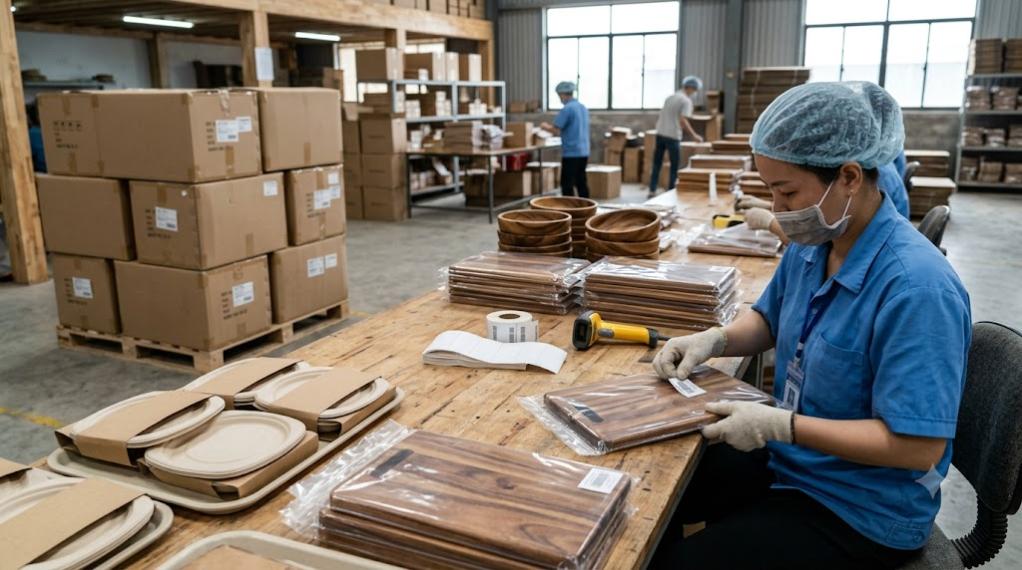
The most expensive habit in marketplace sourcing is treating prep as something that happens after the goods exist. A buyer places an order for 5,000 acacia serving boards, receives them in bulk polybags of ten, and then discovers that every unit needs an individual transparent bag, a scannable unit barcode, a suffocation warning and a set label. The rework is now happening in a bonded warehouse at European or Gulf labour rates, on goods that have already absorbed sea freight, and often under a marketplace appointment window that cannot be moved.
Done at origin, the same work is a line item on the specification sheet. Bagging, labelling and set assembly are integrated into the existing finishing and packing flow, the labels are printed from the same artwork file that produced the sleeve, and the barcode is verified with a scanner on the bench before the carton is closed. The unit cost of prep at origin for a wooden board is typically measured in single-digit US cents. The unit cost of the same prep performed by a third-party logistics provider in a destination market is usually an order of magnitude higher, before anyone counts the storage days lost while the pallet waits its turn.
The practical consequence is that prep belongs in the technical pack alongside dimensions, moisture content and finish. It is a manufacturing instruction. If it is not written down, it will not be repeated identically on the second production run, and marketplace compliance is a game of identical repetition.
What a Marketplace Actually Charges You For When Prep Is Wrong
Fulfilment networks do not usually reject a non-compliant carton outright. They fix it and bill for it. That is worse, because the cost is invisible until it appears as a deduction on a settlement report weeks later, disconnected from the shipment that caused it.
Three categories are worth understanding before you negotiate a factory price. The first is unplanned prep: the fulfilment centre performs bagging, labelling or over-boxing that the seller should have done, and charges a per-unit fee. The second is unplanned service, most commonly applying a unit barcode label because the one supplied was unscannable, damaged, or covered by a sleeve. The third, and most damaging, is a receiving problem that puts the whole shipment into a research queue while it is investigated, which delays the entire consignment rather than the offending units.
Fee schedules change every year and differ by marketplace and region, so the numbers themselves are not worth memorising. What is worth internalising is the structure: these fees are charged per unit, they apply to the entire shipment rather than a sample, and they are not negotiable after the fact. On a 5,000-piece order of low-value wooden utensils, a per-unit prep fee can consume the whole margin. On a 500-piece order of high-value serving boards it may be survivable. Either way, it is a cost that a correctly written purchase order eliminates entirely.
FNSKU, GTIN and the Barcode Decision You Make Before Artwork
Every marketplace unit needs a machine-readable identifier, and the choice between two approaches has to be made before packaging artwork is finalised, because it changes what is printed on the pack.
The first approach uses a manufacturer barcode: a GTIN issued through GS1, printed on the retail pack, identifying the product as a product. The second uses a marketplace-specific unit label, of which the best known is the Amazon FNSKU, which identifies the product as your inventory rather than as a generic article. The distinction matters commercially. Where a manufacturer barcode is used, inventory from different sellers of the same GTIN can be pooled, and the unit a customer receives may not be the unit you shipped. Where a marketplace label is used, your stock stays yours, which is the only defensible position for a private-label programme where you control the finish, the certificate file and the claim wording.
For a Vietnamese factory, this decision produces three concrete instructions. If a marketplace unit label is used, the manufacturer barcode must be fully covered or must never be printed in the first place, because two scannable barcodes on one pack is a receiving error. If both are needed for different channels, the pack design must reserve a clean, flat, light-coloured label panel of a defined size in a defined position, and that panel must not sit across a fold, a seam or a wood grain step. And in all cases the barcode must be scannable through the bag if the label sits under the bag, which in practice means the label goes on the outside of the poly bag, not on the product inside it.
One further point that is specific to wood: laser-engraved barcodes look attractive and almost never scan reliably. Grain contrast varies from board to board, and the burn depth that gives a crisp visual result on acacia gives poor optical contrast under a warehouse scanner. Engrave the brand mark if you want to; print the barcode on a label.
Poly-Bagging: The Rule Set That Catches Wooden Kitchenware
Poly-bagging is where wooden kitchenware programmes fail most often, for two unrelated reasons that happen to collide in the same operation.
The compliance reason is the suffocation warning. Marketplace requirements are broadly aligned on the principle that a bag with an opening at or above a defined threshold, commonly five inches measured flat, must carry a suffocation warning in the language of the destination market, printed in a legible minimum type size, either on the bag itself or on a label affixed to it. Bags are also required to be transparent so that the contents can be identified, to meet a minimum film thickness, and to be either sealed or, where a vent is used, perforated with holes below a maximum diameter. None of this is difficult. All of it has to be specified, because a Vietnamese packaging supplier will otherwise quote the cheapest film available, which is thin, tinted, and printed with nothing.
The technical reason is moisture. A sealed poly bag around a wooden board is a closed system. If the board goes into the bag above its equilibrium moisture content, the bag holds that moisture against the surface for the six to eight weeks of an ocean transit and however many months of warehouse storage follow. The result is mould bloom on the face of the board, a grey haze under a mineral-oil finish, or a musty odour that survives unpacking. This is the single most common reason a wooden kitchenware programme generates a wave of marketplace returns in month four.
The fix is a specification, not a material upgrade. Boards must be bagged only after the finish has fully cured and the moisture content has been verified in the target range for the destination climate, the bag must be vented rather than hermetically sealed unless there is a reason not to, and a desiccant sachet sized to the bag volume should be included where the destination is a humid market or where the transit crosses a monsoon season. Vented bags and suffocation warnings are compatible: perforation below the specified hole diameter satisfies both requirements at once.
- Film: transparent, minimum thickness specified in mils or microns, no tint, no recycled-content haze that obscures the product.
- Warning: suffocation text in the destination language, correct minimum type size, printed or on an affixed label, positioned so it is not hidden by the barcode label.
- Venting: perforations below the maximum permitted diameter, distributed rather than clustered, and never through the barcode panel.
- Closure: self-adhesive lip folded and sealed, or heat-sealed; no staples, no tape wrapped around the product.
- Moisture: bagging permitted only after cure and moisture verification, with desiccant where the route or destination requires it.
Sets, Bundles and the Label That Keeps Them Together
Wooden kitchenware sells extremely well as a set: a three-piece board set, a five-piece utensil set, a bowl with two serving pieces. Marketplaces treat a set as a single sellable unit, which means it has to arrive as a single physical unit and be impossible to break apart accidentally during handling.
Two requirements follow. The set must be packaged so that the components cannot separate, which for a board set usually means a single bag or sleeve around the stack rather than individual bags loosely banded together. And the outer pack must carry a clear instruction not to separate the components for individual sale, which most marketplaces express as a sold-as-set label. Where components are individually bagged inside the set for surface protection, only the outer pack carries the sellable barcode; the inner bags must carry no scannable code at all.
Compostable tableware raises the mirror-image problem. A pack of fifty bagasse plates is a set by nature, and the risk is not separation but count accuracy. Marketplace returns for short counts are disproportionately common in this category because moulded fibre nests unevenly and manual counting is unreliable at speed. Weight-based count verification on a calibrated bench scale, with a tolerance defined in the specification, is faster and far more accurate than counting by hand, and it produces a record.
Case-Packed or Individually Packed: Choosing Per SKU
Fulfilment networks accept two inbound formats. In an individually packed shipment, each unit is separately identified and the carton may hold a mix. In a case-packed shipment, every carton holds an identical quantity of one identical item, and the carton itself is labelled, which removes the need for a unit label on each piece inside.
Case-packing is materially cheaper for a Vietnamese factory to produce and materially cheaper for the fulfilment network to receive, so it is the default worth pursuing. It works well for a single high-volume SKU: one design of cutting board, one size of bagasse plate, one wooden spoon. It stops working the moment the buyer wants a mixed carton, an assortment, or a small trial quantity of a new colourway, because the definition requires exact uniformity down to the piece count.
The sourcing implication is that assortment strategy and prep cost are the same decision. A buyer who insists on twelve variants at 200 pieces each will pay individually-packed prep economics on all of them. A buyer who narrows to four variants at 600 pieces each can case-pack, drop the unit-label operation entirely, and reinvest the saving in better packaging. It is worth running that arithmetic before the range is locked, not after.
Size, Weight and the Fee Tier You Fall Into
Fulfilment fees are calculated from the dimensions and weight of the packaged unit, not the product. For wooden houseware this is a design lever that is almost always left unused.
Marketplaces band products into size tiers with sharp thresholds, and a unit that crosses a threshold by a few millimetres pays the higher tier on every single sale for the life of the listing. A serving tray whose gift box adds twelve millimetres of rigid corner protection on each side can move from a standard tier to an oversize tier and lose more margin over a season than the entire packaging budget. The same is true of weight: a heavy acacia board in a heavy box can cross a weight break that a slightly thinner board in a lighter box would not.
The right process is to work backwards. Establish the tier thresholds for the destination marketplace at the time of design, subtract the packaging allowance, and hand the factory a maximum finished-pack envelope rather than a product dimension. Vietnamese wooden kitchenware is made to a drawing; a target that includes the pack is just as easy to hit as one that does not, provided it is issued before tooling and sanding jigs are set.
Two handling rules also matter at the carton level and are frequently missed. Inbound cartons are subject to a maximum weight, typically fifty pounds or its metric equivalent, above which a team-lift label is required, with a further threshold above which mechanical lift labelling applies. And cartons are subject to a maximum dimension on any single side. A long-handled wooden utensil or an oversized charcuterie board can breach the carton dimension limit even when the unit itself is well within its tier, which forces a shipping carton redesign that is much cheaper to do at the quotation stage.
Drop Testing: Why Wood and Moulded Fibre Fail Differently
Marketplace fulfilment is a rough environment, and packaging that survives a container is not automatically packaging that survives parcel handling. The relevant discipline is transit testing to a published protocol, most commonly one of the ISTA series, with dedicated e-commerce and ships-in-own-container variants used by the major marketplaces and verified through accredited laboratories.
Wood fails in a specific way. It is dense, it is rigid, and it concentrates impact energy at corners. A hardwood board dropped in a lightly padded box does not absorb the shock; it transmits it to the box corner, which bursts, and then the board arrives with a bruised edge and a torn carton. The countermeasure is corner protection and immobilisation rather than general cushioning. A board that cannot move inside its pack survives drops that a well-padded but loosely packed board does not.
Moulded fibre fails in the opposite way. Bagasse and areca palm tableware is light and crushable, so the risk is not impact but compression: a heavy carton stacked on top of a light one during warehouse storage. The countermeasure is a carton with sufficient edge crush resistance and a stacking instruction printed on the box, plus a nested pack geometry that lets the plates share load rather than concentrating it on the rim of the top piece.
Where a buyer intends to pursue a ships-in-own-container or prep-free packaging certification, the testing has to be scheduled against the production timeline, because certification is performed on the actual production pack. That means the pack has to be finalised, tooled and produced in sample quantity well before the main run. Buyers who leave this to the last month usually ship the first order in an over-box and lose the fee benefit for an entire season.
Compostable Tableware in a Warehouse: Shelf Life Nobody Specifies
Compostable and disposable tableware has a property that marketplace inventory planning quietly ignores: it is designed to break down. Under warehouse conditions that process is slow, but it is not zero, and long-tail marketplace inventory is exactly the scenario where it becomes visible.
Bagasse absorbs ambient humidity. Stored uncartoned or in a permeable pack in a hot, humid environment, a stack of plates can soften at the rim, lose rigidity and, in bad cases, develop surface mould. Areca palm leaf, being a natural leaf, can darken and become brittle over time. PLA-lined items soften at elevated temperature, which matters in a Gulf warehouse in August far more than it does in a Northern European one. None of these outcomes is a manufacturing defect. They are storage-condition outcomes, and they generate returns that a seller cannot win because the customer received a genuinely degraded product.
Three practical measures address this. Define a recommended storage condition and a best-before or best-used-by period on the case, so the seller has a basis for inventory rotation. Specify a barrier layer or a shrink-wrapped inner pack for humid destinations rather than relying on a plain kraft sleeve. And size marketplace orders to a realistic sell-through horizon instead of buying a year of cover to hit a price break. On compostable tableware, the price break is frequently smaller than the write-off.
Listing Copy: The Claims That Get a Product Suppressed
Marketplace listing copy is where sourcing documentation meets consumer law, and it is enforced by two independent mechanisms: the marketplace itself, which suppresses listings algorithmically and on complaint, and the national regulator, which acts against the seller.
The direction of travel in the European Union is unambiguous. Directive (EU) 2024/825 begins to apply from 27 September 2026 and removes the availability of unqualified generic environmental claims. In practice that means a bullet point reading eco-friendly or biodegradable, with nothing attached to it, becomes a liability on an EU listing rather than a selling point. A compostable claim has to identify the conditions under which the product composts and, where those conditions are industrial rather than domestic, say so.
Marketplace-specific rules add a second layer. Food-contact articles usually require the seller to hold documentation on request. Products described as dishwasher-safe or microwave-safe invite returns and, if untrue for a mineral-oil-finished hardwood board, invite negative reviews that cannot be removed. And claims about certification, whether forestry, food-safety or compostability, must name the certificate holder and scope that actually exists, because a marketplace compliance request will ask for the document and match the article to it.
The workable discipline is the same one that applies to packaging artwork: draft the listing copy from the specification sheet and the certificate file, not from a competitor page. If the sentence cannot be evidenced from a document already in the folder, it does not go in the listing.
Producer Responsibility: The Numbers a Listing Cannot Go Live Without
Extended producer responsibility is the compliance area that most surprises first-time marketplace importers, because it is not about the product at all. It is about the packaging, and the obligation sits with whoever first places that packaging on the national market.
In Germany, packaging obligations under the Verpackungsgesetz require registration in the LUCID register operated by the Zentrale Stelle Verpackungsregister, together with participation in a dual system. Marketplaces are required to verify that registration and will block listings without it. France applies its own registration regime with unique identifiers per obligation stream, and additionally requires the Triman sorting mark with accompanying sorting information on consumer packaging. Spain, Austria and other member states operate comparable schemes. In the United Kingdom, packaging producer-responsibility obligations require data reporting and fee payment for organisations above the relevant thresholds.
Three points matter for the sourcing relationship. First, these are the buyer obligations, not the Vietnamese factory obligations, and no supplier can register on your behalf. Second, they nevertheless generate factory instructions: the sorting mark and its accompanying text have to appear on the artwork, in the correct language, with the correct pictogram, and that has to be in the print file before plates are made. Third, they are driven by the weight and material of the packaging you actually ship, which means the packaging specification is also a cost input. Reducing pack weight or eliminating a mixed-material laminate reduces the annual fee as well as the freight.
For buyers in the Gulf and wider Asia the picture is different but not absent. Gulf markets increasingly apply conformity and labelling regimes at import, and several Asian markets have introduced packaging-waste rules of their own. The lesson generalises: find out what has to be printed on the pack before the pack is printed.
Prep at Origin or Prep at Destination: Running the Comparison Honestly
Buyers commonly assume that prep at a destination third-party logistics provider is more flexible and therefore safer. It is more flexible. It is rarely cheaper, and it is usually slower.
An honest comparison has four columns. Direct labour cost per unit, where origin prep is performed by the same people already handling the goods and destination prep is performed at destination wage rates. Materials, where the bag, label and sleeve are sourced in Vietnam at Vietnamese prices in either case, but are shipped as loose consumables if prep happens later. Time, where origin prep adds days to a production schedule that has slack while destination prep adds days to a receiving schedule that usually does not. And risk, where origin prep is inspected at the pre-shipment stage against a written specification while destination prep is inspected, if at all, by the party performing it.
Destination prep earns its place in two situations: when the assortment is genuinely unknown at production time, and when a buyer serves several marketplaces with different label requirements from a single pooled stock. Both are real. Neither applies to the typical private-label wooden kitchenware programme, where the SKU list is fixed months in advance and the destination is known at the purchase order stage.
What Belongs in the Purchase Order and the Prep Specification
A prep specification is a short document, but it has to be unambiguous, because it will be executed by people who are not marketplace sellers and who have no way to infer intent. Everything below should be stated in numbers or in a named artwork file, never in adjectives.
- Unit definition: exactly what constitutes one sellable unit, including component count for sets and piece count for tableware packs, with the count-verification method.
- Barcode: symbology, which identifier is used, print file reference, label size, label position on the pack, and the requirement that no second scannable code is visible.
- Bag: material, thickness, transparency, dimensions, closure method, venting specification, and the warning text with its language and minimum type size.
- Set handling: whether components are individually bagged, what the outer pack is, and the exact sold-as-set wording and its placement.
- Finished-pack envelope: maximum length, width, height and weight of the packaged unit, stated as a limit rather than a nominal.
- Carton: board grade and edge crush value, inner count, maximum gross weight, maximum outer dimension, stacking limit, and required handling marks.
- Marks and legal text: country of origin, importer identity block, sorting or recycling marks with their language versions, and any care or use instructions.
- Moisture and cure: permitted moisture range at the time of bagging, minimum cure time after finishing, and desiccant specification where applicable.
- Verification: what the pre-shipment inspection checks, sample size, acceptance criteria, and the requirement to scan a defined number of units with a real scanner and record the result.
Two clauses in the purchase order itself do most of the protective work. The first makes the approved golden sample, including its pack, the reference for acceptance, so that prep is inspected against a physical object rather than a description. The second makes any change to bag, label, artwork or carton a written-approval event, which prevents the quiet substitution of a cheaper film or a resized label between the first and second production runs.
A Marketplace-Prep Checklist Before Production Starts
- Destination marketplaces and countries confirmed, and the current prep, labelling and size-tier rules for each one read directly from the operator, not from a summary.
- Barcode approach decided, and confirmed that no conflicting second code will be printed or visible.
- Finished-pack envelope calculated backwards from the fee tier thresholds and issued to the factory as a maximum.
- Poly bag specified in full, including warning text in every destination language required.
- Set or pack construction defined, with count verification by weight where the piece count is high.
- Case-pack feasibility assessed per SKU, and the assortment narrowed where the saving justifies it.
- Transit test protocol selected, laboratory booked, and testing scheduled against the production pack rather than a prototype.
- Producer-responsibility registrations opened in every destination market, and the resulting marks and text placed in the artwork before plates are made.
- Listing copy drafted from the specification sheet and certificate file, with every environmental claim traceable to a document.
- Storage conditions and rotation period defined for compostable lines, and order quantity sized to sell-through rather than to a price break.
- Golden sample approved in its finished pack, sealed, retained by both parties, and referenced in the purchase order as the acceptance standard.
- Pre-shipment inspection scope extended to prep, with a scan test on a defined sample and a photographic record of the packed unit.
Further Reading
- Export packaging, barcodes and retail-ready presentation for Vietnam wooden kitchenware
- Green claims and on-pack labelling: what you can legally print from 27 September 2026
- Moisture content, kiln drying and cracking in Vietnam wooden kitchenware
- MOQ, samples and the golden sample on a first order
- Quality control and pre-shipment inspection for Vietnam wooden kitchenware
- Compostable tableware certifications: EN 13432, OK compost and PFAS
- Bagasse tableware from Vietnam: wholesale sourcing guide
- GS1 — Global Trade Item Number (GTIN)
- International Safe Transit Association (ISTA) transit test protocols
- Zentrale Stelle Verpackungsregister — LUCID packaging register (Germany)
- Directive (EU) 2024/825 on empowering consumers for the green transition (EUR-Lex)
Where Viet Farm Vision Fits
Viet Farm Vision is a Vietnam-based OEM manufacturer and exporter of wooden kitchenware and houseware, compostable and disposable tableware, agricultural products and handcrafts, supplying wholesale and private-label buyers across the Middle East, Asia and wider international markets.
On marketplace programmes we treat prep as part of the technical pack rather than as an afterthought at the packing bench. The finished-pack envelope is agreed before tooling so that a unit does not drift across a fee threshold, bag film and warning text are specified per destination language, and barcode labels are printed from the same approved artwork file as the sleeve and scan-tested on the bench before cartons are closed. Wooden items are bagged only after finish cure and moisture verification, with venting and desiccant specified by route and season, because the most expensive marketplace return in this category is a mould complaint that surfaces four months after delivery. Compostable lines carry a defined storage condition and rotation period on the case. The approved golden sample is retained in its finished pack as the acceptance reference, and any change to bag, label, artwork or carton is a written-approval event rather than a silent substitution.
If you are preparing a wooden kitchenware, wooden houseware or compostable tableware programme for a marketplace channel and want the prep specification written before production rather than after the first chargeback, our team can work from your destination requirements and return a costed pack specification with samples.