
A UK houseware brand signed off an acacia spatula range last spring on the strength of one sample. The mark was a fine script logo about forty millimetres wide, engraved beautifully on a piece the factory had fussed over for twenty minutes. In production that same mark ran ninety seconds a piece on the laser bed, and the thin strokes burned unevenly wherever they crossed a dark grain line, roughly one piece in eight. The factory asked for eleven cents more per unit and a wider tolerance on engraving defects. Nothing about the product had changed. The branding had simply never been costed as a production operation.
This is the most common avoidable cost in private label wooden kitchenware, and it is almost always discovered after the price has been agreed internally. Below is how the main decoration methods actually behave on Vietnamese hardwood, what each one does to cycle time, which artwork decisions quietly double your setup charge, and the specification lines that belong in your purchase order rather than in an email thread.
Branding Is a Production Operation, Not a Finishing Touch
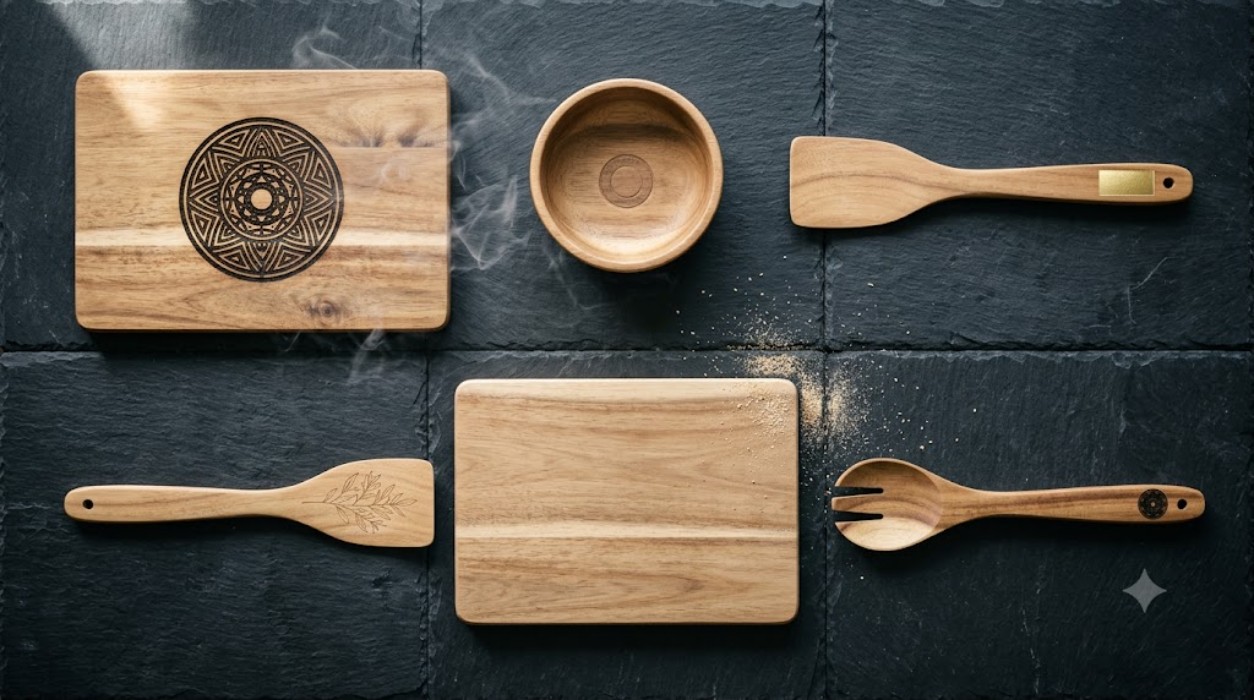
On a wooden spatula the shaping, sanding and oiling are well understood processes with stable cycle times. Decoration is different because it is the only step where your artwork, not the factory’s tooling, sets the speed. A 15 mm circular mark and a 60 mm detailed crest are the same operation on paper and a fourfold difference in laser time in reality. Factories quoting a new buyer will often assume a simple mark, because that is what most buyers eventually choose, and then requote when the real artwork arrives.
The second reason it matters is yield. Decoration happens at the end of the line, after the piece has absorbed all of its material and labour cost. A branding reject is a finished product reject. On a range where the unit FOB is 1.80 USD, moving engraving defects from two percent to six percent costs more than most buyers save by negotiating the wood grade.
The Five Methods and What Each One Really Does
CO2 laser engraving
The default in Vietnam and the most flexible option. No physical tooling, so a design change costs nothing but machine time, and multiple SKUs can share one setup. Vector outline marks run fast. Raster fills, where the laser sweeps line by line to darken a solid area, run slowly and are where cycle time escapes. A solid 40 mm filled circle can take three to five times longer than the same circle as a 1 mm outline.
Colour on acacia is genuinely unpredictable because the wood itself is not uniform. Sapwood burns pale golden brown, heartwood burns near black at the same power. If your logo crosses a grain transition, it will look like two different logos. The fix is placement, not power settings, which is why the placement drawing matters as much as the artwork file.
Heat branding with a metal die
A heated brass or copper die pressed into the surface. Setup costs are real, typically 60 to 180 USD for a die depending on size and detail, but cycle time is two to four seconds and it does not vary with how complex the mark is. For volumes above roughly 5,000 pieces per design this usually beats laser on total cost. The look is warmer and slightly irregular in a way that suits rustic and artisan positioning. Fine detail below about 0.8 mm stroke width fills in and disappears, so a delicate logo is not a candidate.
Cold debossing and pressing
Same die concept without heat, producing a clean impression with no scorch colour. It reads as premium and understated, and it survives sanding and oiling better than anything printed. The catch is species dependence. Rubberwood and bamboo take a deboss cleanly. Dense acacia heartwood resists, and pressing hard enough to register the mark can crush surrounding fibres and raise a halo. It also needs consistent moisture content, which is another reason the kiln schedule and the branding method should be discussed in the same conversation.
Hot foil stamping
Gold, copper or white foil pressed into the wood with a heated die. Visually the strongest option on a retail shelf and the only method that gives you a light mark on dark wood. It is also the least durable. Foil sits on the surface, so it abrades with washing and will not survive a dishwasher or repeated oiling. Reserve it for display pieces, gift sets and the non contact areas of handles, never for the working face of a board.
Pad printing, screen printing and UV printing
The only routes to full colour and to precise fine detail. Pad printing handles curved surfaces such as spoon handles, screen printing suits flat boards, and UV inkjet gives photographic detail with no tooling at all. All three introduce a food contact question that engraving does not, because you are adding a material rather than removing one. If ink appears anywhere a buyer could reasonably call a food contact surface, you need migration testing under EU 1935/2004 or the equivalent in your market, and you need the ink supplier’s declaration in your document pack. Most buyers solve this by confining print to handles and undersides.
Method Comparison at a Glance
| Method | Tooling cost | Cycle time per piece | Dishwasher durable | Best suited to |
|---|---|---|---|---|
| CO2 laser engraving | None | 8 to 90 seconds, artwork dependent | Yes, permanent | Multi SKU ranges, frequent design changes, volumes under 5,000 |
| Heat branding die | 60 to 180 USD per design | 2 to 4 seconds | Yes, permanent | High volume single logo, rustic positioning |
| Cold deboss | 60 to 200 USD per design | 3 to 6 seconds | Yes, permanent | Premium minimal branding on rubberwood and bamboo |
| Hot foil stamp | 80 to 250 USD per design | 4 to 8 seconds | No | Gift sets, display pieces, handle accents |
| Pad or UV print | 40 to 150 USD, none for UV | 5 to 15 seconds | Partial, varies by ink and topcoat | Full colour brand marks on non contact areas |
The column that decides most programmes is not tooling cost. It is cycle time multiplied by order quantity. A die that costs 140 USD once and saves forty seconds a piece pays for itself at about 400 units and then keeps paying.
Wood Species Changes the Answer
- Acacia. Strong grain contrast and variable density. Excellent for laser, where the burn reads as intentional, but expect visible variation piece to piece. Poor for fine deboss. Reject rates on detailed marks run higher than on any other species we handle.
- Rubberwood. Pale, even and close grained. The most forgiving surface for every method, and the best choice if your brand mark is detailed or if consistency across a thousand pieces matters more than character.
- Bamboo. Laser engraves to a clean dark line and debosses well, but the layered construction can delaminate under heavy pressing. Keep deboss depth shallow and test on the actual panel construction, not a sample block.
- Walnut and darker stained finishes. Laser engraving almost vanishes because the burn and the base tone are too close. Foil or a light coloured print is the only option that reads on shelf.
If you are running the same logo across a mixed species range, accept now that it will not look identical on every item, and decide whether you want consistent placement or consistent appearance. You cannot have both.
The Artwork Rules That Prevent a Requote
Most branding requotes trace back to an artwork file that was never usable. Send this with the RFQ, not after the sample:
- Vector format, AI, EPS or PDF with outlined fonts. A 300 dpi PNG is acceptable only for UV printing and nothing else.
- Artwork supplied at 1:1 final size, with the intended width in millimetres stated in the filename. Scaling decisions made by the factory are where surprises come from.
- Minimum stroke width of 0.8 mm for laser and 1.0 mm for any die based method. Anything finer will either disappear or fill in.
- Minimum text height of 2.5 mm on laser, 3.5 mm on a die. Below that, legibility depends on the grain under the letter.
- No gradients, no drop shadows, no soft edges. If your brand identity depends on them, supply a single colour variant specifically for wood decoration.
- State whether solid areas are filled or outlined. This single line is the difference between an eight second cycle and a forty second one.
- A placement drawing showing distance from each edge, orientation relative to the grain, and which face is the branded face.
Placement, Grain and the Food Contact Line
Three placement decisions carry commercial weight. First, put the mark where the grain is calmest, usually the lower third of a board rather than the centre, because the centre of an acacia board is where the darkest figure tends to run. Second, decide the branded face explicitly. On a reversible serving board the factory will otherwise pick one, and your retail photography will show the wrong side on half the shipment. Third, keep any applied material, meaning ink or foil, off surfaces that will touch food, and record that decision in writing so your compliance file matches your product.
Engraving and debossing remove or compress wood rather than adding anything, so neither creates a new food contact substance and neither needs migration testing on its own. That is a real regulatory advantage and it is worth weighing against the shelf impact of foil.
What Branding Actually Adds to Your Unit Price
A worked example on a 5,000 piece acacia spatula order, FOB Ho Chi Minh, using 2026 labour and machine rates.
| Scenario | Setup amortised | Decoration cost per piece | Reject allowance | Added to FOB |
|---|---|---|---|---|
| Simple 20 mm outline mark, laser | 0.00 | 0.035 | 1.5% | 0.04 USD |
| Detailed 45 mm filled crest, laser | 0.00 | 0.140 | 6.0% | 0.17 USD |
| Same crest, heat branding die | 0.028 | 0.018 | 2.0% | 0.05 USD |
| Two colour pad print on handle | 0.022 | 0.055 | 3.5% | 0.09 USD |
Read the second and third rows together. The same visual result costs 0.17 USD a piece one way and 0.05 USD the other, a difference of 600 USD on this order, decided entirely by which machine the artwork was routed to. That decision is usually made by a production planner who was never told the volume.
Durability, Dishwashers and Returns
Every wooden kitchenware programme eventually meets a consumer who puts the board in a dishwasher despite the hangtag. Plan for it in the branding choice rather than the warranty policy. Engraved and debossed marks survive indefinitely because they are geometry, not coating. Foil lifts within a handful of cycles. Printed marks depend entirely on the ink system and any topcoat, and a supplier who cannot name the ink and the cure method cannot tell you how it will age.
There is a second ageing question specific to oiled wood. Mineral oil and beeswax finishes darken the surface over time, which reduces the contrast on a laser engraved mark. Engrave slightly deeper than looks necessary on the golden sample, because the sample you approve is the lightest that product will ever be.
Tooling Ownership and the Second Order
Dies and printing plates are physical assets that sit in someone’s factory. If your purchase order does not say who owns them, the default assumption in Vietnam is that the factory does, and a second supplier will charge you a second setup. Three lines fix this permanently:
- Tooling paid for by the buyer is the buyer’s property and is released on written request at the buyer’s freight cost.
- Tooling is stored, maintained and identified by the buyer’s SKU reference, and replacement due to normal wear is at the supplier’s cost.
- No setup charge applies to repeat orders using existing tooling, and this is stated on the quotation rather than assumed.
The same applies to the engraving programme file on a laser. It is not tooling in the physical sense, but it holds your power settings, speed and placement coordinates, and a factory that loses it will re-derive them and give you a visibly different mark six months later. Ask for the approved parameter sheet to be attached to the golden sample record.
The Branding Spec to Attach to Your PO
- Decoration method, stated per SKU, not per range
- Artwork file reference and version, with outlined fonts
- Mark dimensions in millimetres, width and height
- Fill or outline, stated explicitly
- Placement drawing with edge distances and branded face identified
- Wood species and finish at the moment of decoration
- Engraving depth or deboss depth tolerance
- Acceptable colour range, defined by two physical limit samples rather than a description
- Defect definitions for branding, listing incomplete burn, double strike, misalignment beyond tolerance and scorch halo
- AQL level applied to branding defects specifically
- Tooling ownership, storage and repeat order setup terms
- Ink declaration and migration test report reference, where printing is used
- Approved parameter sheet retained with the golden sample
- Written confirmation that no applied decoration sits on a food contact surface
Fourteen lines again. In this category the two that prevent the most argument are the limit samples and the branding specific AQL, because they turn a subjective complaint about colour into a measurable pass or fail at inspection.
Working With Viet Farm Vision
Viet Farm Vision works with importers, retail groups and distributors sourcing wooden kitchenware and houseware, handmade quilling cards and eco packaging from Vietnam. Branding is specified at the quotation stage rather than discovered at the sample round, because that is the last point where the method is still free to change. For a 2026 private label wooden kitchenware programme that means:
- A decoration method recommended per SKU against your artwork, your species and your order quantity, with the cycle time cost shown rather than buried in the FOB
- Artwork reviewed for stroke width, text height and fill before it reaches the factory, so the first quote is the real quote
- Two physical limit samples produced and retained, defining the acceptable colour range for inspection
- Branding defects written into the AQL table alongside dimensional and finish defects
- Tooling ownership and repeat order setup terms agreed in writing on the first purchase order
Related reading on this site: retail packaging and master carton specifications, pre-shipment inspection and AQL for wooden kitchenware, and moisture content and food safe finishes. External reference: the European Commission framework on materials and articles intended to come into contact with food, Regulation EC 1935/2004.
If you are putting your own brand on a Vietnamese wooden kitchenware range in 2026 and want the method, the artwork and the per unit cost modelled together before you commit to a look, we are happy to walk through it. Contact us at info@vietfarmvision.com or through the enquiry form on vietfarmvision.com.