
A German houseware importer once told us he had visited four wooden kitchenware factories in Binh Duong in a single day and could not tell them apart. All four had the same sanding lines, the same stacks of acacia, the same wall of certificates near the reception desk. He signed with the one that quoted eleven cents lower on a serving board. Nine months later he was writing off 6% of a container for hairline splits along the glue joints, and the factory he had rejected was quietly supplying his largest competitor with zero claims. The difference between the two plants was never visible in the quotation. It sat in two production stages that neither factory had been asked about.
Wooden kitchenware looks like a simple product. A board, a spatula, a bowl. In reality a single acacia serving board passes through eleven distinct operations between the timber yard and the export carton, and the finished piece carries the memory of every one of them. Buyers who understand the sequence can read a factory in an hour. Buyers who do not are left comparing unit prices that describe entirely different products. This guide walks the full line as it actually runs in a Vietnamese plant in 2026, and identifies the five stages where your landed cost and your defect rate are genuinely decided.
Why the process map beats the price list
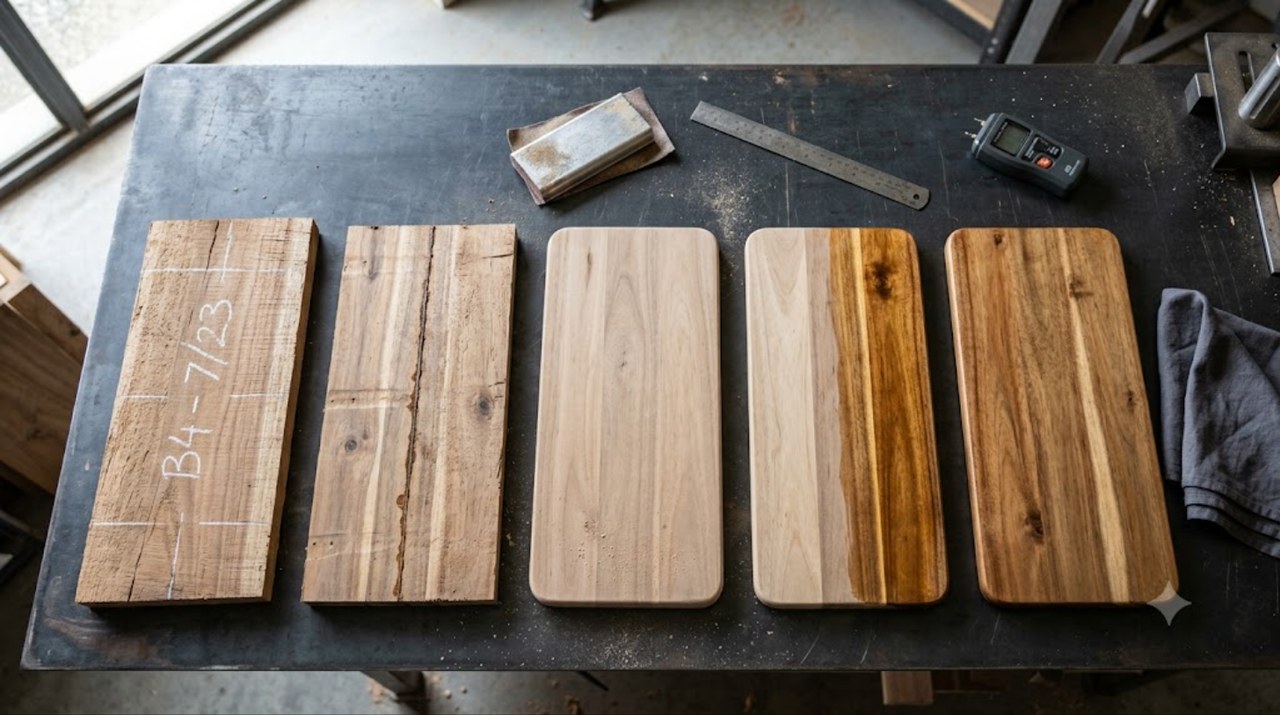
Two factories quoting the same board at $2.40 and $2.29 are not offering the same thing. The gap usually comes from one of three places: timber grade and how much of the board is heartwood versus sapwood, how long the wood actually sat in the kiln, and how many minutes of hand finishing each piece received. None of those appear on a quotation. All three appear in your claims file eighteen months later.
Vietnam exported over $16 billion of wood and wood products in 2025 and remains the largest wood furniture and houseware supplier in Southeast Asia, which means buyers have real choice. That choice is only useful if you can compare plants on something more precise than price and a showroom sample. The eleven stages below give you that vocabulary.
Stages 1 to 3: intake, grading and kiln drying
The line begins in the timber yard, where sawn acacia or rubberwood arrives from plantation suppliers, usually in 25mm and 40mm thicknesses. Stage one is intake and documentation, and in 2026 this is also where the EU Deforestation Regulation paper trail is either created or lost forever. Stage two is grading, where boards are sorted by colour, knot density and sapwood content. Stage three is kiln drying, which for a 25mm acacia board means roughly seven to ten days to bring moisture content from around 40% down to the 8% to 12% band that a finished kitchenware item needs.
- Ask for kiln charge records, not a verbal answer. A charge log shows dates, target moisture and final readings per batch
- Ask what happens when the schedule is tight. A kiln cycle cut from nine days to five is the single most common root cause of splitting after arrival
- Ask where the grading rejects go. A factory that cannot show you its reject stack is probably feeding it back into your order
Stages 4 to 6: ripping, jointing and panel pressing
Dried boards are ripped into strips, defected to remove knots and cracks, then edge glued into panels under hydraulic press. For larger boards the strips may also be finger jointed end to end. This is where a factory decides how much of your board is solid single-piece timber and how much is a composed panel, and it is a decision with real commercial consequences. A three-strip panel and a seven-strip panel can look identical after sanding and staining but behave very differently across a shipping season.
Glue matters as much as geometry. Food-contact wooden items should be pressed with D3 or D4 rated PVA adhesive, and the press time and ambient humidity at the time of pressing both affect joint integrity. A joint pressed too briefly in a humid workshop will hold through inspection and fail three months later in a dry retail environment.
- Specify a maximum number of strips per panel width in your technical sheet, and a maximum acceptable colour variation between adjacent strips
- Specify the adhesive class in writing and ask for the supplier declaration for it
- Decide in advance whether finger joints are acceptable on visible faces. Most retail programmes say no on the top face, yes on the underside
Stages 7 and 8: CNC profiling and calibration sanding
Pressed panels are cut to shape, routed for handles, juice grooves and radii, then passed through a wide belt calibration sander that brings every piece to a uniform thickness. Most Vietnamese plants of any scale now run CNC routers for profiling, which is why complex shapes have become much cheaper than they were five years ago. The tooling cost for a new profile is typically absorbed over a first order of a few thousand pieces rather than charged as a separate line.
Calibration is the stage buyers most often overlook. A board specified at 18mm that arrives between 16.5mm and 19mm across a pallet will pass most visual inspections and fail every retail planogram that stacks product. Ask what the thickness tolerance on the sander is and have it written into the specification, typically plus or minus 0.5mm.
Stage 9: hand sanding and the grit ladder
This is where the labour goes, and where the eleven cent price gap usually lives. A properly finished board runs a grit ladder, commonly 120 then 180 then 240, with edges and radii broken by hand at each step. A budget board gets one pass at 150 and a quick edge wipe. Both feel smooth in a showroom. Only one of them still feels smooth after the first oiling raises the grain, because raised grain is exactly what the finer grits are there to cut back.
If you are comparing two quotations and one is materially cheaper, ask both factories how many sanding passes the piece receives and what the final grit is. The answers will usually explain the whole difference, and they let you decide whether you are buying a cheaper board or simply a less finished one.
Stage 10: oiling, curing and the humidity window
Food-safe finishing is normally mineral oil, a mineral oil and beeswax blend, or a certified natural wood oil. The finish is applied by dip, wipe or spray, then the pieces cure on racks. Curing is a real production constraint, not a formality. Depending on the finish and the workshop climate, racks may be occupied for twenty four to seventy two hours, and during the humid months in southern Vietnam that window stretches.
Packing a board that has not fully cured is the origin of two classic complaints: a faint oily residue on the retail sleeve, and a tacky surface on arrival. Both are entirely preventable and both come from a schedule that has been compressed somewhere upstream. Our note on moisture content, kiln drying and cracking covers how drying and finishing interact once the product leaves the tropics.
Stage 11: marking, inspection and packing
The final stage covers laser engraving or branding, country of origin marking, care labels, barcodes, retail sleeves or boxes, and the master carton. It is also where final inspection happens, usually against an agreed AQL sampling plan with a defect table that both sides signed before production started. A factory that inspects only at the end has already lost the chance to correct anything. Good plants inspect at stage three, stage six and stage nine as well.
If you are adding your own mark, our comparison of laser engraving, debossing and hot foil sets out what each method adds in cycle time and unit cost, and our guide to retail packaging and master carton specification covers the carton side.
The five stages that actually decide your cost and defect rate
Eleven stages is a lot to audit. In practice five of them carry almost all of the commercial risk, and a buyer who controls these five controls the outcome.
- Stage 2, grading. Decides how much sapwood and how many knots reach your order, which drives both visual rejects and long term stability
- Stage 3, kiln drying. The single largest cause of post arrival splitting. Everything downstream inherits this decision
- Stage 5 and 6, jointing and pressing. Decides glue line failures, which appear late and almost always after the claim window has been argued over
- Stage 9, hand sanding. The main labour variable, and the honest explanation for most price gaps between otherwise similar factories
- Stage 10, curing. Compressed curing is invisible at inspection and highly visible on a retail shelf
Notice that only one of the five is about machinery. The rest are about time, and time is what gets cut when a factory has accepted a delivery date it could not really meet. That is why capacity and process quality are the same conversation, a point we set out in detail in our guide to booking production capacity before Tet 2027.
What to ask on a factory visit or a video walkthrough
You do not need to fly to Vietnam to run this check. A forty minute video walk with someone who knows what to ask will tell you most of it. Ask the factory to walk the line in production order and to stop at each of the following.
- The timber yard: ask to see the supply documentation for the stack currently in use, not a sample file
- The kilns: ask to see the charge log on the controller screen, including the batch running right now
- The moisture meter: ask an operator to read three random pieces from the drying shed while you watch
- The press: ask how long the current panel batch has been under pressure and what the adhesive is
- The sanding line: ask how many stations a piece passes and what grit each one runs
- The curing racks: ask how long pieces stay on the rack before packing in this month conditions
- The QC bench: ask to see the defect table being used today and last week inspection records
What to write into the purchase order
Most of what goes wrong with wooden kitchenware is preventable with six lines in a specification sheet. None of them cost money to include and all of them give you a clear position if something does go wrong.
- Target moisture content at packing, stated as a range, with the measurement method named
- Maximum strips per panel and maximum acceptable colour variation between adjacent strips
- Adhesive class, with the supplier declaration attached to the approved sample
- Thickness tolerance after calibration, typically plus or minus 0.5mm
- Final sanding grit and number of sanding passes
- Minimum curing time before packing, stated in hours, with the packing date recorded per carton
For the wider regulatory picture on timber sourcing, the EU Deforestation Regulation guidance published by the European Commission sets out the due diligence obligations that now sit behind stage one of this process for any buyer shipping into the EU.
The short version
A wooden board is not a commodity and two quotations for the same drawing are rarely for the same product. The eleven stages above are where the difference lives, and five of them carry nearly all of it. Buyers who ask about kiln logs, panel composition, sanding passes and curing time before they ask about price end up paying roughly the same money and receiving a materially better product.
If you are evaluating Vietnamese wooden kitchenware suppliers this quarter and would like the process audit run against a specific factory, or a specification sheet built around the six clauses above, we are happy to work through it with you. Contact us at info@vietfarmvision.com or through the enquiry form on vietfarmvision.com.