
A gift and stationery distributor in Dubai sent the same three line enquiry to eleven Vietnamese workshops in March: handmade quilling cards, around 20,000 pieces, please quote your best price. Nine replied within a week. Every one of the nine came back with a range rather than a price, the ranges overlapped almost completely, and the highest bottom-of-range figure sat above the lowest top-of-range figure. The buyer spent five more weeks on follow up questions and still could not put the nine replies into a single comparison table. The workshops were not being evasive. They had been asked to price a product that had not yet been described, and a range is the only honest answer to that question.
Why a handmade card cannot be quoted from a quantity alone
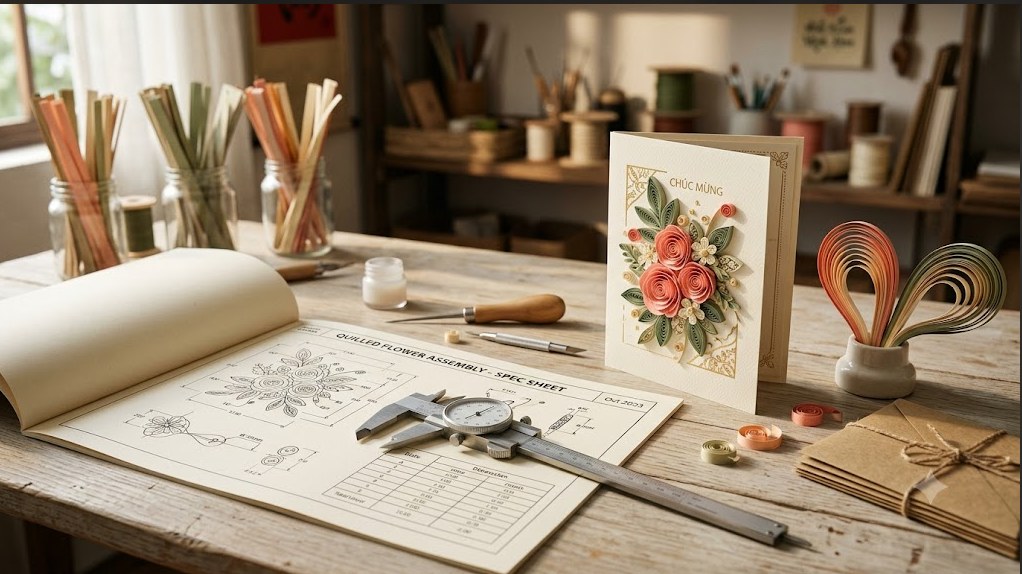
With a moulded or machine made product, quantity carries most of the price. Tooling is amortised, cycle time is fixed, and a supplier who knows the part number and the volume can quote inside a day. A quilling card inverts that. There is no tooling and no cycle time. The cost is almost entirely artisan minutes, and artisan minutes are set by the design: how many coils, how tight they are, how many colours are in play, whether elements are layered, and whether the assembly can be batched or has to be built card by card.
Two designs at the same 20,000 pieces can sit 60 percent apart on unit cost and both be quoted correctly. That is why a quantity-only enquiry produces a range: the workshop is quoting the span between the simplest design it can imagine and the most complex one you might send. Narrowing that span is not the supplier’s job. It is the buyer’s, and it is done with an RFQ pack. We have covered what actually sits inside a quilling card unit price in detail; this guide is about the information you send before that price can be calculated at all.
The twelve data points a quilling card quotation needs
A workshop can price a handmade card firmly, in one exchange, when these twelve are on the page. Anything missing becomes an assumption, and every assumption is priced with a margin of safety that the buyer pays for.
| Data point | What to state | What it changes in the price |
|---|---|---|
| 1. Finished card size | Closed dimensions in millimetres, plus portrait or landscape | Paper yield per sheet, envelope cost, carton fit |
| 2. Card stock | GSM and finish, or a named reference card | Substrate cost and rejection rate on scoring |
| 3. Quilling coverage | Percentage of the front panel carrying quilled work | Artisan minutes, the single largest cost line |
| 4. Colour count | Number of paper strip colours per design | Strip inventory, changeover time, batching efficiency |
| 5. Layering | Flat, single raised layer, or multi-level build | Assembly time and packing depth |
| 6. Design count | How many distinct designs across the order | Sampling cost, line changeovers, effective minimum |
| 7. Quantity per design | Units per design, not only the order total | Whether the design clears the workshop minimum |
| 8. Envelope and insert | Stock, colour, sealed or loose, blank or printed insert | Component cost and a separate assembly step |
| 9. Retail presentation | Polybag, sleeve, belly band, barcode, hang hole | Finishing labour and per-unit consumables |
| 10. Certification required | FSC paper, REACH, BSCI audit, toy safety if applicable | Material sourcing and documentation overhead |
| 11. Delivery term and port | EXW, FOB Cat Lai or Hai Phong, CIF named port | Freight, handling and export documentation |
| 12. Required on-shelf date | The date stock must be on the fixture, not the ship date | Whether the schedule is normal or overtime priced |
The four that buyers leave out most often
Across the enquiries that reach us, four of the twelve go missing far more than the rest, and each one costs the buyer measurably.
- Quantity per design. A 20,000 piece order across four designs is a straightforward booking. The same 20,000 across forty designs is forty separate sampling, training and changeover events, and it will quote materially higher. The order total tells a workshop almost nothing on its own.
- Quilling coverage. Buyers send a reference picture and assume it speaks for itself. It does not. Stating that quilled work covers roughly 40 percent of the front panel, or that the design is a single central motif rather than a full-bleed pattern, removes the widest single band of uncertainty in the quote.
- The on-shelf date. Buyers give a ship date. Workshops need the shelf date, because the gap between them is transit, customs clearance and warehouse processing in the destination market, and that gap is where schedules quietly break.
- Certification. Asking for FSC certified paper after the quote is accepted is a change of material, not a change of paperwork. Named upfront it costs a few percent; named late it costs a resample and a schedule.
Writing an artwork brief that can actually be costed
Most RFQ packs fail at the artwork brief rather than at the commercial terms. A photograph of a card found online tells a workshop what you like; it does not tell them what you will accept. Three additions turn a mood board into a costable brief.
- A scale reference. State the finished card size on the same page as the image. The same motif at 105 x 148 mm and at 150 x 210 mm are different products in artisan minutes, not a resize.
- A colour direction, not a colour match. Paper strips come in fixed mill colours. Asking for a palette family with two or three anchor references is quotable; asking for an exact Pantone match on a dyed paper strip is usually not, and it will either be declined or padded.
- A complexity ceiling. One line is enough: “no more than six colours and no more than three raised layers per design.” This lets the workshop quote to a defined envelope rather than to the worst case your reference image implies.
If the artwork is your own and exclusivity matters, the brief is also where ownership should be stated, before any sample is cut. Once a design has been developed in a workshop, the conversation about who owns it is harder than it needed to be.
How to compare quotations that do not look comparable
Even a complete RFQ produces replies in different shapes. One workshop quotes FOB with the envelope included, another quotes EXW with the envelope as a line item, a third quotes CIF and folds sampling into the unit price. Normalise before you judge. Four adjustments are enough to put any set of quilling card quotations on the same footing.
| Adjustment | How to normalise |
|---|---|
| Delivery term | Restate every quote as FOB at the same Vietnamese port; ask each supplier for the EXW-to-FOB difference in writing rather than estimating it |
| Bill of materials | Confirm envelope, insert, polybag and barcode are inside or outside each unit price, and add the missing ones back |
| One-off costs | Pull sampling, artwork development and any plate or die charges out of the unit price and show them as a separate line |
| Schedule | Convert each lead time to the same start trigger, normally deposit received and artwork approved, since suppliers count from different points |
Once normalised, the spread between serious workshops on a well specified quilling card is usually narrow. A quote that still sits far below the others after normalisation is not a bargain to chase; it is a signal that something in the specification has been read differently, and the cheapest hour you will ever spend is the one asking which line it was.
What to request alongside the price
A quotation is a number. A quotation pack is a decision. Ask for these five in the same reply, and you will rarely need a second round.
- Unit price per design, at two or three quantity breaks, so you can see where the curve flattens
- Sampling cost and sampling lead time, stated separately from bulk
- Production lead time counted from deposit and artwork approval
- Carton specification: pieces per inner, pieces per master, carton dimensions and gross weight
- Payment terms and what the deposit specifically secures
The carton specification matters more than it looks. It is what lets you calculate volume and freight before you commit, and it is the figure most often supplied late. Our guides to HS codes and rules of origin and to the compliance evidence pack cover what travels with the carton once it exists.
A realistic timeline from RFQ to first shipment
Buyers who plan backwards from a shelf date rather than forwards from an enquiry date are the ones who ship on time. For a first order of handmade quilling cards with original artwork, the following is a normal, non-expedited sequence.
| Stage | Typical duration | What decides it |
|---|---|---|
| RFQ issued to firm quotation | 3 to 7 days | Completeness of the pack; an incomplete RFQ doubles this |
| Quotation to sample dispatch | 7 to 14 days | Design count and whether artwork needs interpretation |
| Sample in transit and reviewed | 7 to 10 days | Courier route and your own internal sign-off |
| Revisions and golden sample approval | 7 to 14 days | Number of revision rounds; budget for at least one |
| Bulk production | 25 to 45 days | Quantity per design and workshop loading that season |
| Inspection, booking and sailing | 7 to 12 days plus transit | Vessel schedule and destination port |
Add it up and a first order commonly runs 14 to 18 weeks from enquiry to shelf, before ocean transit to your market. That number is not a warning; it is a planning input. Buyers targeting a Q4 gifting season who issue their RFQ in July are comfortable. Buyers who issue it in September are buying overtime, and the season around repeat orders and replenishment runs on the same arithmetic.
A one-page RFQ you can copy
Everything above compresses into a single page. Send this and you will receive prices rather than ranges.
- Company and channel. Who you are and where the cards will be sold, in two lines. Workshops quote differently for a museum shop, a supermarket and a corporate gifting programme, and they are not guessing at your expense when you tell them.
- Product. Card size, stock and GSM, quilling coverage, colour ceiling, layer ceiling, envelope and insert specification.
- Assortment. Number of designs and quantity per design, with a note on which are repeats of an existing range and which are new development.
- Presentation. Polybag, sleeve, barcode, hang hole, and whether the retailer requires a specific pack ratio.
- Compliance. Certifications required, and the market each one is required for.
- Commercial. Delivery term and named port, target on-shelf date, expected payment terms, and whether you want quantity breaks.
- Attachments. Artwork or reference images with the scale reference on the same page, plus any retailer packaging specification.
If certification is part of the brief, check the claim rather than the logo. Paper certification claims can be verified directly through the FSC public certificate search, and it takes about a minute against a certificate number a supplier supplies.
The questions worth asking before you choose
Price separates quotations. The answers below separate suppliers, and they cost nothing to ask.
- How many artisans can work on this design concurrently, and what happens to the lead time if we double the quantity per design?
- Which parts of the process are in your own workshop and which are subcontracted to home-based artisans?
- What is your normal reject rate on a design of this complexity, and how is it absorbed?
- If we approve a golden sample, how is consistency held across 20,000 handmade pieces?
- What is the smallest repeat order you will accept on this design next season?
How Viet Farm Vision handles quilling card RFQs
We work as a manufacturing network and export partner rather than a single workshop, which means an RFQ is matched to the workshop whose capability and current loading actually fit it, instead of being forced through whichever line happens to be free. Buyers send us the brief in whatever shape it arrives; we complete the twelve data points with them, put the enquiry to the workshops that genuinely make that kind of card, and return a normalised comparison rather than a set of replies in different formats.
Sampling, compliance documentation, inspection and export paperwork run through the same channel, so the specification agreed at RFQ stage is the specification inspected before the container is sealed. If you are preparing a quilling card programme for 2027, send the brief as it stands and we will tell you what is missing before it costs you a round of sampling.
Enquiries: info@vietfarmvision.com | Vietnam handcrafted quilling cards OEM overview