
Most quilling card buyers start with the design: the peony, the crane, the lotus. Experienced buyers start with the format. Card size, fold style, envelope and insert decide how much paper art fits on the front, how many hours the artisan spends per piece, how the card travels in a carton, which postage band your end customer pays, and which retail fixture it sits on. Get the format right and the same quilled design can sell at three different price points. Get it wrong and a beautiful card ends up crushed, overpriced or unsellable in its channel.
This guide explains the main quilling card formats produced in Vietnam, what each one costs in labour and freight terms, and how to build a format mix that fits your market. It is written for gift wholesalers, stationery importers, museum shop buyers and private label brands placing OEM orders for handmade quilling cards.
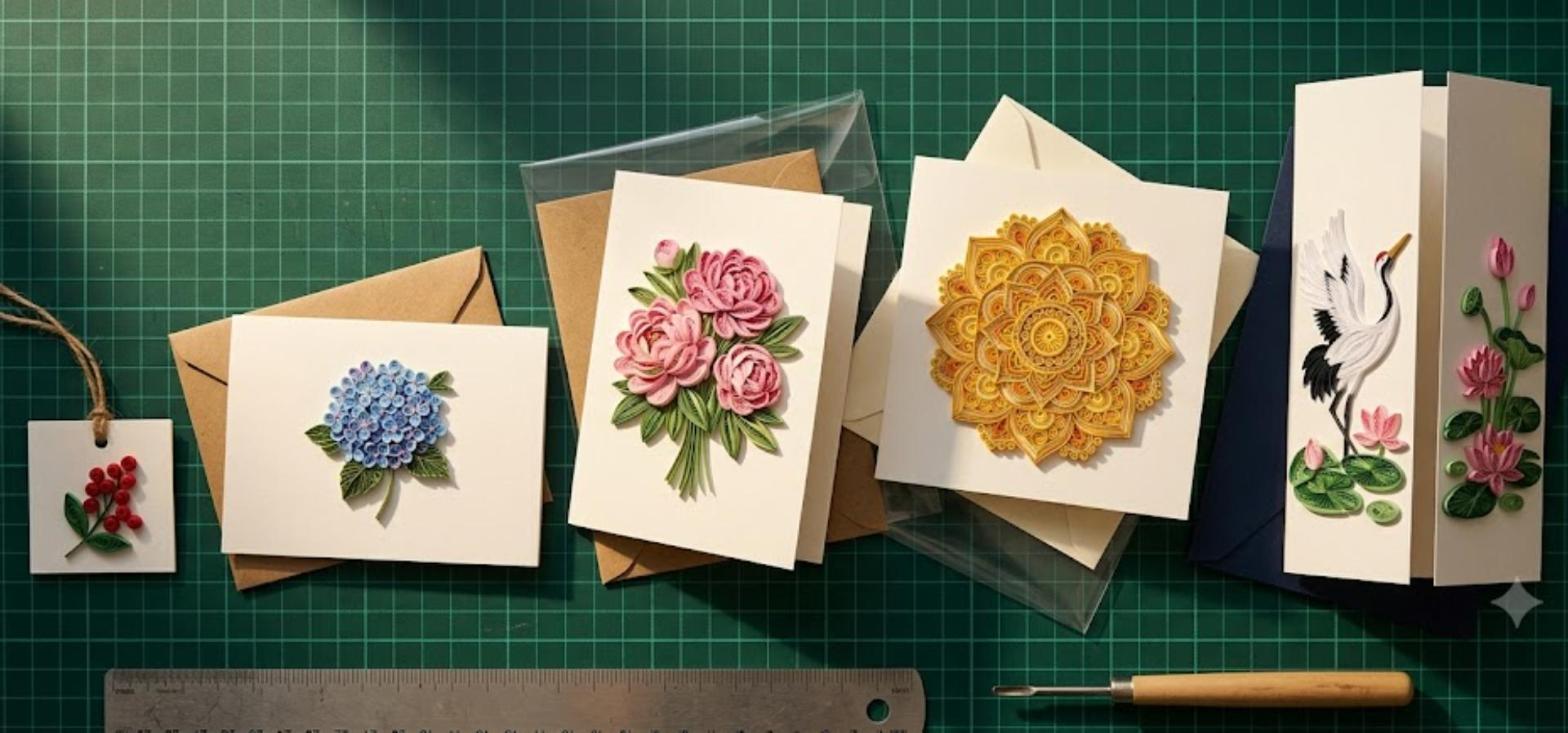
Why format is a commercial decision, not a design detail
Quilling is a raised, three dimensional craft. Every coil, tight roll and teardrop is shaped by hand and glued on edge. That means the front panel area drives labour almost directly: a design that fills a 5×7 inch front takes noticeably longer than the same motif scaled to a 4×6 postcard, and the extra time shows up in the unit price. Format also controls three costs buyers often underestimate:
- Protection cost. Raised paper work needs a clear sleeve, a backing board or a box. Larger and deeper designs need more of it.
- Freight cost. Quilling cards ship by volume, not weight. Thicker formats fill a carton faster, so cost per card in freight rises with depth, not just size.
- End customer postage. In many markets a raised card that exceeds standard letter thickness is charged as a large letter or small parcel. If your shoppers mail the card, this matters at the shelf.
The core formats and where each one sells
The table below compares the formats Vietnamese quilling workshops produce most often. Sizes are typical finished dimensions; workshops can adjust to your fixture or envelope standard.
| Format | Typical size | Relative labour | Best channel | Watch out for |
|---|---|---|---|---|
| Gift tag / mini card | 7 to 9 cm square | Low | Checkout counters, gift wrap add ons, hotel amenities | Motif must stay simple to remain legible at small size |
| Flat postcard | A6 (10.5 x 14.8 cm) or 4×6 in | Low to medium | Museum shops, souvenir retail, framing | No inside writing space; needs a rigid backer |
| Classic folded card | 5×7 in (12.7 x 17.8 cm) | Medium | Greeting card spinners, independent gift shops, online | Most competitive format; design quality must stand out |
| Square folded card | 15 x 15 cm | Medium to high | Premium stationery, wedding and celebration | Non standard envelope and, in some markets, higher postage |
| Gatefold / tall card | 10 x 21 cm (DL) or larger | High | Luxury gifting, corporate, keepsake ranges | Two decorated panels; protect the hinge in transit |
| Boxed keepsake card | Any of the above in a rigid box | High plus packaging | Department stores, corporate gifts, premium online | Box adds cost and carton volume; plan landed cost first |
Depth: the dimension buyers forget to specify
Length and width are always on the purchase order. Depth often is not, and it is the dimension that causes the most problems. A flat, low relief design may stand only a few millimetres off the card face. A layered bouquet with upright petals can stand well over a centimetre. Specify a maximum relief height on your tech pack, and agree whether the measurement includes the sleeve or backing board. This one number controls envelope choice, carton count, damage risk and postage band.
A practical approach many importers use is to set two relief classes across the range: a slim class for cards that will be mailed, and a deep class for cards sold as keepsakes or framed gifts. Designs are then developed to fit one class or the other from the start, instead of being flattened after a sample fails a postage test.
Envelopes, sleeves and inserts
The envelope is part of the product, and for quilling cards it does more work than usual. Points to define before sampling:
- Envelope size and colour. Allow a few millimetres of clearance beyond the card plus relief. Kraft, cream and white are standard; coloured envelopes add a premium feel but increase SKU count.
- Envelope paper weight. A heavier envelope gives a better hand feel and protects the raised work if the card is mailed.
- Clear sleeve. Most retail channels expect each card in a resealable clear sleeve so shoppers can see the quilling without touching it. Confirm sleeve material and any recycled content requirements for your market.
- Backing board. A card stock or grey board insert behind the card keeps it flat in the sleeve and stops the design from flexing.
- Inside insert. A blank or printed inner sheet lets shoppers write a message without marking the decorated card. Printed sentiments are a simple way to localise one design for several markets.
How to build a format mix for your range
Rather than ordering one design in one format, structure your range so each format has a job. A typical starter range for a gift wholesaler might look like this:
- Volume core: classic 5×7 folded cards in your best selling occasions (birthday, thank you, floral blank). This is where most units sit.
- Entry price point: gift tags or mini cards using simplified versions of the core motifs. These lift basket value at checkout.
- Hero tier: a small number of square or gatefold designs with richer detail, positioned at a higher shelf price and used for window and online imagery.
- Seasonal layer: Christmas, Lunar New Year, Ramadan and Eid, Diwali or wedding season designs, built on the same formats so packaging and fixtures stay consistent.
Keeping the number of formats small and the number of designs flexible makes reorders easier, reduces packaging SKUs and lets the workshop plan artisan time more accurately. Our guide on reorders and SKU rationalisation covers this in more depth.
Format and freight: think in cartons, not cards
Because quilling cards are light but bulky, freight cost per card depends on how many sleeved cards fit in an export carton. Before confirming formats, ask your supplier for a carton count per format at your agreed relief height. Two designs with the same front size can have very different carton counts if one stands twice as high. For smaller trial orders, air or express freight is common; for repeat programmes, consolidating with other goods can lower cost per unit. See our quilling card freight and Incoterms guide for the options.
Common format mistakes
- Approving a sample design before confirming the envelope, then finding the relief does not fit.
- Scaling a detailed 5×7 design down to a gift tag without simplifying it, so the motif turns into an unreadable cluster of coils.
- Choosing a square format for a channel where shoppers mail cards, without checking local postage rules.
- Ordering many formats in small quantities, which multiplies sleeve, envelope and carton SKUs and raises unit cost.
- Leaving relief height off the tech pack, so production varies from batch to batch.
Format specification checklist
- Finished card size and fold style (flat, single fold, gatefold, tall)
- Maximum relief height, and whether it includes sleeve or board
- Card base stock colour and weight
- Envelope size, colour and paper weight
- Clear sleeve type and closure
- Backing board and inside insert (blank or printed sentiment)
- Labelling and barcode position on sleeve or back
- Inner pack and master carton count per format
- Target retail channel and whether the card will be mailed
Sourcing quilling cards from Vietnam in the right format
Viet Farm Vision works directly with a handmade quilling card workshop in the Mekong Delta, producing custom handmade greeting cards for gift wholesalers, stationery brands, museum shops and corporate buyers worldwide. We help you choose formats for each channel, set relief and envelope specifications, approve golden samples, and plan cartons and freight before production starts.
To discuss a quilling card range or request format samples, contact us at info@vietfarmvision.com or request a quote.