
Retail is not the only buyer for a handmade quilling card. Hotel groups place them on pillows at turndown, destination-management companies drop them into welcome packs, banks and law firms send them to clients at year end, and wedding and event planners order them by the hundred with a couple’s monogram worked into the paper. These buyers rarely browse a catalogue. They arrive with a logo, a date and a budget per guest — and they need a supplier who can turn all three into a card that looks bespoke without behaving like a one-off art commission.
This guide is written for corporate gift buyers, hospitality procurement teams and event planners sourcing quilling cards from Vietnam. It covers how a logo is translated into paper coils, which order structures make sense at 300, 3,000 and 30,000 pieces, how to lock a delivery date to an event that cannot move, and the specification points that separate a gift that impresses from one that arrives crushed in a welcome bag.
Why corporate and hospitality buyers are a different brief
A retail card is bought by one person who chooses it. A corporate or hospitality card is chosen once by a buyer and then received by hundreds or thousands of people who never asked for it — guests, clients, delegates. That changes what matters:
- Brand accuracy over design variety. One design, executed identically across the whole run, carrying a colour and shape the brand team will check against its guidelines.
- The date is fixed. A gala dinner, a Lunar New Year client mailing or a hotel’s Eid turndown programme does not move because a shipment slipped.
- Personalisation at scale. Names, room numbers or table numbers on inserts, sometimes for every single piece.
- Presentation is part of the product. The envelope, sleeve, seal and gift box are seen before the card is — and often photographed.
Turning a logo into paper: what quills well and what does not
Quilling builds an image from rolled and shaped strips of paper, typically 3–5 mm wide, glued edge-on to a card base. That gives a raised, tactile result that print cannot match — but it also sets hard limits on what a logo can look like in paper. The first conversation with a workshop should be about simplification, not about colour matching.
| Logo element | How it translates to quilling | Recommendation |
|---|---|---|
| Bold geometric marks, monograms, simple emblems | Excellent — outlines and fills reproduce cleanly | Quill the full mark as the hero element |
| Thin serif wordmarks and small type | Poor — strips cannot hold lines finer than the strip width | Foil-stamp or print the wordmark; quill the symbol only |
| Gradients, photographic or 3D-rendered logos | Not reproducible as gradients | Agree a flat 2–4 colour interpretation with the brand team |
| Exact Pantone colours | Limited by available coloured strip stock | Approve physical strip swatches, not screen colours |
| Very small marks (under ~25 mm) | Detail collapses; coils read as noise | Scale the quilled mark up, or use it as a medallion within a larger motif |
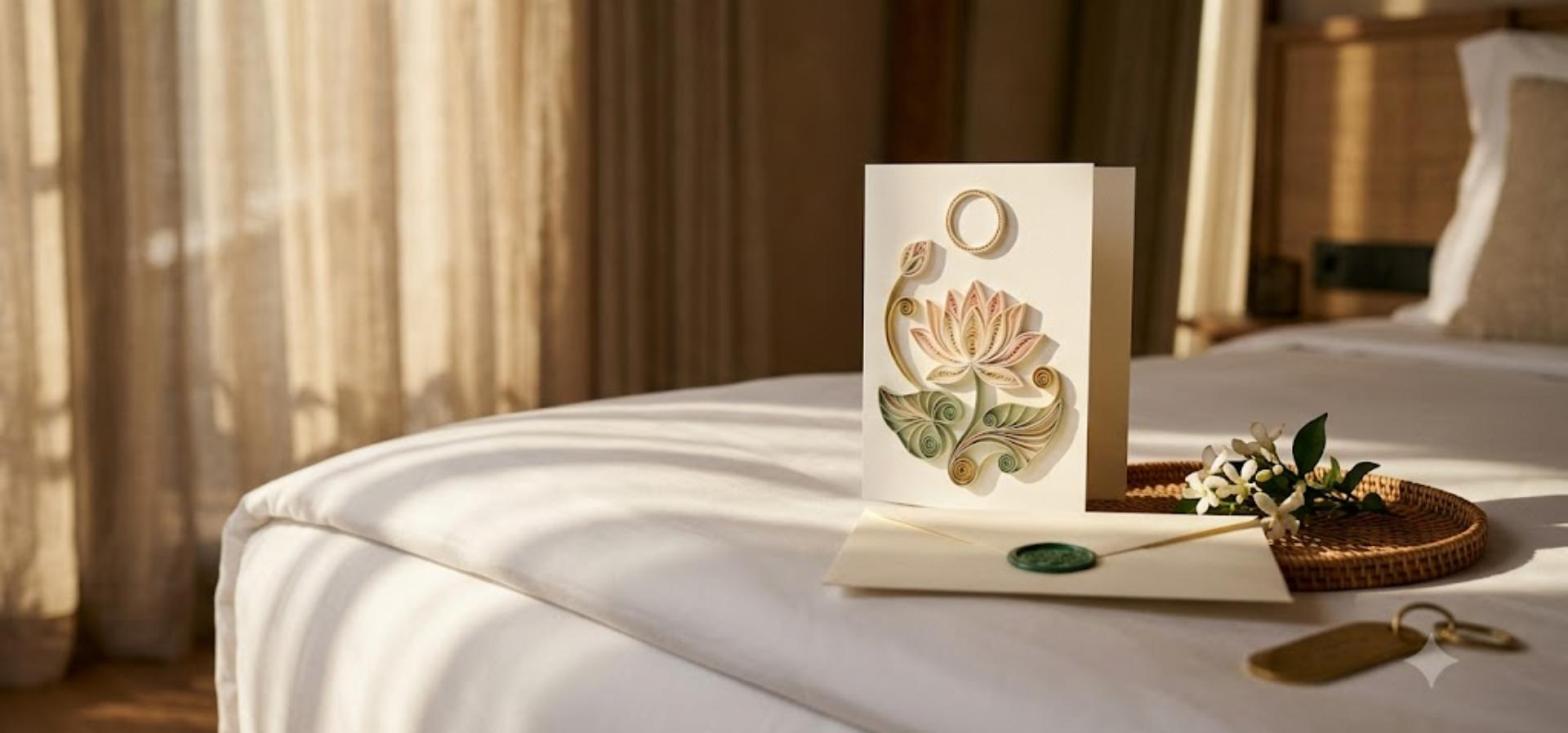
The most successful corporate quilling cards rarely quill the whole logo. They pair a quilled motif that belongs to the brand or the occasion — a lotus for a Vietnamese resort, a crescent and lantern for an Eid programme, a stylised building for a property developer — with a small quilled medallion or a foil-printed wordmark. The brand is present and accurate; the craft carries the emotion.
Before artwork development starts, settle who owns the resulting design and whether it is exclusive to your organisation. Our guide to artwork ownership, exclusivity and IP on quilling card orders covers the clauses to agree in writing.
Three order structures, three different supplier conversations
Corporate volumes vary far more than retail volumes, and the right way to structure an order changes with quantity. Treat the figures below as planning ranges; the actual lead time depends on design complexity and the workshop’s seasonal loading.
- Event run (roughly 200–1,000 pieces). Weddings, galas, board dinners. Usually one custom design plus personalised inserts. The cost of artwork development and sampling is spread over few pieces, so expect a noticeably higher unit price — or adapt an existing catalogue design with your colours and medallion to keep development cost down.
- Programme run (roughly 1,000–10,000 pieces). Client year-end mailings, hotel seasonal turndown programmes, conference welcome packs. One or two custom designs, produced in a single batch. This is the sweet spot: development cost is absorbed and the workshop can plan artisan capacity in advance.
- Rolling supply (10,000+ pieces per year). Hotel groups and gift-box companies that use a card year-round. Best structured as an annual forecast with scheduled call-off batches, so the design stays consistent and stock never runs out between seasons. See our note on repeat-order minimums and replenishment calendars.
Working back from an event date that cannot move
Every corporate quilling order should be planned backwards from the date the cards must be in hand — not from the date the purchase order is signed. A practical backwards schedule looks like this:
- In-hand date at your venue, office or fulfilment house, with a buffer of at least one week for distribution and personalisation.
- Arrival and clearance: allow for the freight mode you will actually use. Small event runs usually travel by express or air; programme runs by consolidated sea freight. Our guide to air, sea and express freight for quilling cards compares the options.
- Production window: handmade output scales with the number of trained artisans, not with machine speed. Book capacity early for the October–December peak, when retail Christmas and Lunar New Year orders compete for the same hands.
- Golden sample approval: one physical approved sample, signed off by the person who owns the brand guidelines — not just the buyer.
- Artwork and swatch approval: the simplified logo interpretation and the physical paper-strip colours.
The step that most often breaks an event timeline is step 4. Brand teams that see the quilled interpretation for the first time at golden-sample stage frequently request changes, and each round adds sample production plus courier time. Put the brand owner in the loop at artwork stage, and use the process described in our sampling and golden-sample approval guide.
Personalisation without slowing production
Personalising the quilled front for every recipient is possible for very small runs, but it multiplies handling and error risk. For most corporate and hospitality orders, keep the quilled card identical and move personalisation onto elements that can be printed digitally and matched to the card late in the process:
- A printed insert sheet or tag carrying the guest name, message or table number.
- Envelope addressing or a printed belly band around the card.
- A blank inside page left for handwritten notes from a general manager or partner — often the most valued touch of all.
If inserts are printed in Vietnam, supply the final name list as a locked spreadsheet with a sign-off date, and ask for a printed proof of the first and last ten names before the full run.
Presentation and protection for gifting use
A raised quilled design is the card’s value and its weak point. In a hotel turndown or a delegate bag it travels loose, gets pressed under other items and is handled by staff who are not thinking about paper coils. Specify presentation and protection together:
- Rigid gift box or window box for premium client gifts — highest perceived value, highest cube cost.
- Clear sleeve with a backing board for turndown and welcome packs — protects the coils at modest cost.
- Coloured envelope with a wax seal or branded sticker for mailed client cards, with a stiffener to stop the quilled front flattening in the post.
- Certified paper where your sustainability policy requires it — ask whether card base and strip stock can be supplied with FSC-certified material and what documentation will accompany it.
The packing choices also drive freight cost, because handmade cards ship by volume rather than weight. Our retail-ready packaging guide explains how sleeve and carton choices change the cube.
Occasions that drive corporate quilling demand
Corporate demand clusters around a handful of moments, and each favours different motifs. Planning designs a season ahead lets one development cost serve several programmes:
- Ramadan and Eid — crescents, lanterns and geometric patterns for hotels, banks and government entities across the Middle East.
- Lunar New Year — apricot and peach blossom, zodiac animals and red-and-gold palettes for client mailings across Asia.
- Diwali, Christmas and year-end — diyas, wreaths and neutral “season’s greetings” designs for multinational client lists.
- Corporate milestones — anniversaries, store openings and product launches, where the brand mark itself becomes the hero.
- Weddings and private events — monograms, florals and the couple’s chosen palette.
Mistakes that turn a corporate gift into a problem
- Approving the logo interpretation on screen and seeing it in paper only when the shipment arrives.
- Booking production in November for a mid-December mailing, when artisan capacity is already committed.
- Specifying a beautiful loose card for a delegate bag with no sleeve or backing board.
- Leaving the brand owner out of golden-sample sign-off and reopening the design after production starts.
- Ordering the exact head-count with no overage for damage, late additions and VIP extras — a 5–10% buffer is normal practice.
Corporate quilling card checklist
- In-hand date fixed, with production and freight planned backwards from it.
- Logo simplified for quilling, and colours approved on physical strip swatches.
- Design ownership and exclusivity agreed in writing.
- Golden sample signed off by the brand owner.
- Personalisation moved to inserts, tags or envelopes wherever possible.
- Presentation and protection specified for how the card will actually be handed out.
- Quantity includes a 5–10% overage.
For the full list of data points a workshop needs to quote accurately, see the RFQ pack for Vietnam quilling cards.
Sourcing corporate quilling cards from Vietnam
Viet Farm Vision works directly with a handmade quilling card workshop in the Mekong Delta, producing custom handmade greeting cards for hotels, corporate gift buyers, event planners and gift retailers worldwide. We help translate your logo or occasion into a quilled design, manage swatch and golden-sample approval, and plan production and freight backwards from your event date.
To discuss a corporate or hospitality quilling programme, contact us at info@vietfarmvision.com or request a quote.