
A homeware buyer in Dubai once approved a sample of acacia salad servers that looked as if they had been carved by hand. The handles had soft facets, the bowls of the spoons were slightly different from one another, and the whole set felt warm and personal. The bulk order arrived looking like a different product. Every pair was identical, the facets were gone, and the edges were crisp and even. Nothing was wrong with the quality. The factory had simply moved the item from a carver’s bench to a CNC router to hit the price and the lead time, and nobody had written the forming method into the purchase order.
How a wooden kitchen item is shaped decides far more than its look. It sets the unit price, the minimum order, the consistency from piece to piece, how fast a factory can scale, and even what the product can honestly be called on the pack. This guide explains the three forming methods used in Vietnam’s wooden kitchenware workshops, hand carving, lathe turning and CNC shaping, what each one costs, where each one fits, and how to specify it so the bulk matches the sample you fell in love with.
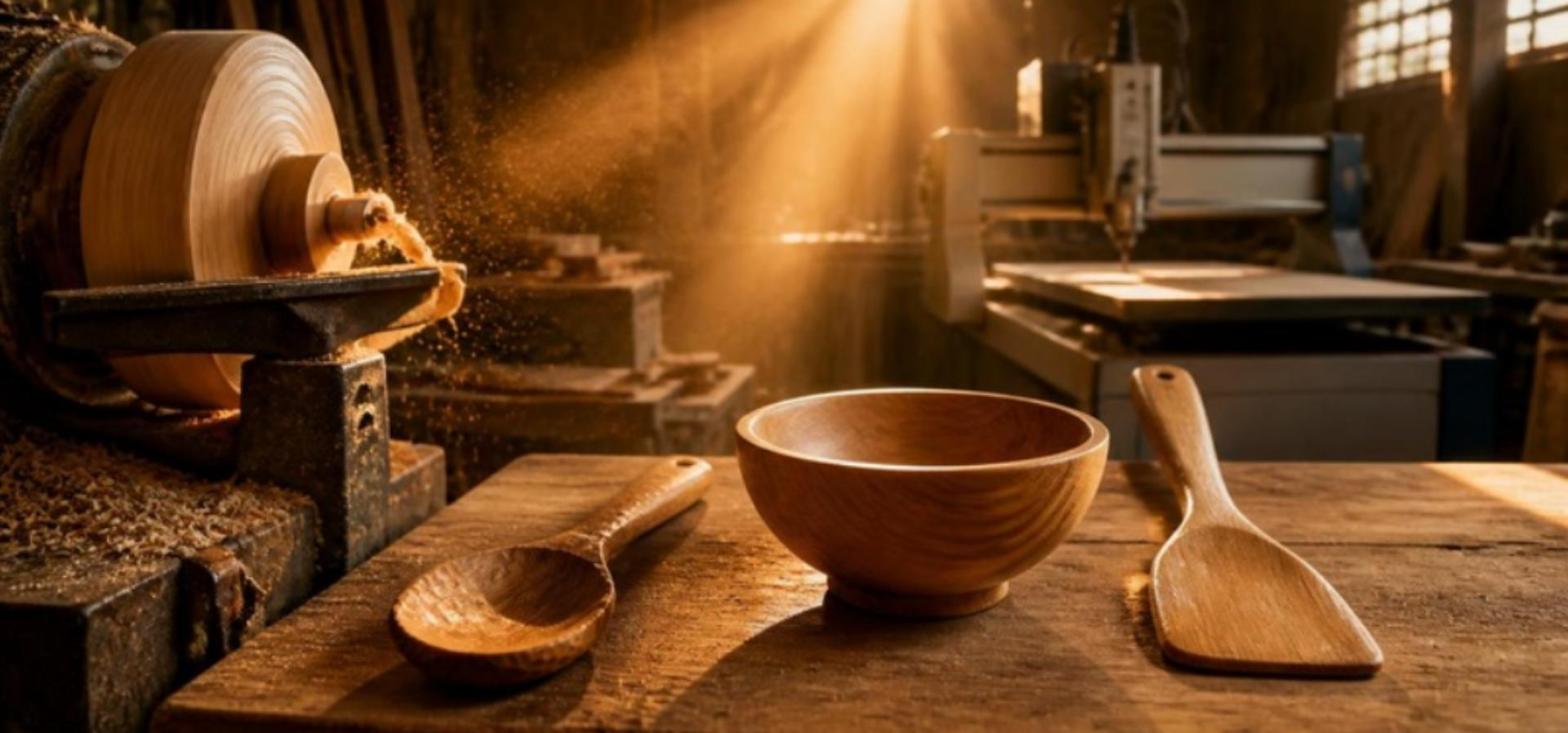
Why forming method is a commercial decision, not a craft detail
Two items in the same species, the same size and the same finish can sit at very different FOB prices because they were formed differently. Forming method drives three things a buyer cares about: labour minutes per piece, yield from each board of timber, and variation between pieces. Hand carving is high in labour and variation, lathe turning is efficient for anything round, and CNC shaping is efficient and uniform for flat profiles once the program and fixtures are paid for. Most Vietnamese factories use all three under one roof, often on the same product, and the mix they choose is the single biggest lever behind a quote.
Method one: hand carving
Hand carving starts from a rough blank cut on a band saw. A carver then shapes the bowl of the spoon, the handle and the transitions with knives, gouges and rasps, before sanding. It is the method behind spurtles, rustic spoons, scoops, small serving pieces and anything with an organic, faceted look.
- Strengths: character, a genuine handmade story, no tooling cost, very low minimums per design, and easy design changes between orders.
- Limits: the highest labour minutes per piece, natural variation of a few millimetres between pieces, and output tied to the number of skilled carvers, which tightens before Tet and during peak season.
- Best for: premium gift sets, boutique and concept stores, artisan collections, and short runs where the story matters more than uniformity.
The commercial trap with hand carving is scaling. A design that sells well at 2,000 pieces may be impossible to deliver at 20,000 pieces in the same window without either adding carvers, who each have a slightly different hand, or quietly moving part of the shaping to a machine.
Method two: lathe turning
On a lathe, the blank spins and the turner cuts it with a chisel or a profile knife. It is the natural method for anything round in section: bowls, salad bowls, pepper mill bodies, rolling pins, honey dippers, spoon handles, cups and lids. Semi-automatic copy lathes can turn the same profile again and again from a template, which is how Vietnamese factories produce handles and rolling pins at volume.
- Strengths: very good efficiency for round items, low waste on smaller blanks, a smooth continuous surface that takes oil well, and good consistency once a template is set.
- Limits: only works for round geometry, large diameter bowls need thick, well dried blanks that are scarcer and more expensive, and end grain areas on turned bowls need careful drying to avoid cracks.
- Best for: bowls and tableware programs, rolling pins, mill bodies and any handle that will be repeated across a range.
For bowls, ask whether the item is turned from one solid blank or from a glued, segmented or laminated blank. Both are legitimate. They are priced differently and they age differently, exactly as with the board constructions we explain in our guide to cutting board construction.
Method three: CNC shaping
A CNC router cuts the profile from a flat board under computer control, often several pieces at a time on one fixture. Spatulas, turners, flat spoons, slotted spoons, serving boards with handles, trays and anything with a repeating outline are typically roughed out this way, then finished by hand sanding.
- Strengths: the tightest piece to piece consistency, high hourly output, easy nesting to improve timber yield, and precise features such as hanging holes, recesses and logo pockets.
- Limits: a one off cost for programming and fixtures, flat or gently curved shapes rather than deep three dimensional bowls, and a more uniform, less personal look unless the design adds texture deliberately.
- Best for: high volume utensil sets, private label programs for retail chains, HORECA lines that need identical replacement pieces, and any SKU that will be reordered for several seasons.
The programming and fixture cost is usually modest compared with a container value, but it matters on small first orders. Ask the factory to show it as a separate line, so you know what you are paying once and what you are paying on every piece. Our breakdown of the anatomy of a wooden kitchenware FOB price shows where these one off costs usually hide.
The hybrid reality: most products use more than one method
In practice, very few items are made by one method alone. A typical Vietnamese acacia spoon is CNC roughed from a flat board, its handle edges are rounded on a spindle, and its bowl is finished by hand. A salad bowl may be lathe turned and then hand carved on the outside to give a faceted texture. A serving board may be CNC cut and then hand distressed.
This is good news for buyers, because it means you can choose where the character goes and where the efficiency goes. It is also the reason a sample and a bulk order can drift apart. If the sample was made by a senior craftsman at the bench and the bulk is run on the factory’s normal hybrid route, the result can look noticeably different.
How forming method shows up in price, MOQ and lead time
Exact numbers depend on species, size and finish, but the pattern across Vietnamese workshops is consistent:
- Labour per piece: hand carving is highest, lathe turning is moderate for round items, CNC shaping is lowest once running.
- MOQ per design: hand carving can accept a few hundred pieces, lathe turning a few hundred to a few thousand, and CNC shaping is most economical from a few thousand pieces upward because of setup.
- Consistency: CNC is tightest, lathe turning with templates is close behind, hand carving varies by design and by carver.
- Scalability: CNC and copy lathes scale by adding shifts, hand carving scales only by adding people, which takes time to train.
- Design change cost: hand carving is almost free to change, lathe turning needs a new template, CNC needs reprogramming and possibly new fixtures.
A quote that seems surprisingly low for a handmade looking item is often a CNC or hybrid route. That can be exactly the right choice. It simply needs to be a choice you made rather than one you discover at inspection.
Honest labelling: what you can call handmade
Many retailers in the Middle East, Asia and Europe now ask suppliers to support any handmade, hand carved or artisan claim on pack or on a marketplace listing. If the item is CNC roughed and hand finished, words such as hand finished or hand sanded are accurate, while hand carved may not be. Agree the wording with your supplier before artwork is approved, and keep a short process description on file. It protects your brand if a customer or a retail partner ever asks how the product was made.
Writing the forming method into the purchase order
A simple clause avoids most disputes. For each SKU, state:
- The forming route, for example CNC roughed, edges spindle rounded, bowl hand finished.
- Which features must remain visibly handmade, such as faceted handles or tool marks on the bowl.
- The acceptable variation in length, width and bowl depth, in millimetres.
- That the approved golden sample was made on the same route as bulk production, or, if not, that a pre production sample from the bulk route will be approved first.
- That any change of forming route requires written approval from the buyer.
These five lines take ten minutes to agree and remove the most common reason for a gap between sample and bulk. For the full sequence of approvals, see our guide to the production stages inside a Vietnam wooden kitchenware factory.
Matching forming method to your channel
- Supermarkets and hypermarkets: CNC or copy lathe routes for reorderable, identical sets at a sharp price.
- Department stores and lifestyle chains: hybrid routes, with machine efficiency on the body and visible hand finishing on the parts customers touch.
- Gift, concept and boutique retail: hand carved or hand faceted pieces, smaller runs, a strong origin story.
- HORECA and catering: CNC for flat utensils and boards so replacements match, lathe turning for bowls and risers.
- E-commerce sellers: hybrid routes that photograph well, with tight consistency so the item customers receive matches the listing.
How Viet Farm Vision handles forming method on wooden kitchenware orders
Viet Farm Vision works as a manufacturing network and export partner for wooden kitchenware made in Vietnam. On every utensil, bowl and board quotation we state the forming route for each SKU, the one off programming or template cost if there is one, and the tolerance the factory will hold. Golden samples are made on the bulk route, photographed from three angles, and that reference travels with the order through production and inspection.
Where a buyer wants a handmade look at a price that hand carving cannot reach, we would rather show the options openly, for example a CNC body with a hand faceted handle, than let the route change quietly between sample and bulk.
Buyers planning a wooden utensil, tableware or serveware program for 2027 are welcome to send a drawing, a current product photograph or a target retail price to info@vietfarmvision.com. We will come back with the forming route we recommend for each item, the trade offs behind it, and an indicative FOB range.