
A kitchenware importer in Riyadh once placed two orders for what his range sheet called the same product: a 40 by 28 centimetre acacia chopping board, 2.5 centimetres thick, oiled, with a juice groove. Both suppliers sent photographs that looked identical from the top. One quote came in at a little over four dollars FOB, the other at almost seven. He took the cheaper one for the first container. By the second reorder, his customer service team had a folder of photographs showing boards split along a single straight line, always in the same place, always after a few weeks of daily washing.
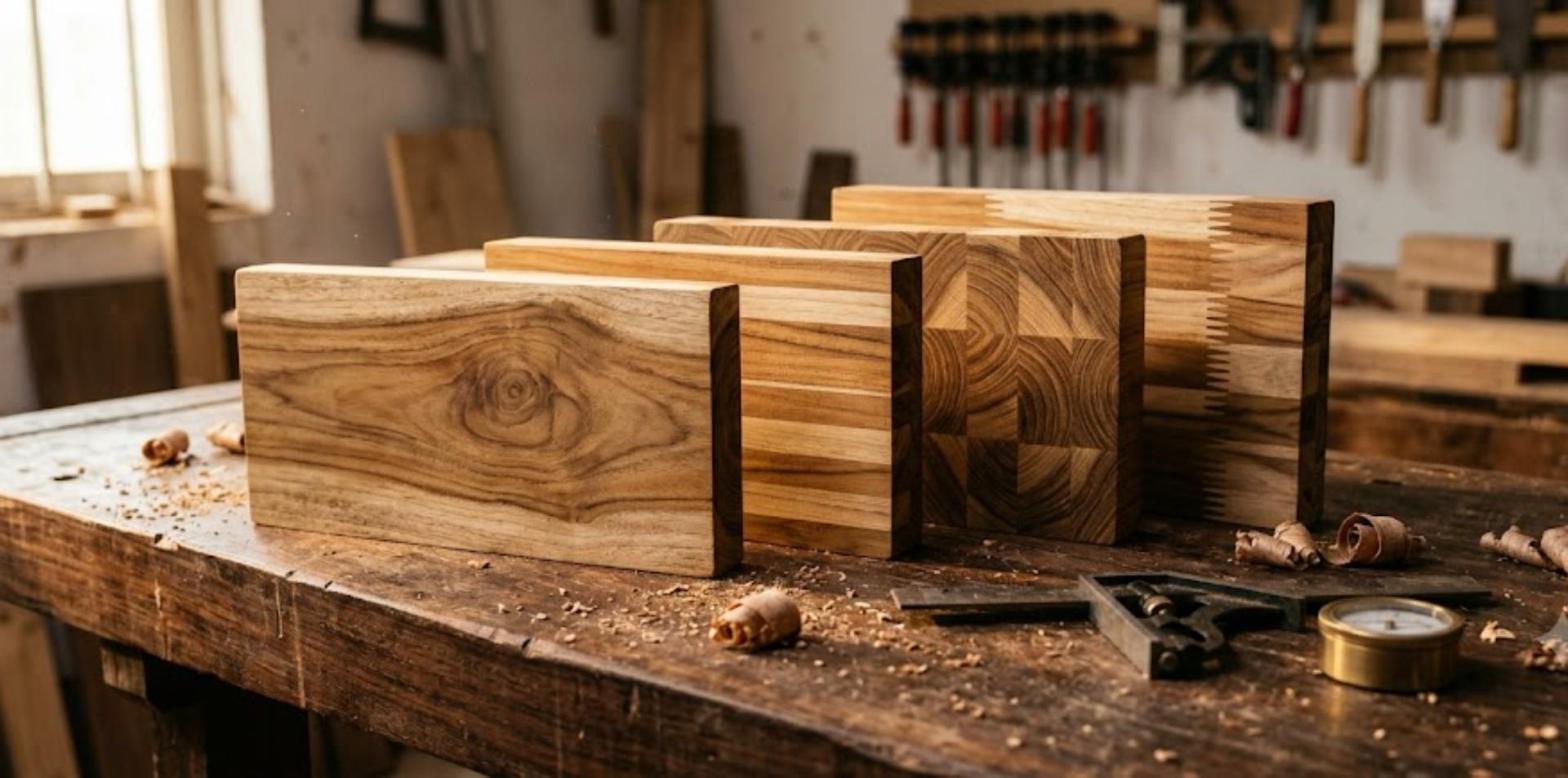
The two boards were never the same product. One was a solid slab with a grain direction the factory chose for yield rather than stability. The other was edge glued from narrow, quarter sawn strips. From above they look alike. From the end, and after six months in a real kitchen, they behave like different categories. This guide explains the four construction types Vietnamese workshops use for cutting and serving boards, what each one costs to make, how each one fails, and how to write the construction into a purchase order so that the board you approve at sample stage is the board that arrives.
Why construction matters more than species on a cutting board
Most buyers start a board program by choosing a species: acacia for its colour and density, rubberwood for its price and pale tone, occasionally teak or a mixed hardwood for a premium line. Species matters, and our note on the acacia and rubberwood raw material market covers how it moves your price. But on a flat product that is soaked, scrubbed and dried hundreds of times, the way the wood is assembled decides more about warping, splitting and returns than the species name on the specification.
A cutting board is a wide, thin panel of a material that swells and shrinks across the grain far more than along it. Every construction type is a different answer to the same problem: how to stop that movement from cupping the board, cracking it, or pulling a glue line apart. Each answer has a cost in timber yield, labour and press time, and that cost is what the gap between a four dollar quote and a seven dollar quote is usually made of.
Construction one: solid single piece
A solid board is cut from one plank. It has the most natural look, with uninterrupted figure across the whole face, and buyers in premium gifting often ask for it for exactly that reason. It is also the construction that is most sensitive to how the plank was sawn. A flat sawn plank, where the growth rings run roughly parallel to the face, moves the most across its width and tends to cup towards the side that was nearer the bark. A quarter sawn plank, with rings close to vertical, is far more stable but yields much less usable width from each log.
In acacia, which in Vietnam is mostly plantation grown and harvested at modest diameters, wide clear solid planks are scarce. That scarcity shows up in two ways. Either the solid board is expensive because the factory is paying for wide stock and rejecting a lot of it, or it is cheap because the factory is using whatever width is available, including flat sawn boards with the pith close to one edge. The second version is the one that splits along a straight line a few weeks after it reaches a consumer.
- Best suited to: serving boards, cheese and charcuterie boards, small bread boards under about 30 centimetres wide, and premium lines where the buyer accepts a higher price for the look.
- Typical risk: cupping and end checks on wider boards, especially where moisture content at shipment was not controlled.
- What to specify: maximum width for solid construction, a requirement that pith is excluded, and preferred grain orientation for anything wider than about 25 centimetres.
Construction two: edge grain, glued from strips
An edge grain board is made by ripping timber into strips, typically 3 to 6 centimetres wide, turning them so the narrow edge faces up, and gluing them side by side under pressure. This is the workhorse construction for Vietnamese cutting board exports. It uses narrower and cheaper stock, which suits plantation acacia and rubberwood, and because each strip moves a little and in alternating directions, the finished panel is considerably more stable than a solid board of the same size.
The quality of an edge grain board lives almost entirely in the glue line. A well made board uses a waterproof adhesive rated for wet interior use, typically a D3 or D4 class polyvinyl acetate or a comparable food contact suitable system, strips that have been planed square and glued within hours of machining, and enough clamping pressure and press time for full cure. A poorly made board uses the same strips with a cheaper adhesive, glues them days after machining when the surfaces have already moved, or releases the press early to turn the clamps faster. All of these look identical at the sample stage and only show up after repeated washing.
- Best suited to: everyday chopping boards, large carving boards, private label ranges where consistency across thousands of units matters more than a single piece look.
- Typical risk: glue line separation, visible as a hairline gap that opens after soaking. Colour banding between strips if timber is not sorted.
- What to specify: adhesive type and water resistance class, maximum and minimum strip width, colour sorting rule (uniform, or deliberately alternating), and a soak test on the approved sample.
Construction three: end grain
An end grain board turns the timber so that the cut ends of the fibres form the working surface, producing the familiar checkerboard or brick pattern. Knife edges slip between the fibres rather than slicing across them, so the board is kinder to blades and tends to hide cut marks. It is the construction chefs ask for by name, and the one that photographs best on a premium retail page.
It is also by far the most labour intensive. The timber is glued into an edge grain panel, crosscut into strips, the strips are turned ninety degrees and glued again, and the resulting block is planed and sanded on a surface that absorbs abrasive quickly. There are two full glue cycles instead of one, more waste at each crosscut, and much longer sanding. End grain also takes up water readily through the open fibre ends, so it needs thorough oiling at the factory and clear care instructions for the end user, otherwise it can crack at the glue lines between blocks.
- Best suited to: premium butcher blocks and chef boards, usually at least 3.5 to 4 centimetres thick, sold with care guidance and often with feet or a recessed grip.
- Typical risk: cracking between blocks if the board is thin, dried too fast or shipped before oil has penetrated. Higher unit cost that the retail price must carry.
- What to specify: minimum thickness, block size, adhesive type, number of oil coats and dwell time before packing, and a target moisture range at loading.
Construction four: finger jointed
Finger jointing joins short pieces end to end with interlocking zig zag profiles, producing long strips out of offcuts that would otherwise be waste. Those strips are then edge glued into a panel. For a factory, it is a way to raise timber yield sharply. For a buyer, it can bring a large board down to a price point that solid or long strip construction cannot reach.
Finger jointing is not a defect in itself. Plenty of good quality kitchen worktops are built this way. What matters is whether the buyer knows it is there and whether the retail positioning allows it. The joints are visible on the face as small zig zag lines, and in a market where the product is sold on natural beauty, consumers can read them as a sign of a lower grade product. Joints also add glue lines in the direction where a board is weakest, so adhesive quality and joint precision matter even more than in plain edge grain.
- Best suited to: value ranges, large prep boards, utility and food service boards where price and size matter more than appearance.
- Typical risk: visible joints read as cheap by consumers, and joint failures if the profile is cut loosely or glued with a low grade adhesive.
- What to specify: whether finger joints are permitted at all, whether they are permitted on the face or only on the underside, and minimum length of each piece between joints.
The cost ladder, and why a cheaper quote is often a different board
Holding size, species and finish constant, the construction ladder for a typical acacia chopping board runs roughly in this order from lowest to highest cost: finger jointed edge grain, plain edge grain, solid, and end grain. The exact gaps depend on the factory, the size and current timber prices, but the direction is consistent, and end grain commonly sits at a clear premium over edge grain of the same footprint because of the second glue cycle, the extra waste and the sanding time. A solid board can swing either side of edge grain depending on whether the factory is buying genuinely wide clear stock or simply using what it has.
That is why two quotes on a vague specification are so often not comparable. If the RFQ says only “acacia cutting board, 40 by 28 by 2.5 centimetres, oiled”, one factory may quote long strip edge grain, another may quote finger jointed strips, a third may quote a solid flat sawn slab. All three are honest answers to an incomplete question. For a fuller picture of what sits behind each line of a quotation, see our breakdown of what goes into a wooden kitchenware FOB price.
How each construction fails, and what that means for returns
Returns on wooden boards rarely come from the face looking wrong on arrival. They come from what happens in the first three months of use. Each construction has a characteristic failure, and knowing it tells you where to put inspection effort.
- Solid boards: cupping and splits running with the grain, usually starting at the ends. Most often linked to flat sawn stock, included pith, or moisture content that was too high at shipment.
- Edge grain boards: a glue line that opens into a fine straight gap after soaking. Linked to adhesive grade, delayed gluing after machining, or short press time.
- End grain boards: cracks between blocks and surface checking on thin boards. Linked to insufficient thickness, fast drying, and too little oil before packing.
- Finger jointed boards: separation at an individual joint or consumer complaints about appearance. Linked to loose joint profiles and to a mismatch between construction and retail positioning.
Moisture content links all four. A board that leaves Vietnam at a moisture content well above the equilibrium level of the destination market will shrink once it arrives in a dry, air conditioned Gulf home or a centrally heated European kitchen, and that shrinkage loads every glue line and every grain weakness at once. Our guide to moisture content and food safe finishes explains the target ranges and how to verify them before loading.
Simple tests that tell you which board you are really buying
None of this requires a laboratory. A buyer or an inspector can check construction and the most common weaknesses with a handful of tests on the approved sample and again on a random draw from production.
- Look at the end. The end face of a board shows its construction honestly: one continuous ring pattern for solid, a row of strips for edge grain, a checkerboard for end grain. Photograph it at sample approval and use that photograph as the reference at inspection.
- Check grain orientation on solid boards. Rings running close to vertical on the end face indicate quarter sawn, more stable stock. Rings curving across the width, especially around a dark centre spot, suggest flat sawn stock with pith nearby.
- Run a soak and dry test. Immerse a sample for a few hours, then leave it to dry at room temperature for two days. Look for glue lines that open, cupping that does not recover, and joints that lift.
- Measure moisture content. A pin type meter on several points of several boards from each lot, checked against the agreed range, tells you more about future returns than any visual check.
- Check flatness on a known flat surface. Rocking corners on arrival usually mean the board will keep moving.
These checks belong in the inspection protocol alongside the usual visual criteria. Our guide to pre shipment inspection and defect classification shows how to fit them into an AQL plan without adding days to the inspection.
Writing construction into the purchase order
The single most effective change a buyer can make is to stop describing a board only by size, species and finish. Construction should be its own line in the specification, with enough detail that two factories reading it would quote the same product. A workable construction clause covers the following points.
- Construction type: solid, edge grain, end grain, or a defined combination such as an end grain centre with edge grain borders.
- Finger joints: not permitted, permitted on the underside only, or permitted, with a minimum piece length.
- Strip or block dimensions: minimum and maximum width for edge grain, block size for end grain.
- Grain and stock rules: pith excluded, preferred grain orientation for solid boards over a stated width.
- Adhesive: type and water resistance class, with a food contact declaration from the adhesive supplier.
- Moisture content: target range at loading and the measurement method.
- Finish: oil type, number of coats, and minimum dwell time before packing.
- Reference: an end face photograph of the approved golden sample, signed and dated, attached to the purchase order.
Clause eight is the one that settles most disputes. When a split board comes back from a customer, the first question is always whether it was made the way it was approved. An end face photograph answers that in seconds.
Matching construction to your channel
There is no single correct construction. A food service distributor in the Gulf buying large prep boards by the pallet is well served by good quality edge grain, possibly finger jointed on the underside, priced to be replaced. A department store gift range in Europe or Japan may justify solid serving boards with selected figure. An online chef focused brand building reviews over years will often find that end grain earns its premium, provided thickness and finishing are specified properly. The mistake is not choosing a cheaper construction. The mistake is choosing it by accident, through a specification that left the factory to decide.
How Viet Farm Vision handles board construction on wooden kitchenware orders
Viet Farm Vision works as a manufacturing network and export partner for wooden kitchenware made in Vietnam, so construction is agreed at the quotation stage rather than discovered at inspection. For board programs, each quote states the construction type, the strip or block dimensions, whether finger joints are used and where, the adhesive class and the target moisture range at loading. Approved samples are photographed on the end face and that photograph travels with the order through production and inspection.
Where a buyer has a target retail price that a given construction cannot meet, we would rather show the trade off openly, for example edge grain with a selected face strip instead of solid, or a thicker edge grain board instead of a thin end grain one, than quote a lower price on a board that will come back. For buyers developing a new range from a sketch, our guide to design for manufacturing on wooden kitchenware covers the earlier decisions.
Buyers planning a cutting board or serving board program for 2027 are welcome to send a drawing, a current specification, or simply a photograph of the end face of a board they are already selling, to info@vietfarmvision.com. A first response with a construction recommendation and indicative pricing for each option usually follows within two working days.