
If you want to import quilling cards into Australia, the short answer is this: handmade greeting cards from Vietnam are cleared like any other commercial consignment, with a formal import declaration once the goods are worth more than A$1,000, 10% GST on the landed value, and a possible duty saving if your paperwork proves Vietnamese origin under one of the free trade agreements both countries belong to. The hard part is usually timing, not paperwork.
This guide is for Australian gift shops, newsagencies, stationery stores, gallery shops and online sellers planning a first or private label range.
Why import quilling cards into Australia from Vietnam?
Shoppers increasingly reach for cards that look and feel made by hand. In quilling, each design is built from narrow strips of paper that are rolled, pinched and glued into flowers, leaves and figures, so the card has real texture and depth while still sliding into a standard envelope. If you are new to the craft, our guide to quilling techniques explained for card buyers shows what separates a tight, clean coil from a rushed one.
Vietnam suits this product: the work is skilled handwork, the shipping lane to Australia is short compared with Europe or North America, and both countries share trade agreements that can remove duty when origin is documented correctly.
What duty and GST apply when you import quilling cards into Australia?
Greeting cards generally sit under customs heading 4909 (printed or illustrated postcards and cards bearing personal greetings or messages). Your customs broker will confirm the exact classification for your design and finish, and that confirmation is worth having in writing before the first shipment.
Three cost layers matter:
- Customs duty. Australia’s general rate on most manufactured goods is 5%, but most Vietnamese goods enter at 0% under the ASEAN-Australia-New Zealand Free Trade Agreement (AANZFTA), which was upgraded in 2025. Vietnam is also covered by the CPTPP and RCEP, and the best rate depends on your tariff line, so check it with your broker (Cosmo Sourcing overview of Vietnam to Australia trade rules).
- GST. Most imports attract 10% GST, calculated on the customs value plus duty, international freight and insurance, not on the invoice alone (business.gov.au: importing and your business).
- Clearance costs. Above A$1,000, import processing charges, broker fees and local delivery apply, and on a small first order they can exceed the duty itself.
The A$1,000 threshold
Most goods worth up to A$1,000 can enter without a formal import declaration, while consignments above that value need one, lodged by you or, far more commonly, by a licensed customs broker (business.gov.au). A sample parcel usually falls below the line; a wholesale order will not, so book a broker before the first real shipment.
Which export documents should your Vietnam supplier send?
Your broker needs a clean, consistent set of documents. Viet Farm Vision prepares the full export set for every order:
- Commercial invoice showing seller, buyer, a plain description such as “handmade paper quilling greeting cards with envelopes”, quantity, unit value, total value and Incoterm.
- Packing list showing cartons, card counts per carton, net and gross weights and carton dimensions, matching the invoice line by line.
- Certificate of Origin (CO) confirming the goods were made in Vietnam. Tell us at the quote stage which agreement your broker intends to use, because the form of the CO has to match the agreement you claim under.
- Transport document: the air waybill or bill of lading, issued by the forwarder.
The most common delay we see is not a missing document but a mismatch, for example a carton count on the packing list that differs from the bill of lading. That is one reason our final inspection step includes counting cartons and sending photos and video before handover.
How strict is Australian biosecurity for paper card shipments?
Paper cards themselves are a low-risk product, but Australia is strict about anything that can carry pests, and the usual trap for a card shipment is the pallet, not the card. Solid wood packaging must meet ISPM 15: approved treatment by a certified provider and the IPPC stamp on the timber. Non-compliant or infested packaging is treated, re-exported or destroyed at the importer’s expense (Department of Agriculture, Fisheries and Forestry: ISPM 15).
Keep it simple: ISPM 15 stamped or non-wood pallets, clean cartons, and no dried flowers, seeds or bark inside the card unless your broker has confirmed the conditions. A design made entirely from paper strips avoids the question.
When should Australian buyers order for each card season?
This is where Australia differs most from the US and UK. Father’s Day falls on the first Sunday in September, not in June (Finder: when is Father’s Day in Australia), Mother’s Day is the second Sunday in May, and Christmas lands in high summer, so your designs and your order dates both need adjusting. The table works backwards from the in-store date.
| Occasion (2027) | Date | Cards on shelf | Approve samples by | Design notes for Australia |
|---|---|---|---|---|
| Valentine’s Day | 14 February | Mid January | Early November 2026 | Red roses and hearts, summer-bright palettes |
| Mother’s Day | 9 May | Early April | Mid January | Native blooms, soft florals, garden themes |
| Father’s Day | 5 September | Early August | Late April | Birds, bikes, fishing, outdoor motifs |
| Christmas | 25 December | Early October | Late June | Summer Christmas: native flora, beach and bush scenes |
| Weddings, birthdays, thank you | Year round | Continuous | Any time, reorder in batches | Core everyday range that carries the shelf |
If Valentine’s Day 2027 is on your plan and samples are not yet approved, air freight is likely the only realistic route. For Mother’s Day and later, sea freight is usually workable if you start now. Our comparison of air, sea and express freight for quilling cards explains how volumetric weight changes the maths.
Which quilling card designs sell in Australia?
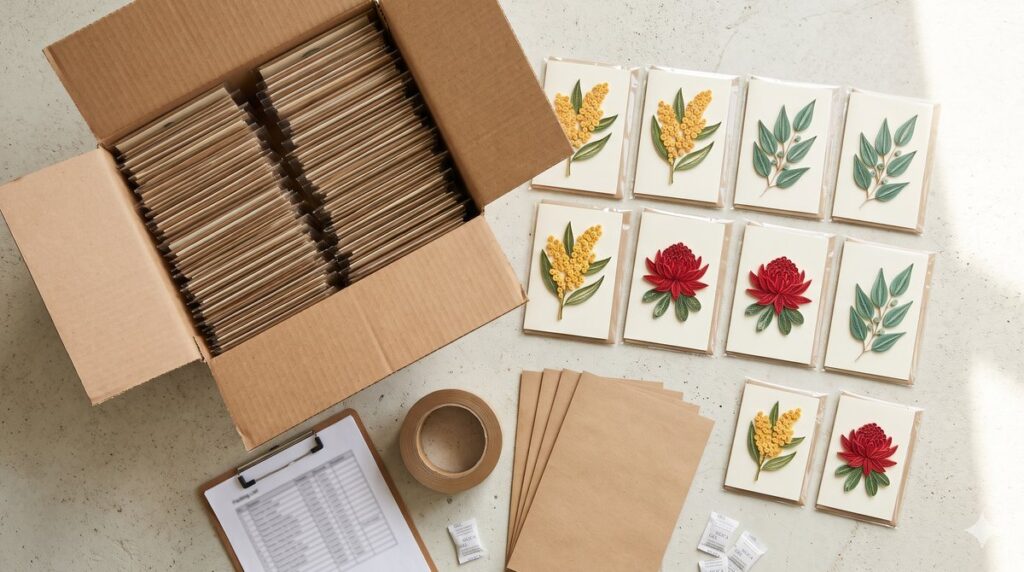
Designs built around local flora give an imported handmade card a local voice. Golden wattle, red waratah, bottlebrush, banksia and eucalyptus leaves translate well into quilling, because coiled paper can mimic their round clusters and long, curved leaves. We take custom designs from your own artwork or reference images and can add your logo or brand mark to the card back or packaging, so a gallery shop or regional gift brand can sell a range that is clearly its own. Private label sleeves, backing cards and header cards are available too.
Step by step: your first order of quilling cards for Australia
- Send a brief. Occasions, number of designs, card size, envelope colour, packaging, target in-store date and port or city of delivery. Our RFQ pack guide lists the details that get you a firm quote first time.
- Approve samples. Nothing goes into production until you have signed off physical samples. This is step one of our four-step quality process.
- Line up your broker. Confirm the tariff classification, the FTA you will claim under and the CO format your broker wants, and pass that to us before production finishes.
- Production with mid-run check. Cards are handmade at our partner workshop, mainly by local women who live near the workshop, and we check work in progress at the workshop during the run.
- Final inspection and carton count. Every card is checked before packing, cartons are counted, and you receive photos and video before the goods leave.
- Documents and freight. Commercial invoice, packing list and CO are issued, the forwarder issues the transport document, and your broker lodges the import declaration.
- Receive, check, reorder. Check the cartons on arrival, track sell-through by design, and plan the next season’s reorder early.
How to protect handmade cards on the long sea route
Quilled designs stand slightly proud of the card, so packing matters more than with flat printed cards. Ask for each card to be sleeved individually, packed upright or flat in snug inner boxes so they cannot shift, with dividers between layers and moisture absorbers in the carton for sea freight. Cartons should be strong enough to stack without crushing the top layer. If you plan to sell from spinner racks or counter displays, decide on barcodes and sleeve format before production; our guide to retail-ready quilling cards covers this in detail.
What affects price and lead time?
We do not publish a fixed price list, because the honest answer depends on the order. The main drivers are the number of coils and colours per design, card size and fold, how many different designs share one order, custom packaging and logo work, and how much time is left before your ship date. Fewer designs in deeper quantities, and a realistic deadline, usually cost less. Selling in the UK too? See how to import quilling cards into the UK.
Frequently Asked Questions
Do I need a customs broker to import quilling cards into Australia?
Not legally, but in practice most businesses use one. Once a consignment is worth more than A$1,000 it needs a formal import declaration, and a licensed broker will classify the cards, calculate duty and GST and lodge the declaration for you.
Will I pay duty on handmade cards from Vietnam?
Possibly not. Most Vietnamese goods enter Australia duty free under AANZFTA when origin is proven, while the general rate on most manufactured goods is 5%. Confirm the rate for your tariff line with your broker and make sure we issue the Certificate of Origin in the format your claim needs. GST at 10% applies either way.
Can you make Australian native flower designs?
Yes. We work from your own artwork, photos or mood boards, and native flora such as wattle, waratah, bottlebrush and eucalyptus suits the quilling technique well. You approve a physical sample before any production starts.
Can the cards carry my own brand?
Yes. We can print or attach your logo and supply private label packaging, such as branded sleeves or header cards, so the range sells under your name. Send your brand files with your brief so they can be included in the sample.
How early should I order for Christmas in Australia?
Christmas cards are usually on Australian shelves by early October, so aim to approve samples around late June and ship by sea in time to clear customs in September.
Ready to plan your Australian quilling card range?
Browse our handmade greeting cards to see the style and finish, then send your designs, quantities and target in-store date through our Request a Quote page. We reply within one business day with questions, a sampling plan and a quotation, so you can lock in your Mother’s Day and Father’s Day 2027 ranges while there is still time to ship by sea.