
Vietnamese paper crafts grew out of village workshops that have made bark paper, woodblock prints and festival decorations for centuries, and that patient, hand-led way of working is the same skill set behind today’s handmade quilling cards. For a buyer, knowing this heritage gives you a true story to tell shoppers about where a card comes from and why it looks and feels the way it does.
What are the main traditional Vietnamese paper crafts?
Three traditions come up again and again when you look at Vietnam’s paper heritage: dó paper making, Đông Hồ woodblock prints from Bắc Ninh, and the Hàng Trống and Kim Hoàng folk painting styles of the Hanoi area. They are linked. Dó paper was the surface the painters worked on, and the painting villages were the main customers of the paper villages.
| Craft | Where it comes from | What makes it distinctive | Story angle for a card buyer |
|---|---|---|---|
| Dó paper | Paper villages such as Dương Ổ (Bắc Ninh) and the old Yên Thái guild in Hanoi | Hand-formed sheets made from the inner bark of the dó tree, known for being thin yet long-lasting | Vietnam’s long relationship with paper as a craft material, not just a commodity |
| Đông Hồ woodblock prints | Đông Hồ village, Bắc Ninh province | Carved wooden blocks, natural pigments and paper coated with powdered scallop shell; tied to Lunar New Year | Hand-pressed images made for festivals and gifting, the ancestor of the greeting card idea |
| Kim Hoàng painting | Kim Hoàng village, Hoài Đức, Hanoi | Orange-red paper with light, fine strokes showing rural life and folk tales | A craft that nearly vanished and was revived by a community effort |
| Hàng Trống painting | Hàng Trống street, old Hanoi | Woodblock outline finished by hand-painting, on dó paper | The mix of a repeatable base and individual handwork, much like a production run of handmade cards |
Dó paper: the material behind Vietnam’s paper heritage
Dó paper is made from the inner bark of the dó tree (Rhamnoneuron balansae). According to the Wikipedia entry on dó paper, the bark is soaked in limewater, boiled, scraped and beaten into pulp, then lifted sheet by sheet on a bamboo screen and dried against porous walls. Artisans describe the work as dozens of separate steps, many of them family know-how.
VietNamNet reports that dó paper was used for centuries for folk paintings, books and calligraphy, and lists paper villages in Bắc Ninh, Thanh Hóa, Hòa Bình and Hanoi. The same report notes the craft is now struggling, because the paper is no longer used for everyday writing and needs new markets such as decorative art and export products.
The lesson for card buyers is simple. In Vietnam, paper has long been treated as something worth crafting carefully by hand. Quilling cards are a modern technique, not a direct descendant of dó paper, but they draw on the same culture of patient handwork.
Đông Hồ prints: Vietnam’s festive paper gift tradition
Đông Hồ woodblock printing is probably the best-known Vietnamese paper craft. On 9 December 2025, UNESCO added the craft to its List of Intangible Cultural Heritage in Need of Urgent Safeguarding. UNESCO describes prints made with carved family woodblocks, natural pigments and special paper coated with scallop powder, showing themes of worship, history, daily life and landscapes.
Việt Nam News traces the craft back about 500 years and links it closely to the Lunar New Year, when the prints were hung at home and on ancestral altars. Only a handful of families still practise it. In other words, Đông Hồ prints were festive paper pictures people bought to mark a special day and to wish each other well, which is close to what a greeting card does today.
Kim Hoàng and Hàng Trống: revival and hand-finishing
Kim Hoàng painting, from a village on the western edge of Hanoi, was popular in the 18th century and is known for orange-red paper with light, fine strokes. Nhân Dân reports that many of its woodblocks were lost in a 1915 flood and the craft effectively disappeared after 1945, until a revival project began in 2015 and new works were shown publicly in 2016.
Hàng Trống painting, from Hanoi’s old quarter, combined a woodblock outline with colour added by hand. This is a handy way to explain handmade production to shoppers: every card in a run follows the same approved design, yet each one is shaped by hand, so small natural variations are part of the product.
How does this heritage connect to quilling cards made in Vietnam?
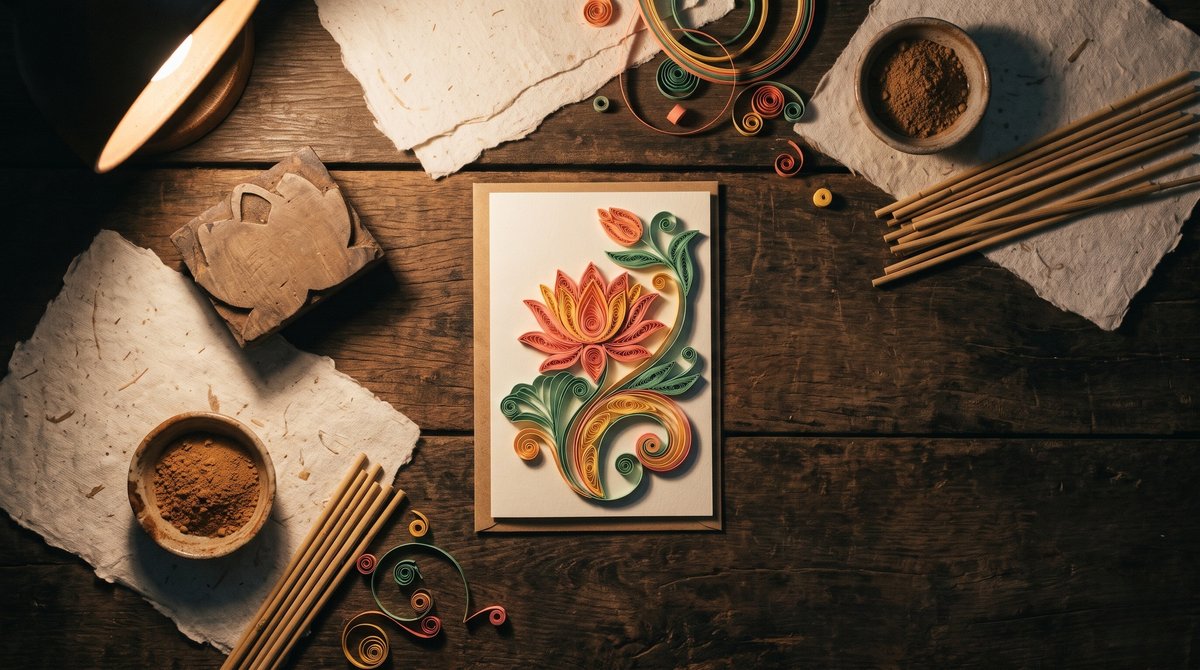
Quilling itself is not a Vietnamese invention. Its roots are usually traced to Europe, as we explain in our article on the history of quilling. What Vietnam brings is a living culture of paper handwork and a skilled workforce. The handmade quilling cards we supply are made at a partner workshop by craftspeople who are mainly local women living near the workshop. Each paper strip is rolled, pinched and glued by hand, as shown in our step-by-step guide to how quilling cards are made.
How can retailers use Vietnamese paper craft heritage in their story?
- Shelf card or swing tag: one or two lines on “handmade in Vietnam, where paper craft has a centuries-old history” gives shoppers a reason to pick up the card.
- Lunar New Year display: link your Tết or Lunar New Year range to the Đông Hồ tradition of festive paper pictures, using a short sign that cites UNESCO.
- Museum and gallery shops: pair quilling cards with an exhibition on Asian crafts, printmaking or paper art.
- Private label packaging: a back-of-pack story panel can carry the heritage message under your own brand.
Frequently Asked Questions
Is quilling a traditional Vietnamese paper craft?
No. Quilling is usually traced to European traditions. Vietnam’s own historic paper crafts include dó paper making and Đông Hồ, Hàng Trống and Kim Hoàng folk paintings. Quilling cards made in Vietnam draw on the country’s culture of skilled handwork rather than on one specific historic craft.
What is Đông Hồ painting?
Đông Hồ painting is a woodblock printing craft from Bắc Ninh province, traditionally linked to the Lunar New Year. The prints use carved wooden blocks, natural pigments and paper coated with scallop powder. UNESCO added the craft to its urgent safeguarding list in December 2025.
Can I mention Vietnamese heritage on private label card packaging?
Yes, as long as the claim is accurate. “Handmade in Vietnam” with a short note on the country’s paper-craft history is fair. Avoid suggesting the card is made with a specific traditional paper or technique unless it really is. We can print your story panel and logo on private label packaging.
Can I order quilling cards with Vietnamese-inspired designs?
Yes. We take custom designs based on your own artwork or brief, such as lotus flowers or Lunar New Year motifs. Every design goes through sample approval before production, and finished cartons are photographed and filmed for you before shipping.
Bring a handmade story to your card range
If you want quilling cards with a real handmade story behind them, tell us about your market, designs and packaging needs. Send your brief through our Request a Quote page and we will reply within 1 business day.