
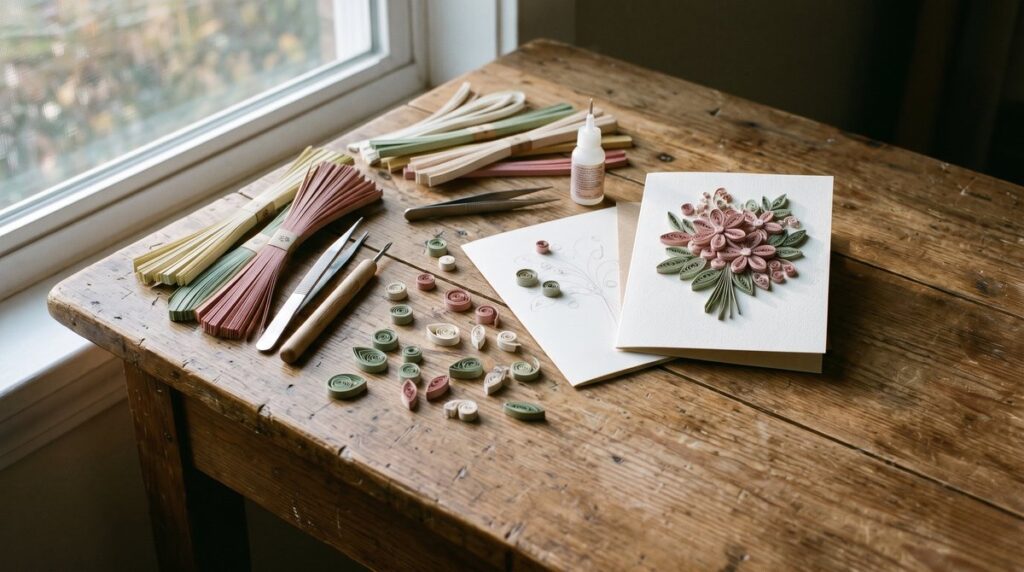
How quilling cards are made, in one sentence: narrow strips of coloured paper are rolled into coils, pinched into shapes such as teardrops and leaves, and glued edge-on to a card front, piece by piece, following an approved design. Every element is formed by hand, which is why a quilled card has real depth and why no two cards are perfectly identical.
For a wholesale buyer, knowing the process is more than background reading. Each stage is a point where colour, layout, sturdiness and consistency are decided, so it is also a point where you can ask the right questions before you place an order. This guide walks through the workshop process from brief to carton, and shows what to check at each step.
What is a quilling card, and why does the process matter to buyers?
Quilling, also called paper filigree, is the craft of rolling thin strips of paper into shapes and assembling them into a design. The Victoria and Albert Museum describes it as rolling thin strips of paper into various shapes that together form a design, a technique used in Europe since at least the medieval period to imitate metal filigree. Historic Deerfield explains the same basic method used today: slip the end of a strip into a slotted tool, spin it into a coil, release it, glue the end and squeeze it into shape.
A quilling card applies that method to a greeting card. The difference from a printed card is that the image is built, not printed. That has three practical consequences for a retailer: the design stands proud of the card face, each card takes skilled hand time, and small variations between cards are normal. Understanding how the card is built helps you set fair expectations for samples, lead times and retail presentation.
How quilling cards are made: the workshop process step by step
The sequence below reflects how handmade quilling cards are produced at our partner workshop in Vietnam, where the cards are made by skilled artisans, mostly local women who live near the workshop. Exact timings depend on the design, so treat this as a map of the stages rather than a schedule.
| Stage | What happens | What the buyer approves or checks |
|---|---|---|
| 1. Design brief | Choose a catalogue design or send your own artwork, colours, card size and any logo or text | Final artwork, colour references, card format |
| 2. Pattern and colour plan | The design is broken down into individual quilled elements and a colour list | Colour plan and element count, if the design is complex |
| 3. Strip preparation | Coloured paper is cut into narrow strips in the widths the design needs | Usually nothing; this is internal preparation |
| 4. Rolling coils | Each strip is wound on a slotted quilling tool into a coil, then released and glued closed | Coil tightness and evenness on the sample |
| 5. Shaping | Coils are pinched into teardrops, leaves, petals, scrolls and other shapes | Shape accuracy against the approved design |
| 6. Assembly | Shapes are glued edge-on to the card front following a template | Layout, spacing, height of the raised design |
| 7. Finishing | Card base, inside message, logo printing, envelope and retail sleeve are added | Logo placement, text, private label packaging |
| 8. Inspection and packing | Cards are checked one by one, sleeved, packed and counted into cartons | Inspection photos and video before shipment |
Stage 1 and 2: from design brief to a buildable pattern
Every order starts with a design. You can select from existing designs or commission a custom quilling card from your own artwork. A flat illustration does not automatically translate into quilling, so the artwork is broken down into elements that can actually be rolled and shaped: a rose becomes a set of curled petals, a bee becomes a few tight coils and two teardrop wings. This is where fine detail sometimes needs to be simplified. If your design relies on very thin lines or tiny lettering, expect suggestions to adapt it.
Stage 3 and 4: preparing strips and rolling coils
Strips are cut to the widths the design calls for, then rolled one at a time. The artisan winds the strip around a slotted tool, lets the coil relax to the size required, and glues the loose end. Tight coils stay small and dense for flower centres; loose coils open up and are later shaped into petals and leaves. Our guide to quilling techniques explains the main coil types and why they matter for durability.
Stage 5: shaping coils into petals, leaves and figures
A loose coil can be pinched on one side to make a teardrop, on two sides to make a leaf or eye shape, or pressed into squares, triangles and crescents. Scrolls and open curls add movement to stems and borders. Consistency at this stage is what makes a run of cards look like one product: petals of similar size, leaves pinched at a similar angle, colours used in the same positions.
Stage 6: assembling the design on the card
The shaped pieces are glued on their edges to the card front, following a template so each card matches the approved layout. This edge-on construction is what gives quilling its raised, sculptural look. It is also why glue placement matters: a well-built card has elements fixed securely enough to survive handling, sleeving and shipping, without visible glue marks around them.
Stage 7: finishing, branding and private label
Once the design has set, the card is finished. This can include a printed inside message, your logo printed or attached on the back, a matching envelope and a retail sleeve. For brands and retailers who sell under their own name, private label packaging is added at this stage. Decide these details at the brief, not after sampling, because they affect materials and packing.
How is quality controlled when every card is handmade?
Handmade does not have to mean unpredictable. We work to a four-step inspection process:
- Pre-production sample approval. Nothing goes into production until you approve a physical sample or detailed photos of it.
- Mid-production check at the workshop. Cards are compared against the approved sample while the run is under way, so issues are corrected early.
- Card-by-card inspection before packing. Each card is checked for loose elements, glue marks, colour mistakes and damage.
- Carton count with photos and video. Cartons are counted and you receive photos and video before the goods are shipped.
If you want to understand how to verify a supplier remotely, our article on remote supplier audits for quilling card workshops covers what to ask for.
What affects lead time and cost in handmade quilling cards?
Because the work is manual, the main drivers are the design itself and the scope of finishing. In principle:
- Number of elements. A card with many small coils takes longer than a simple design with a few bold shapes.
- Colour count. More colours mean more strip preparation and more chances for mismatch, so they add time.
- Custom versus catalogue design. A new design needs pattern work and sampling before production starts.
- Branding and packaging. Logo printing, inserts and private label sleeves add steps after assembly.
- Seasonal timing. Orders for peak gifting seasons should be placed months ahead, because hand capacity cannot be switched on overnight.
For precise quotations and timelines, send your design and quantities through our Request a Quote page. We reply within one business day.
How are finished quilling cards packed for export?
Raised paper designs need protection. Cards are typically sleeved individually, packed so nothing presses on the quilled surface, and placed in cartons that resist crushing. Every shipment comes with export documents, including a commercial invoice, packing list and certificate of origin. Our guide to packaging and protecting quilling cards for export goes into carton specifications, and once stock arrives, how to store quilling cards explains how to keep them retail-ready. Buyers in Europe can also read today’s guide on importing quilling cards into France.
Frequently Asked Questions
Are quilling cards really made entirely by hand?
Yes. The coils, shapes and assembly are done by hand by skilled artisans at our partner workshop. Printing of inside messages or logos and the card base are prepared separately, but the quilled design itself is handmade.
Will every card in my order look exactly the same?
Cards follow the same approved template, colours and layout, so a run looks consistent on the shelf. Small variations in coil size or petal angle are a normal sign of handwork. The mid-production and card-by-card checks keep those variations within the approved sample.
Can you turn our own illustration into a quilling card?
Usually, yes. Send your artwork and we will review which elements can be quilled and suggest simplifications where lines are too fine. You approve a pre-production sample before any production begins.
Can our logo and private label packaging be added?
Yes. Logos can be printed or attached on request, and cards can be packed in private label sleeves or boxes. Include these requirements in your first brief so they appear on the sample.
Plan your next handmade card range
Knowing how quilling cards are made lets you brief better, approve samples with confidence and set realistic timelines for your season. Browse our handmade greeting cards, then send your design ideas, quantities and target delivery date through the Request a Quote page. We respond within one business day.