Rice exports in Q1 2026 decreased in value, increasing pressure for restructuring.
In the first quarter of 2026, rice exports decreased by 7.8% in value due to a decline in average prices. Increased competition necessitates flexible management and restructuring of the rice industry.
Export rice prices fall, competition intensifies.
In the first three months of 2026, Vietnam’s rice exports showed a “mismatched” picture, with production remaining almost unchanged but value declining significantly. Specifically, the total volume of rice exports reached 2.3 million tons, with a value of 1.11 billion USD, a slight increase of 0.2% in volume but a decrease of 7.8% in value compared to the same period last year.
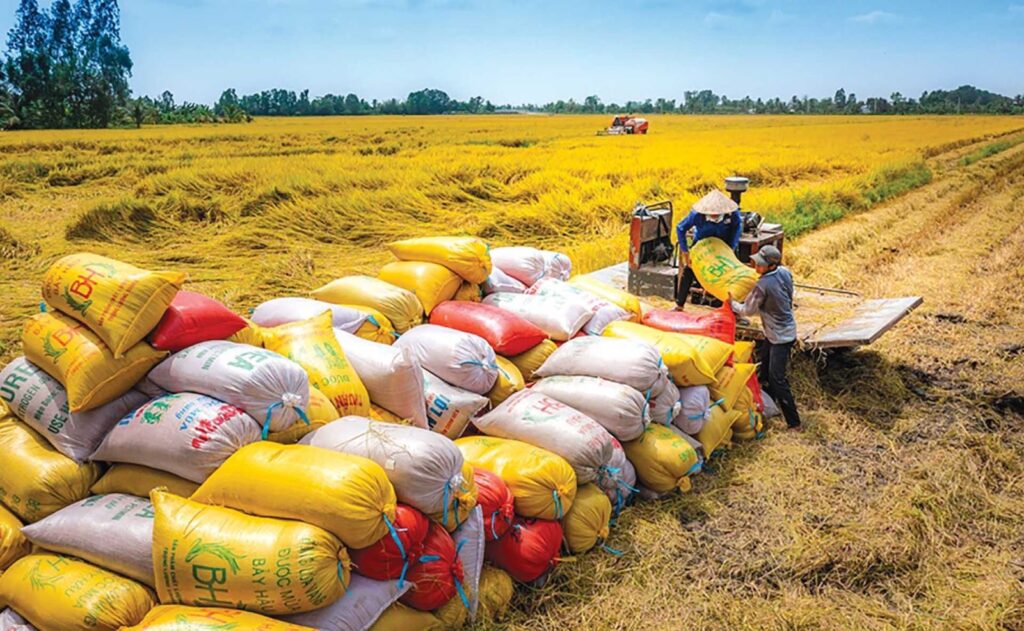
In March alone, rice exports are estimated at 1 million tons with a value of US$516.5 million. The average export price of rice fell to only about US$480.1/ton, a decrease of 8%, reflecting the downward pressure on the market amidst abundant global supply.
Regarding markets, the Philippines continues to be the largest partner, accounting for 52.6% of the market share and maintaining stable growth. China emerged as a bright spot with a 2.5-fold increase in export value, while some traditional markets such as Ghana and Ivory Coast saw sharp declines. This shows an increasingly clear differentiation in the structure of export markets.
Domestically, rice prices in the Mekong Delta in March showed mixed trends. Fresh rice prices decreased due to abundant supply during the peak harvest season of the Winter-Spring crop, while dried rice and high-quality varieties saw slight increases. This trend reflects a gradual shift towards the high-value segment, rather than purely competing on production volume. Meanwhile, international rice prices are also under pressure as India and Thailand simultaneously adjusted their prices downwards. Vietnamese rice prices remain more stable, but increased transportation costs, especially on long-distance routes such as Africa, are eroding business profits.
According to the Ministry of Industry and Trade, rice exports in 2026 are facing many challenges, from geopolitical fluctuations increasing costs to fierce competition from major exporting countries such as India, Thailand, and Pakistan. In addition, technical barriers, traceability requirements, and increasingly stringent quality standards are also creating further pressure. Dependence on a few traditional markets also increases risks when import policies change.
Restructuring the value chain, improving quality, and reducing emissions.
Faced with these challenges, the rice industry is shifting strongly towards a strategy of in-depth development. Instead of chasing production volume, the 2026 target has been adjusted to stabilize exports at 7-7.5 million tons, but increase the value to 4.5-5 billion USD.
In an interview with the Industry and Trade Newspaper, Mr. Le Thanh Tung, Permanent Vice Chairman and General Secretary of the Vietnam Rice Industry Association, said that the Mekong Delta currently has about 1.5 million hectares of rice land, producing about 24 million tons per year, not only meeting domestic demand but also creating a large source of exports, helping Vietnam maintain its position as the world’s third largest rice exporter. However, to increase value, it is necessary to reorganize production along the value chain, starting with reducing input costs and controlling quality.
The project to cultivate 1 million hectares of high-quality, low-emission rice is being implemented to comprehensively restructure the value chain. In particular, the application of assessment tools such as Viricert helps control the production process, creating a basis for certifying “green, low-emission Vietnamese rice,” thereby enhancing its reputation in the international market.
According to Mr. Tung, the participation of farmers and cooperatives in the supply chain with businesses is a key factor. When production is organized systematically, adheres to procedures, and is linked to the market, the rice not only has a higher value but also has the opportunity to participate more deeply in high-end segments.
From a management perspective, Mr. Phung Duc Tien, Deputy Minister of Agriculture and Environment, said that the agricultural sector is promoting the application of science and technology and digital transformation. Currently, about 85-89% of the area uses high-quality rice varieties, but in the context of increasing competition, further improving quality is a mandatory requirement.
Research programs are focusing on short-duration, high-yield rice varieties that are adaptable to climate change. Simultaneously, the development of industry databases, the promotion of digital transformation, and the expansion of emission reduction models are being vigorously implemented.
Notably, the emission reduction target is not limited to 1 million hectares but will be expanded nationwide, aiming for a net-zero emission commitment by 2050. Farming practices such as the “3 reductions, 3 increases” model, rational fertilizer use, crop rotation, and agricultural input stockpiling are also being applied to reduce costs and improve production efficiency. Furthermore, localities are strengthening linkages with businesses in procurement, storage, and processing, gradually forming a sustainable rice ecosystem.
Regarding the Ministry of Industry and Trade, on March 19, 2026, the Ministry issued Directive 08/CT-BCT on promoting rice production and export, implementing the Prime Minister’s directive in Official Dispatch 21/CĐ-TTg. The directive requires that rice export management be closely linked to stabilizing the domestic market, ensuring food security, and enhancing the efficiency and sustainability of the industry. Units from the central to local levels, associations, and businesses are required to implement comprehensive solutions, closely monitor the market, and proactively respond to fluctuations.
The Ministry of Industry and Trade also directed the acceleration of market expansion, leveraging FTAs, and strengthening trade promotion; while simultaneously tightening domestic market management, controlling quality and prices, and improving the risk management capacity of export businesses.
In the context of a global market shifting from competition based on quantity to competition based on quality, environmental standards, and traceability, restructuring the rice industry is no longer an option but a necessity. In fact, despite facing many difficulties, the agricultural sector maintained a growth rate of 3.58% in the first quarter of 2026, with export revenue reaching US$16.69 billion. This shows that there is still significant room for development if the rice industry effectively utilizes the opportunities presented by this transformation.
In the long term, experts believe three pillars should be prioritized: developing high-quality rice varieties; strengthening supply chain linkages; and building a national rice brand. When these factors are implemented synchronously, Vietnamese rice will not only maintain its market share but also increase its value, affirming its position in the global market.
Under competitive pressure, Vietnam’s rice industry is accelerating restructuring towards improving quality, reducing emissions, and strengthening the value chain to maintain its position.
By Hanh Nguyen
Source: congthuong.vn