
A housewares buyer in Jeddah once ordered the same oiled acacia salad bowl set twice, six months apart, from two different Vietnamese workshops. The FOB price differed by eleven cents, in favour of the first supplier. By the time both containers had been emptied into his own warehouse, the cheaper set had cost him more per piece. Nothing had gone wrong, nobody had cheated, and no freight rate had moved against him. The second workshop had simply fitted around two thousand more sets into the same twenty foot box, because somebody there had drawn the carton around the bowl instead of around the shelf.
This is the part of a wooden kitchenware program that almost never appears in a quotation comparison. Buyers negotiate the unit price down to the cent, then accept whatever carton the factory has always used, which means they pay ocean freight, terminal handling, trucking and warehouse labour on a container that is part product and part air. On a typical acacia range, the air is worth a quarter of what moves.
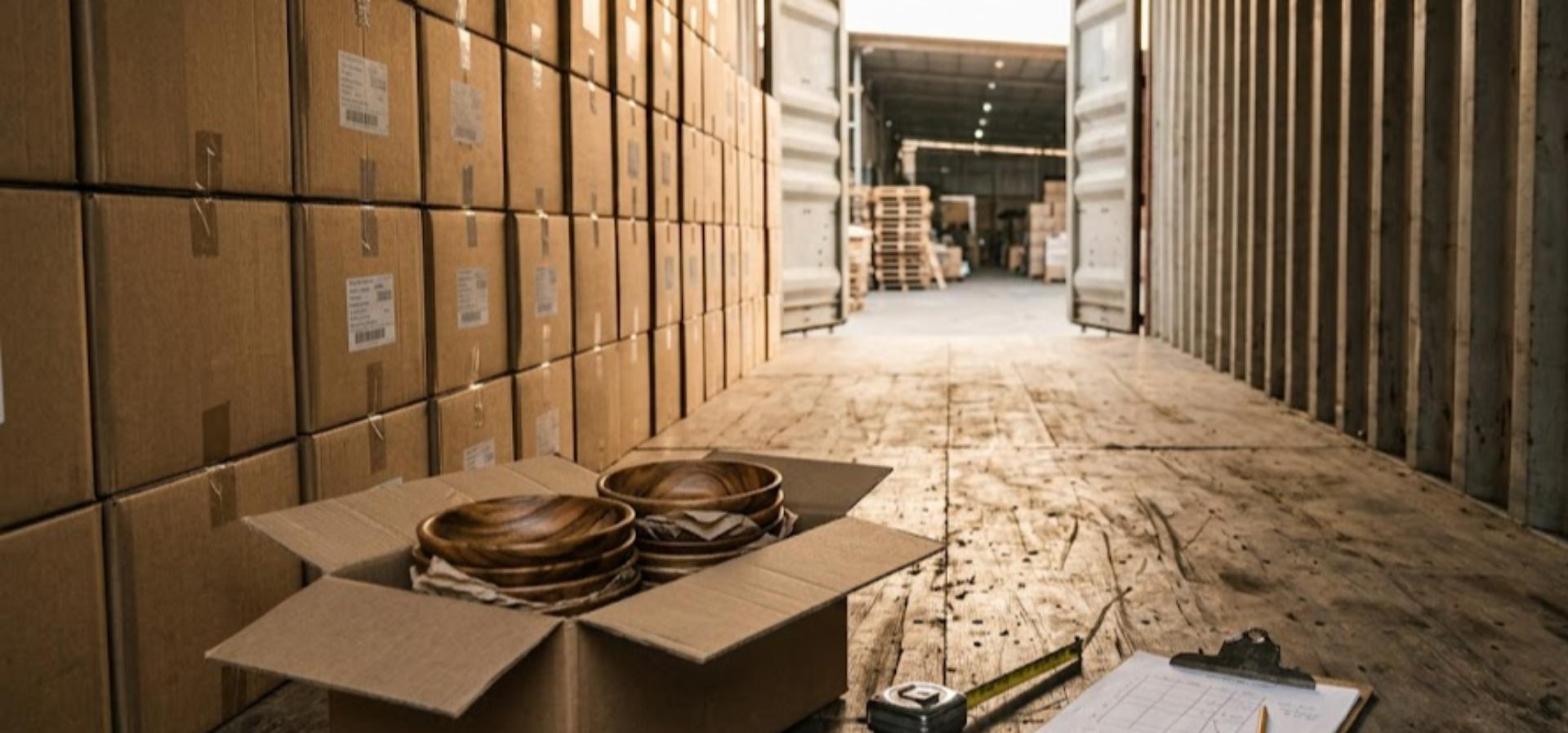
Wooden kitchenware cubes out long before it weighs out
A standard twenty foot container offers roughly 33 cubic metres of internal space and a payload allowance in the region of 21 to 26 tonnes, depending on the line and the destination port. A forty foot high cube offers roughly 76 cubic metres against a similar weight allowance.
Packed wooden kitchenware, meaning bowls, boards, trays and utensil sets together with the cartons and interleaves around them, usually lands somewhere between 130 and 230 kilograms per cubic metre. Run that arithmetic and a fully stuffed twenty foot container of mixed acacia houseware weighs four to seven tonnes. The box is completely full and the weight allowance is barely a quarter used.
That single fact governs everything else. Your freight is bought by volume, so every cubic centimetre of trapped air inside a carton is paid for more than once, on the ocean leg and again on inland haulage and storage. Weight, which dominates the economics of tiles, ceramics and canned food, is close to irrelevant here. Buyers who arrive in wooden houseware from a dense category often spend their first year optimising the wrong variable.
The number worth calculating is cost per piece landed
Take a twenty foot container from Ho Chi Minh City to Jebel Ali. In a normal 2026 market an importer might budget an all in figure of roughly 1,300 to 1,600 US dollars for ocean freight, origin terminal handling and documentation, before destination charges. Call it 1,450 for the sake of the arithmetic.
Load 9,000 bowl sets into that container and freight contributes about 16 cents per set. Improve the loading to 11,500 sets and the contribution falls to about 13 cents. Three cents per piece does not sound like a victory worth chasing, until you notice that it is usually larger than the discount buyers spend three weeks negotiating, that it needs no concession from the supplier at all, and that it repeats on every container for as long as the carton specification stays in place.
So the comparison line in your sourcing file should not be the FOB price. It should be FOB plus freight divided by pieces per container, calculated for each offer with that supplier’s own carton. Two quotations that look eleven cents apart regularly land four cents the other way.
Nesting is the biggest single lever, and it is settled at the drawing stage
Bowls and trays nest, boards stack, utensils interlock. Whether they actually do so in your order is decided long before the first carton is sealed.
- Bowls need a consistent wall taper, commonly five to eight degrees, for a stack of six to occupy roughly the height of two and a half. A straight sided bowl that photographs beautifully can quietly double your shipped volume.
- Serving boards stack dead flat until a handle is added. A board with a drilled hanging hole still stacks flat. A board with a carved side handle or a deep juice groove introduces a gap on every single layer.
- Utensil sets lose air when the heads are alternated head to tail inside the inner box rather than laid in parallel.
- Anything that nests needs an interleaf, a tissue sheet, a thin kraft disc or four foam dots, to prevent rub marks and finish transfer. Interleaves cost very little and take almost no volume.
Ask for a nesting test on the approved sample rather than on a drawing. Twelve physical pieces stacked, measured with a tape and photographed beside a ruler will tell you more about your freight bill than any specification sheet.
Carton dimensions: draw the box to the container, not to habit
This is where the largest and least glamorous gains sit. The internal width of a twenty foot container is about 2.35 metres, the internal height about 2.39 metres and the internal length about 5.9 metres.
A workshop packing into a 50 by 60 by 40 centimetre master carton out of habit fits four cartons across the width, leaving a 35 centimetre channel of unusable space, five cartons high, leaving 39 centimetres under the ceiling, and nine cartons deep, leaving 50 centimetres at the door. That is 180 cartons and about 21.6 cubic metres inside a 33 cubic metre box.
Trim the same carton to 47 by 58 by 39 centimetres and the arithmetic changes completely: five across with nothing wasted, six high, ten deep. That is 300 cartons and close to 32 cubic metres. The carton lost about a tenth of its volume, so it carries about a tenth fewer pieces, and the container still ships roughly half as much product again. The wasted channels along the width, the height and the door end have simply gone.
Real stuffing never reaches the theoretical number. Stacks need tolerance, cartons bulge, the last row has to be dunnaged and a palletised load behaves differently again. The direction of the gain is real, though, and it is free. It costs a corrugated supplier nothing to cut a different size, and it costs the factory nothing to pack into it.
Floor loaded or palletised, decided before the carton is drawn
Pallets cost cube. A standard pallet takes 12 to 15 centimetres of height out of every stack and leaves dead space along the container walls, which together usually costs 8 to 12 per cent of usable volume. In exchange you get fast unloading, clean handling into a distribution centre and, in many retail supply chains, a requirement that is not open for discussion.
If you palletise, the pallet footprint, 1200 by 1000 or 1200 by 800 millimetres, fixes the carton module before anything else does. If you floor load, the container itself fixes it. Deciding late means redrawing the carton, re-approving printed artwork and losing a fortnight you had allocated to production.
Wooden pallets and wooden dunnage leaving Vietnam must be heat treated and marked under ISPM 15, the international standard for wood packaging material in trade. Confirm the mark is present and legible before the container is sealed. A missing stamp becomes a destination problem, and destination problems are always the importer’s.
Protection costs volume, and some of it earns every centimetre
Not all packaging volume is waste, and cube efficiency pursued blindly produces damaged containers.
- A printed retail sleeve or gift box typically adds 15 to 25 per cent to shipped volume against a plain polybag. If the box sells the product at shelf, it earns its freight. If the product sells itself from an open display or a marketplace listing, it does not.
- Corner protection and a heavier board grade on the bottom tier cost a little height and prevent crushed stacks. A collapsed bottom row is the most expensive volume you will ever save.
- Silica gel and a sealed liner add essentially no volume and matter a great deal on a sailing into a dry destination climate, where the moisture content set at the factory has to survive the journey.
The question to put to every packaging element is the same one: does this exist to protect the product, to sell the product, or because it has always been there.
When a forty foot high cube is the cheaper box
A forty foot high cube offers roughly 2.3 times the volume of a twenty foot container, but on most Asia to Middle East and Asia to Europe lanes it does not cost 2.3 times as much to move. The ratio usually sits somewhere between 1.3 and 1.7 once ocean freight, terminal handling and documentation are added together. Per cubic metre, the larger box is often 20 to 35 per cent cheaper, and it halves the customs entries, the document sets and the destination handling events for the same annual volume.
The arguments against are real, but they are about cash and warehousing rather than about freight. A larger order ties up more working capital, holds more stock at destination and needs road access that some delivery addresses simply do not have.
The practical test for a growing program is whether two twenty foot orders placed six weeks apart could become one forty foot high cube placed once. For many buyers moving 15,000 to 40,000 pieces a year, they can, and the saving funds the sampling budget for the following season.
Mixed loads: use the weight allowance you have already paid for
Since a wooden houseware container cubes out with tonnes to spare, the cheapest marginal goods you can add are dense ones. Thick end grain chopping blocks, heavy serving boards, mortars and wood and stone combinations all raise the average density and consume capacity that would otherwise sail empty.
This is also the practical argument for consolidating categories with one export partner rather than splitting a modest order across three workshops. Three LCL shipments of 8 to 11 cubic metres will nearly always cost more in total, arrive on three different dates and generate three sets of destination charges, than one consolidated full container with a single loading plan and a single set of documents.
Five loading questions to put into your next RFQ
- What are the master carton external dimensions, the pieces per carton, and the gross and net weight, and how were those dimensions chosen?
- How many master cartons load into a twenty foot and into a forty foot high cube, floor loaded and palletised, and what volume does that represent?
- Does the product nest, and can you send photographs of a measured stack of the approved sample?
- If we allowed you to change the carton by up to five centimetres on any side, what would you change, and what would it do to the pieces per container?
- Will pallets and dunnage carry a legible ISPM 15 heat treatment mark, and who carries the cost if they do not?
Question four is the one that pays for the other four. Most factories already know the answer and have simply never been asked.
How Viet Farm Vision plans loading for wooden kitchenware orders
Viet Farm Vision works as a manufacturing network and export partner rather than as a single workshop, so carton design and container planning belong to the quotation rather than to whatever the factory settles after the price is agreed. Each wooden kitchenware offer carries the carton dimensions, the pieces per carton, the cartons per twenty foot and per forty foot high cube, and the freight contribution per piece that results, so two offers can be compared on landed cost instead of on FOB alone.
Where a range is still at the drawing stage, dimensions and wall tapers are reviewed for nesting before samples are cut, because a shape that nests is almost always cheaper to ship than the same shape discounted. Where several categories move at once, orders are consolidated into one loading plan to use the weight allowance a wooden houseware container leaves unused. For the cost side of the same picture, see our breakdown of what sits inside a wooden kitchenware FOB price, and for the packaging decisions upstream of loading, our guide to retail sleeves and master carton specifications.
Buyers planning a wooden kitchenware program for 2027 are welcome to send a drawing, a current carton specification, or simply the pieces per container they are achieving today, to info@vietfarmvision.com. A first response with a revised carton proposal, the pieces per container it should produce and the freight saving per piece usually follows within two working days.