
To import quilling cards into the Netherlands from Vietnam, you need an EORI number, a customs broker or forwarder who lodges the import declaration in the Dutch system, a correct tariff classification, and a valid EVFTA proof of origin from your supplier if you want preferential treatment. Most of the real work happens before the cartons leave Vietnam: the documents, the carton marks and the product information need to be ready for a Rotterdam or Schiphol arrival, not fixed after it.
This guide is written for Dutch gift shops, stationery retailers, museum shops and online sellers who want to import quilling cards into the Netherlands under their own brand. It follows the order in which we coordinate shipments with our partner workshops in Vietnam. Everything on duties and regulations below is stated as of 9 November 2026 and should be confirmed with your customs broker before you book.
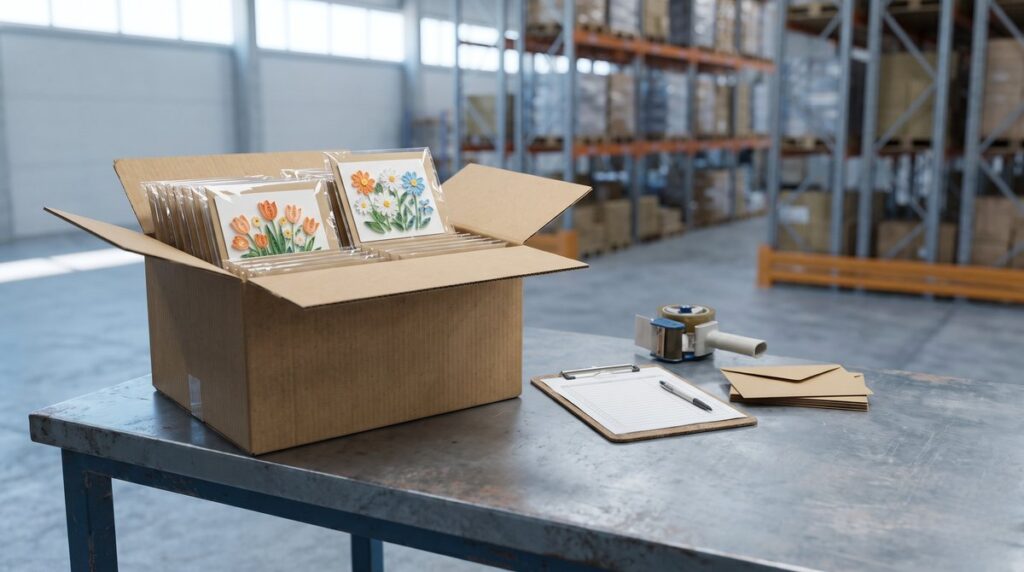
What do you need to import quilling cards into the Netherlands?
The Netherlands applies the EU’s common customs rules, so the core requirements are the same as in any EU member state. What makes the Dutch route practical is the port of Rotterdam and Schiphol airport, which many importers use as their EU entry point even when the goods are later sold in Belgium, Germany or further afield.
Before your first order, put these pieces in place:
- An EORI number registered with the Dutch Customs (Douane), or in another EU state if your company is based there. Without it, no import declaration can be filed.
- A customs broker or forwarder with direct representation authority, who will file the declaration and handle import VAT.
- A tariff classification agreed with your broker before shipment. Greeting cards are usually classified in Chapter 49, but quilled cards with added elements, gift sets or cards packed with other items may be classified differently.
- A decision on preferential origin under the EU-Vietnam Free Trade Agreement (EVFTA), so your supplier prepares the right proof of origin.
- A plan for product safety and traceability information if the cards will be sold to consumers, especially online.
Customs duty, EVFTA and VAT: what applies as of November 2026?
Duty on greeting cards entering the EU is set in the EU’s common tariff (TARIC), and you can look up the exact line, the third-country rate and the EVFTA preferential rate for your product in the European Commission’s Access2Markets database. We do not quote a rate here on purpose: the correct figure depends on the code your broker confirms, and a quilled card sold in a box with a ribbon may not sit in the same line as a flat card in a sleeve.
To claim EVFTA preference, the goods must meet the agreement’s rules of origin and travel with a valid proof of origin. The European Commission’s EVFTA guidance on rules of origin explains that, for goods exported from Vietnam, the proof is normally a certificate of origin (Form EUR.1) issued by the Vietnamese authorities, or an origin declaration made out by the exporter for low-value consignments within the agreement’s threshold. Ask your supplier which one they will issue and check the wording before the goods ship.
Import VAT is charged on top of the customs value, duty and transport costs to the EU border. The Dutch government lists the standard VAT rate at 21%, with reduced rates for specific goods and services (government.nl). Many importers use an Article 23 licence, which lets you report import VAT on your regular VAT return instead of paying it at the border; your broker can tell you whether you qualify.
Does the new EU €3 parcel duty affect wholesale card orders?
From 1 July 2026, the EU applies a temporary flat customs duty of €3 per item category on low-value e-commerce parcels worth up to €150, replacing the old duty exemption for these consignments (European Commission). A wholesale shipment of cards to your warehouse is not a low-value parcel and is declared normally. The rule matters if you plan to sell cards to EU consumers by shipping single parcels directly from Asia, a model that is now less attractive than holding stock in the Netherlands.
Do quilling cards fall under the EU Deforestation Regulation (EUDR)?
This is the question Dutch buyers ask most in 2026. Under the amended regulation, obligations for large and medium operators apply from 30 December 2026 and for micro and small enterprises from 30 June 2027 (EY). The same amendment removed printed products of Chapter 49, such as printed pictures and greeting card sets, from the list of products in scope (Imago).
Paper and paperboard products in Chapters 47 and 48 remain in scope. So the practical step is to confirm the classification of everything in the carton: if your cards are classified in Chapter 49, the EUDR should not apply to them, but if a gift set, an envelope pack sold separately or a paper packaging item is classified in Chapter 48, ask your broker and supplier what due diligence information you will need. As of October 2026, the December 2026 date was still in force, although further changes were being discussed (FoodNavigator).
Selling to Dutch consumers: GPSR and product information
Since 13 December 2024, the EU General Product Safety Regulation (GPSR) applies to consumer products sold in the EU, online and offline (Baker McKenzie). For a greeting card the risk profile is low, but the information duties still apply: an EU-based responsible economic operator, product identification and contact details on the product or its packaging, and the same details on your online listing.
This is where private label packaging helps. When we prepare private label sleeves and back-of-card printing with our partner workshops, the buyer supplies the importer name, address and any batch or item reference, and these are printed during production rather than stickered on arrival. If you sell on online marketplaces, ask the platform which product data fields it requires before you approve the packaging artwork.
Step-by-step: from first sample to a Rotterdam delivery
| Step | What happens | Who is responsible | Tip for Dutch buyers |
|---|---|---|---|
| 1. Design and sample | Your designs or our partner workshop’s designs are sampled; logo and private label options agreed | Buyer and VFV | Approve colours under daylight, not only on screen |
| 2. Pre-production approval | Golden sample signed off; packaging artwork with importer details confirmed | Buyer | Include GPSR contact details and barcodes now |
| 3. Production and mid-run check | Cards made by hand at the partner workshop; mid-production inspection | VFV and partner workshop | Ask for photos of the first finished cartons |
| 4. Final inspection | Every card checked before packing; cartons counted, photos and video sent to you | VFV | Check carton marks match your packing list |
| 5. Export documents | Commercial invoice, packing list and certificate of origin prepared | VFV | Send your broker the draft documents before departure |
| 6. Shipping | Sea freight to Rotterdam or air freight to Schiphol, on the Incoterm you choose | Buyer or forwarder | Agree who books freight and insurance in writing |
| 7. Import clearance | Broker files the declaration, duty and VAT handled | Buyer’s broker | Use an Article 23 licence if eligible |
| 8. Receiving | Goods-in check against packing list; damage noted on delivery | Buyer | Photograph any damaged cartons before opening |
How should quilling cards be packed for the Dutch market?
Quilled cards have raised paper coils that can be crushed by pressure or shifted by vibration, so packaging is not a detail. For EU shipments we usually recommend individual clear sleeves, cards packed upright in inner boxes with dividers, and export cartons that are not overfilled. Our guide to greeting card packaging for retail covers the retail side in more detail.
Which quilling card designs sell well in the Netherlands?
We avoid claiming market data we cannot verify, but buyer briefs from Northern Europe tend to share some patterns: tulips and spring flowers, birthday and thank-you designs with clean white space, and a restrained colour palette rather than heavy gold. Many Dutch shops also sell to German-speaking and French-speaking customers, so blank-inside cards or cards with a small message in several languages travel further. If you already import into neighbouring markets, our guides for importing quilling cards into Germany and France cover the differences.
You can browse sample designs on our handmade quilling greeting cards page, and every design can be adapted with your colours, logo and private label packaging.
Checklist before your first order
- EORI number active and broker appointed with direct representation.
- Tariff code agreed with your broker for each item, including gift sets.
- EVFTA proof of origin type confirmed with the supplier.
- Article 23 VAT licence checked.
- EUDR position confirmed for any Chapter 48 items in the shipment.
- GPSR responsible operator and contact details on packaging.
- Incoterm, freight booking and insurance agreed in writing.
- Delivery window planned around your selling season, not the other way round.
Frequently Asked Questions
Can I import quilling cards into the Netherlands without a Dutch company?
You need an EORI number and someone in the EU who can act as importer of record, which can be a company in another EU member state. Your broker can also advise on indirect representation if you are based outside the EU. For consumer sales, the GPSR still requires an EU-based responsible economic operator.
Is there customs duty on greeting cards from Vietnam?
The rate depends on the tariff code your broker confirms. Look up the third-country and EVFTA preferential rates for that code in Access2Markets, and remember that preference only applies with a valid proof of origin. Import VAT is due either way.
Do I need EUDR due diligence for quilling cards?
As of November 2026, printed products in Chapter 49 were removed from the EUDR’s scope, so cards classified there should not need it. Paper items classified in Chapter 48 remain in scope from 30 December 2026 for larger operators. Confirm the classification of every item before you rely on this.
Can the cards carry my brand and my company details?
Yes. Our partner workshops can print or attach your logo, and we prepare private label sleeves, back-of-card printing and outer packaging with your company details. Adding GPSR information at this stage avoids relabelling in the Netherlands.
How quickly will I get a quotation?
We reply to quote requests within one business day. Send your designs or references, quantities per design, packaging needs and the Incoterm you prefer.
Ready to plan your first order?
If you are planning to import quilling cards into the Netherlands for spring or the 2027 gifting season, share your brief through our Request a Quote page. We will come back within one business day with design options, packaging suggestions and the export documents we will prepare for your broker.