
To import quilling cards into New Zealand, you need a Customs client code, a customs broker to lodge an import entry for any shipment valued over NZ$1,000, and enough budget for 15% GST plus the border levies charged on each entry. New Zealand has trade agreements with Vietnam (AANZFTA, CPTPP and RCEP), so preferential duty treatment may be available when the paperwork proves Vietnamese origin. Most of the real risk, though, sits on the supply side: an approved sample, clean export documents and cartons built to survive a long sea or air leg into the South Pacific.
This guide is written for New Zealand gift shops, stationery retailers, museum stores and online sellers placing a first order of handmade quilling greeting cards from Vietnam. Border rules below are summarised from New Zealand Customs Service, the Ministry for Primary Industries (MPI) and the Ministry of Foreign Affairs and Trade (MFAT), as of 12 November 2026. Rules and fees change, so confirm the details for your own shipment with a licensed customs broker.
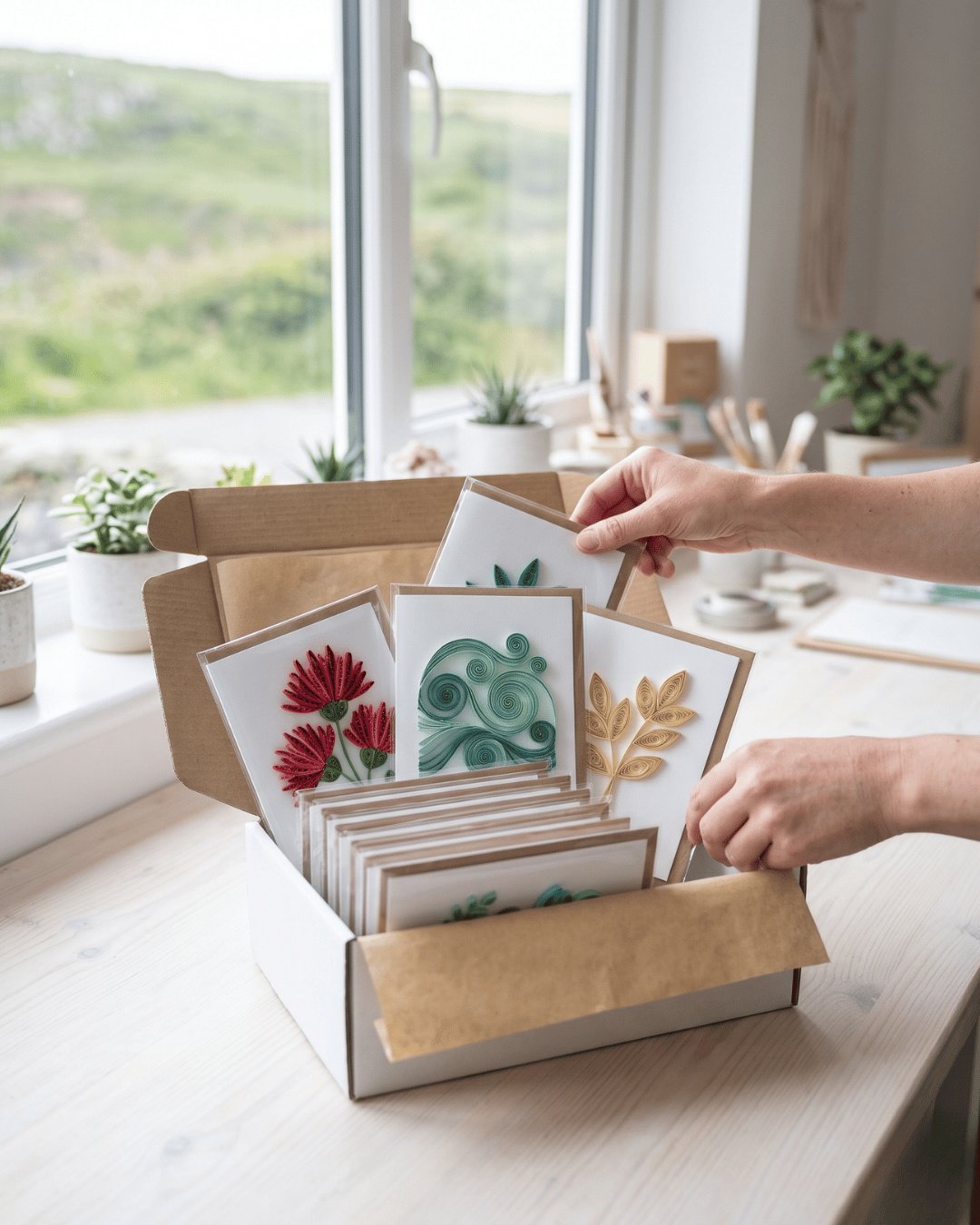
What do you need before you import quilling cards into New Zealand?
New Zealand Customs separates imports by value. According to the Customs guide Importing goods for business or commercial use, goods with a Customs value over NZ$1,000 need a Customs client code (applied for with Form 224) and an electronic import declaration lodged by a registered user, which in practice usually means a customs broker. Lower-value consignments can be cleared through simpler declarations.
The short pre-order list
- A registered business and a Customs client code (your broker can help you apply).
- A customs broker or freight forwarder who handles small consolidated shipments from Ho Chi Minh City or Hanoi.
- A tariff classification for your cards, confirmed by the broker against the Working Tariff Document of New Zealand.
- A decision on whether to claim preferential treatment under a trade agreement, and which origin document the supplier must provide.
- Agreed Incoterms, so both sides know who pays freight, insurance and destination charges.
Which taxes, duties and levies apply to greeting cards in New Zealand?
Three cost lines matter at the border. First, Goods and Services Tax: Customs calculates 15% GST on the value of the goods plus any duty and the freight and insurance you paid. Second, customs duty: the rate depends on the tariff item your broker selects, and Customs advises checking the Working Tariff Document because rates can change. We do not quote a duty rate here, because only your broker’s classification for your exact product can confirm it.
Third, the import levies. From 1 April 2026, the Customs quick reference guide on levies lists a High-Value Goods Import Levy (for goods over NZ$1,000) of NZ$51.81 per entry by air and NZ$118.44 per entry by sea, excluding GST, split between Customs and MPI. Because the levy is charged per entry, consolidating several card designs into one shipment usually spreads it more efficiently than splitting an order into many small consignments.
| Cost line | How it is calculated | Who confirms it |
|---|---|---|
| GST | 15% of goods value plus duty, freight and insurance | NZ Customs / your broker |
| Customs duty | Rate set by the tariff item; may be reduced under a trade agreement with valid proof of origin | Your broker, using the Working Tariff Document |
| High-Value Goods Import Levy | Fixed amount per import entry, higher for sea than air (from 1 April 2026) | NZ Customs and MPI |
| Broker and port charges | Set by your broker, forwarder and the destination port | Your logistics partners |
| International freight and insurance | Depends on Incoterms, volume, mode and season | Supplier or your forwarder |
Do trade agreements help when importing quilling cards from Vietnam?
New Zealand and Vietnam are both parties to three regional agreements. The ASEAN-Australia-New Zealand Free Trade Agreement (AANZFTA) has been in force since 2010 for New Zealand, and its upgrade entered into force on 21 April 2025, according to MFAT. Vietnam is also a member of the CPTPP and of RCEP alongside New Zealand.
For a buyer, the practical question is simple: does a lower preferential rate exist for your tariff item, and is it worth the paperwork? If the general duty on your classification is already low, the saving may be small. If it is not, ask your broker which agreement gives the best outcome and what origin evidence they need. Tell your supplier before production, because the certificate of origin or origin declaration has to match the invoice exactly. As of 12 November 2026 we are not aware of any New Zealand-specific tariff change affecting greeting cards, but check the Working Tariff Document and its amendments before each order season.
What documents should your Vietnamese supplier provide?
Customs lists invoices, packing lists and insurance details as the core information supplied with an import entry. For a handmade card order, ask for these as standard:
- Commercial invoice showing a clear product description (handmade paper quilling greeting cards with envelopes), quantities per design, unit values, currency and Incoterms.
- Packing list with carton numbers, contents per carton, net and gross weights and carton dimensions.
- Certificate of Origin under the agreement your broker chooses, if you are claiming preference.
- Bill of lading or air waybill from the carrier or forwarder.
- Packing material declaration, if your broker or forwarder requests one, confirming whether any wood packaging is used.
At Viet Farm Vision we prepare the commercial invoice, packing list and CO with every export order, and we reply to quote requests within one business day so you can share draft documents with your broker early.
Are there biosecurity rules for paper cards entering New Zealand?
New Zealand takes biosecurity seriously, and Customs notes that shipping containers, wood and packing materials are risk goods that must be declared. Finished paper greeting cards are generally a lower-risk product, but the packaging around them matters. If your shipment travels on wooden pallets or in wooden crates, MPI requires that wood packaging meets the ISPM 15 standard. The simplest approach for card orders is to ship on ISPM 15 marked pallets or to avoid wood packaging altogether.
How should quilling cards be packed for the trip to New Zealand?
Quilled designs are raised paper coils, so the main risks are crushing and movement. We recommend individually sleeved cards, an inner box per design so retailers can restock without repacking, and a rigid outer carton that is filled to avoid empty space. Our guide to greeting card packaging for retail covers sleeve, header card and display options in more detail.
Every order runs through a four-step quality check at our partner workshop: sample approval before production, a mid-production check, a card-by-card inspection before packing, and a final carton count with photos and video sent to you before dispatch. That last step is useful for New Zealand buyers, because you can share the carton photos with your broker and spot any labelling issue before the goods leave Vietnam.
When should New Zealand retailers order for each season?
New Zealand’s card calendar runs on southern hemisphere seasons, so Christmas arrives in summer and designs with bright summer flowers, coastal colours and red blossoms often sit alongside traditional winter motifs. Lead time is shaped by design complexity, the number of custom designs, sampling rounds and shipping mode, so we give firm dates at the quotation stage rather than generic numbers. As a working rule, start sampling well ahead of the season and leave a buffer for sea freight and clearance.
| Step | What happens | Your action |
|---|---|---|
| 1. Brief and quote | You share designs, quantities, packaging and target season | Send an RFQ; ask your broker about classification |
| 2. Sampling | Partner workshop makes samples of each design | Approve colours, size and packaging |
| 3. Production | Cards are hand-quilled; mid-production check | Confirm documents and origin claim |
| 4. Final inspection | Card-by-card check, packing, carton photos and video | Approve shipment; book freight per Incoterms |
| 5. Shipping and clearance | Sea or air freight; broker lodges import entry | Pay GST, any duty and levies; receive goods |
If you also sell into Australia, many of the same planning steps apply. See our guide to importing quilling cards into Australia to compare the two markets.
Can you order private label and custom quilling cards for New Zealand?
Yes. Our partner workshops make cards from your own artwork or adapt existing designs to local tastes, and we can print or attach your logo and supply private label packaging. Cards are handcrafted at the workshop by skilled artisans, mostly women from the surrounding community. For New Zealand stores, popular briefs include native-inspired botanical palettes, ocean blues and greens, and simple thank-you or birthday cards that sell all year. Small trial orders are welcome so you can test a range before committing to a larger seasonal buy.
Frequently Asked Questions
Do I need a customs broker to import quilling cards into New Zealand?
For goods valued over NZ$1,000, New Zealand Customs requires an electronic import declaration lodged by a registered user, which usually means a broker. Brokers also apply for client codes and advise on classification. You stay legally responsible for the declaration, so keep your supplier documents accurate.
How much GST do I pay on imported greeting cards?
GST is 15%, calculated on the value of the goods plus any duty and the freight and insurance you paid. Import levies are also charged per entry and attract GST. Your broker will give you the final figure on the entry.
Can I claim lower duty under AANZFTA, CPTPP or RCEP?
Possibly. New Zealand and Vietnam are parties to all three agreements, but the benefit depends on your tariff item and on valid proof of origin. Ask your broker which agreement suits your classification, then tell your supplier before production so the origin document matches the invoice.
Will MPI inspect a shipment of paper cards?
Paper cards are generally lower risk, but containers and packing materials are declared risk goods. Using ISPM 15 compliant pallets, or no wood packaging, and clean paper-based fillers reduces the chance of delays. Any extra gift items packed with the cards need their own check.
Can I order a small trial range first?
Yes, small trial orders are welcome. Minimums depend on the number of designs and the level of customisation, so we confirm them in the quotation. Grouping designs into one consolidated shipment also helps spread per-entry levies.
Ready to plan your first New Zealand order?
Share your designs, target quantities, packaging needs and season, and we will come back with sample options, documents and a quotation within one business day. Request a quote for handmade quilling cards and start building a range for your New Zealand customers.