
Quilling cards vs printed cards is really a question of what job the card does on your shelf. Printed cards win on unit cost, speed and design volume; quilling cards win on texture, perceived value and the “handmade” story that lets a gift shop or museum store sell at a premium. Most successful retailers stock both and give each a clear role.
This guide compares the two formats, along with embossed, foiled and letterpress cards, from a wholesale buyer’s point of view: how each is made, how it behaves in transit and on display, and where a handmade quilled range earns its place in an assortment.
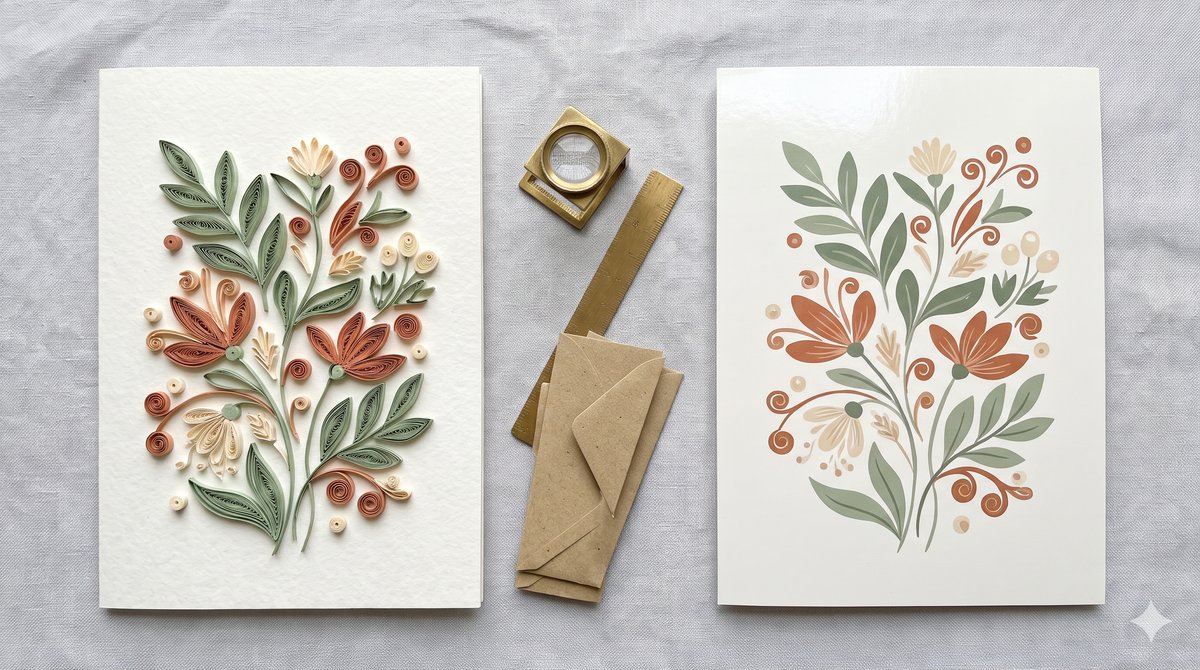
Why does the quilling cards vs printed cards question matter for buyers?
Greeting cards are a mature, high-volume category. In the US, the Greeting Card Association has estimated that Americans buy around 6.5 billion cards a year, and more than 90% of households buy cards (EBSCO Research Starters, citing GCA). In the UK, the GCA’s market report put consumer spending on single cards at £1.51 billion in 2023, while volumes slipped 1.9% to around 800 million cards (Progressive Greetings / GCA Market Report).
Rising value on falling volume tells you something useful: shoppers are buying fewer cards but spending more per card. That is the space where a tactile, handmade product competes. A flat printed card is easy to replace with a text message; a hand-quilled card is closer to a small gift, and that changes how it is priced and merchandised.
How are printed, embossed and quilling cards made?
Printed cards (digital and offset)
Printed cards reproduce artwork with ink. Digital printing suits short runs and many designs; offset lithography suits long runs of a single design. Colour lithography has shaped the card trade since the nineteenth century, when Louis Prang built his lithographic business near Boston and helped make cards affordable for the mass market (EBSCO). The result is a flat card with an unlimited colour palette and very consistent output.
Embossed, foiled and letterpress cards
These are printed cards with a finishing step. Embossing presses a raised pattern into the board, foil adds metallic highlights, and letterpress bites the design into thick paper. They add touch and shine, but the relief is shallow and the design is still mechanically repeated across the run.
Quilling cards
A quilling card is built by hand. Artisans roll narrow paper strips into coils, pinch them into teardrops, leaves and petals, and glue each shape onto the card face to form flowers, animals or seasonal motifs. The design stands off the surface, catches light and casts small shadows. If you want the detail on coil types, our guide to quilling techniques for card buyers walks through tight coils, loose coils, marquises and fringed flowers. At our partner workshop in Vietnam, this work is done by skilled craftspeople, mostly local women who live near the workshop.
Quilling vs printed vs embossed cards: side-by-side comparison
| Factor | Printed card | Embossed / foil / letterpress | Quilling card |
|---|---|---|---|
| Surface | Flat | Shallow relief or shine | Raised, layered paper sculpture |
| How it is made | Machine printed | Machine printed plus finishing | Hand rolled and hand assembled |
| Design flexibility | Any artwork, photo or text | Artwork plus finishing dies | Best for bold motifs: flowers, birds, animals, seasonal icons |
| Unit cost | Lowest | Medium | Higher, driven by labour time per card |
| Lead time drivers | Press schedule | Press plus tooling | Design complexity, quantity and artisan capacity |
| Uniformity | Identical | Identical | Consistent to approved sample, with small handmade variation |
| Transit risk | Low | Low | Needs protective packing so coils are not crushed |
| Shelf role | Volume, humour, everyday | Mid-premium, occasions | Premium, gift-like, keepsake |
| Story for shoppers | Artist or brand | Craft finish | Handmade by artisans, frameable after use |
Where do handmade quilling cards outperform printed cards?
- Perceived value. Shoppers can feel the work. A raised quilled bouquet reads as a gift in itself, which supports a higher retail price than a flat card of the same size.
- Keepsake life. Many recipients keep or frame quilled cards, which gives the product word-of-mouth value that a printed card rarely earns.
- Story-led channels. Museum shops, botanical gardens, independent boutiques and gift stores sell on provenance. A card handmade by artisans in Vietnam gives staff something real to say at the till.
- Fewer, deeper SKUs. Because each design carries more weight, a compact quilling range can anchor a display without hundreds of designs.
- Corporate and wedding orders. Logos and custom designs can be added, so the card becomes part of a branded gift rather than a commodity.
When are printed cards the better choice?
Be honest with your range planning. Printed cards are the right tool when the message depends on text or photography, when humour drives the sale, when you need hundreds of designs at a low price point, or when a design changes every season. They are also simpler to post in standard envelopes. Quilling is not a replacement for that business; it is the premium tier on top of it.
What should buyers check before adding quilling cards to a printed card range?
1. Approve a physical sample, not just a photo
Depth, colour and coil tightness are hard to judge on screen. Our process starts with a pre-production sample you approve before any bulk work begins, and every finished card is checked against it.
2. Plan packaging around the relief
A raised design needs protection from pressure in cartons and from shoppers’ fingers on the shelf. Individual sleeves or boxes, spacers and firm master cartons matter more than with flat cards. We cover this in detail in our guide to protective packaging for exporting quilling cards.
3. Merchandise them differently
Quilling cards sell best face-out, at eye level and grouped by occasion, not buried in a spinner of printed cards. Our article on greeting card display ideas for gift shops has layout suggestions.
4. Agree what “handmade variation” means
Handmade does not mean inconsistent. Agree tolerances on colour, layout and glue finish against the approved sample. Our four-step quality control covers sample approval, a mid-production check at the workshop, inspection of every card before packing, and a carton count with photos and video sent to you before shipment.
5. Confirm export paperwork early
Commercial invoice, packing list and certificate of origin should be part of the plan from the first order, so customs clearance in your market is predictable.
How do custom design and private label work for quilling cards?
Unlike a printed range, where custom work means new artwork files, custom quilling starts with a motif the artisans can build in paper. You can send your own design or reference, and the workshop develops a sample for approval. Your logo can be printed or attached, and cards can ship in private label packaging ready for retail. Pricing and production time depend mainly on design complexity, the number of coils and layers, order quantity and packaging, so the clearest path to a firm quote is to share your target designs and quantities up front. You can see current styles on our handmade quilling greeting cards page.
Frequently Asked Questions
Are quilling cards more expensive than printed cards wholesale?
Yes, in most cases. Each quilling card is rolled and assembled by hand, so labour time per card is the main cost driver, while printed cards spread fixed costs across long machine runs. Retailers usually position quilling cards in a higher price tier to match.
Can quilling cards be sent through the post?
They can, but the raised design needs protection. Many retailers sell them with a rigid envelope or a box. Some postal services also charge more for thicker or non-standard mail, so it is worth checking local rules for your market and telling shoppers.
Will every quilling card in an order look identical?
Each card is made to match the approved sample in design, colours and layout. Because they are handmade, small differences in coil shape are normal and are part of the appeal. Every card is inspected before packing to keep it within the agreed standard.
Can I mix quilling and printed cards in one display?
Yes, and many shops do. A common approach is to keep printed cards for everyday and humour sections and use quilling cards as a premium block within occasion zones, such as weddings, sympathy or Mother’s Day. Clear signage about the handmade process helps shoppers understand the price difference.
Can quilling cards carry my logo or brand?
Yes. Logos can be printed or attached to the card or packaging, and custom designs based on your brief are available. This is popular for corporate gifting, hotels and private label retail ranges.
Ready to add a handmade tier to your card range?
If you are weighing quilling cards vs printed cards for your next season, the simplest next step is to compare a real sample with your current best sellers. Tell us your market, the occasions you want to cover and your packaging needs through our Request a Quote page, and we will reply within one business day.