
Why Global Buyers Are Choosing Vietnam Over China for OEM Manufacturing in 2026
Date: June 29, 2026 | Category: Trade Policy & Market Opportunities
In short: Vietnam edge over China for OEM manufacturing rests on three pillars: a persistent tariff gap (Chinese goods carry permanent Section 301 duties of 7.5-25%+ that Vietnamese goods do not – even after the February 2026 Supreme Court ruling reshaped the headline rates), over $36 billion of foreign direct investment in 2025, and rapidly upgrading logistics infrastructure.
In 2026, the question for many global procurement teams is no longer whether to diversify away from China — it is where to go instead. Vietnam has emerged as the leading answer for a wide range of product categories: agricultural ingredients, wooden goods, handcrafted products, eco-friendly packaging, and light manufacturing. This article gives you the data-backed case for why Vietnam is winning, what the real advantages are, and what the honest limitations are that buyers need to plan around.
The Tariff Reality: 20% vs 100%+
The single most powerful driver of sourcing shifts to Vietnam in 2026 is the tariff differential. Under the US-Vietnam trade framework announced in late 2025 and operationalised in 2026, genuine Vietnamese-origin goods enter the US market at a 20% tariff rate. Chinese goods across many manufacturing categories face 100% or higher tariffs — a stack of MFN rates plus Section 301 tariffs that has made US import of many Chinese goods economically unviable.
The arithmetic is straightforward: a buyer importing $500,000 of wooden kitchenware annually pays $100,000 in tariffs from Vietnam vs $500,000+ from China. (Update July 2026: after the February 2026 Supreme Court ruling the specific headline rates changed – Vietnamese goods currently face a flat 10% surcharge while Chinese goods still carry permanent Section 301 duties on top, so the gap persists. See our updated US tariff guide for current rates.) That difference is the business case for sourcing diversification — and it applies whether you are importing to the US, or to markets with their own anti-dumping or countervailing duty measures on Chinese goods.
FDI Surge: The World Is Already Moving
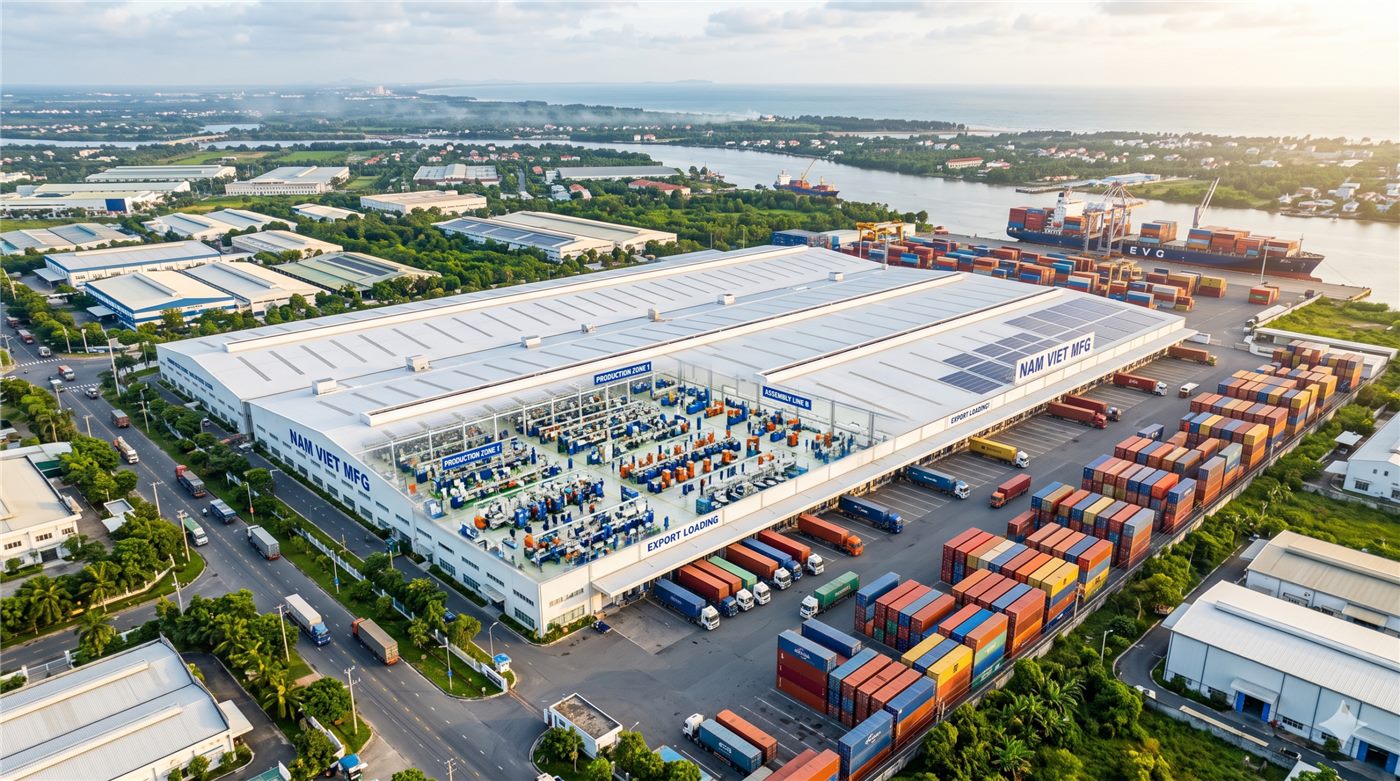
The smart money has been moving to Vietnam for years, but 2025–2026 represents an acceleration. Vietnam attracted over $36 billion in foreign direct investment in 2025 — primarily in electronics, semiconductors, and manufacturing infrastructure. Samsung, Intel, LG, Foxconn, and dozens of tier-1 global manufacturers have established or significantly expanded Vietnam operations.
What this means practically: the supplier ecosystem is maturing rapidly. Component availability is improving. Logistics infrastructure (ports, highways, industrial zones) is being upgraded. And the talent pool — engineers, quality managers, export documentation specialists — is growing. Vietnam is not just cheap labour anymore; it is an industrial ecosystem.
Vietnam’s Structural Advantages
| Factor | Vietnam | China | India |
|---|---|---|---|
| US tariff rate (2026) | 20% | 100%+ | 26% |
| FTA network | Strong (RCEP, EVFTA, VN-UAE CEPA, UKVFTA) | Limited with West | Growing |
| Labour cost (manufacturing) | Competitive | Rising | Competitive |
| Lead times to Asia/Middle East | Short | Short | Moderate |
| English proficiency (business) | Good & improving | Variable | Strong |
| Geopolitical risk | Low | High (US-China tension) | Low-Medium |
Vietnam’s Free Trade Agreement Network
Beyond the US relationship, Vietnam has built one of Asia’s most comprehensive FTA networks — giving buyers in multiple regions a cost advantage when sourcing from Vietnam:
- RCEP (2022): Preferential access across ASEAN, China, Japan, South Korea, Australia, New Zealand
- EVFTA (2020): Near-zero tariffs on most goods entering the EU from Vietnam
- UKVFTA: Preferential access to the UK post-Brexit
- VN-UAE CEPA (Feb 2026): Zero tariffs on most goods into the UAE and preferential access to broader GCC
- CPTPP: Access to Canada, Mexico, Australia, Japan, and other Pacific markets
No other sourcing country in Southeast Asia — not Thailand, not Indonesia, not Malaysia — has this combination of bilateral and multilateral trade agreements simultaneously active.
Honest Limitations: What Vietnam Cannot Yet Match
A credible comparison requires honesty about Vietnam’s limitations:
- Component supply chain depth: For complex manufactured goods, China’s component ecosystem remains deeper. Vietnamese factories often still import significant inputs from China — which affects true origin calculations and supply chain resilience.
- Scale ceiling: For truly massive orders (tens of millions of units of a single SKU), China’s manufacturing scale remains unmatched. Vietnam is strongest in the mid-volume, high-mix segment.
- Logistics infrastructure gaps: Vietnam’s port and road infrastructure is improving but not yet at China’s level. Lead time variability can be higher, particularly for inland manufacturing zones.
- Supplier verification complexity: The rapid influx of investment has created a mixed supplier landscape. Due diligence requirements are higher than they were five years ago.
The Bottom Line for B2B Buyers
Vietnam in 2026 is the right primary or complementary sourcing destination for buyers who need: genuine Vietnamese-origin goods for tariff purposes, mid-volume OEM manufacturing with flexibility, agricultural ingredients from a certified supply base, or handcrafted and wood products at competitive cost. The FTA network, the improving industrial ecosystem, and the growing workforce of export-experienced manufacturers make this a sourcing relationship worth building now — before capacity constraints tighten further.
Viet Farm Vision connects international buyers with verified Vietnamese manufacturers across agricultural products, wooden goods, eco-friendly packaging, and handcrafted products. Contact us to start a sourcing conversation →
Explore our products: Vietnamese Agricultural Products | Wooden Kitchenware & Houseware
Frequently Asked Questions
Is Vietnam still cheaper than China for US importers after the 2026 tariff changes?
Yes for most covered categories: the February 2026 Supreme Court ruling replaced the old 20% Vietnam rate with a flat 10% surcharge that applies to all origins, while Chinese goods additionally carry permanent Section 301 duties of 7.5-25% or more. See our US tariffs landed cost guide for current numbers.
What advantages does Vietnam offer beyond tariffs?
Over $36 billion in foreign direct investment in 2025 – concentrated in electronics, semiconductors and manufacturing infrastructure – plus upgrading ports, highways and industrial zones, competitive labor costs, and improving quality systems.
What is the main risk when shifting sourcing from China to Vietnam?
Transshipment fraud: goods that are Chinese-made but routed through Vietnam. Genuine Vietnamese origin with verifiable production records is essential – customs enforcement is strict and penalties severe.
Which product categories is Vietnam strongest in?
Wooden houseware and kitchenware, agricultural products, eco-friendly packaging and disposables, handcrafted paper goods, plus fast-growing electronics and furniture manufacturing.