
Single-use plastic bans are rewriting foodservice and retail procurement across Europe, the Middle East and Asia, and compostable disposable tableware has moved from a niche “green” line into a mainstream volume category. For importers, distributors and private-label brands, Vietnam has quietly become one of the most competitive origins for two products in particular: areca (betel) palm leaf plates and sugarcane bagasse containers. This 2026 guide explains what B2B buyers need to verify before placing an order — product specifications, certifications, minimum order quantities, and why sourcing from Vietnam makes commercial sense this year.
Why compostable disposables are a 2026 procurement priority
Regulation is now the primary demand driver. The EU Single-Use Plastics Directive continues to widen, GCC markets are tightening rules on plastic foodware, and major retail and hospitality buyers have set hard deadlines to phase out fossil-based disposables. For a procurement team, switching to certified compostable tableware is no longer a marketing choice — it is a compliance requirement that protects shelf access and tender eligibility. That shift has created steady, repeat-order demand for plant-based plates, bowls, clamshells and cutlery, exactly the categories where Vietnamese factories have built real capacity.
Areca palm leaf tableware: what you are actually buying
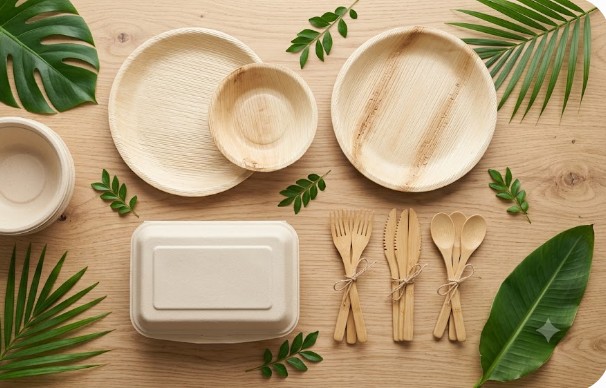
Areca plates are made from the naturally shed leaf sheath of the betel-nut palm — heat-pressed into shape with nothing added: no chemicals, no coatings, no bleaching. The result is a premium, wood-grain disposable that photographs beautifully for catering and events, while remaining genuinely home- and industrial-compostable.
- 100% natural — single-material, chemical-free, and compostable in weeks
- Functional — microwave-safe, freezer-safe, and resistant to oil and heat up to typical serving temperatures
- Formats — round and square plates, bowls, compartment trays and platters from roughly 4″ to 12″
- Positioning — a natural premium look that commands higher retail price points than pulp or paper
Bagasse (sugarcane pulp) tableware
Bagasse is the fibrous pulp left after sugarcane juice extraction — an agricultural by-product turned into sturdy, moulded tableware. It is the workhorse of the compostable category: neutral in colour, stackable, and cost-efficient at volume. Vietnam’s proximity to large sugarcane growing regions gives local manufacturers a reliable raw-material supply.
- Range — plates, bowls, clamshell food boxes, cups and cutlery via disposable eating utensils and disposable plate lines
- Performance — grease- and water-resistant, microwave-safe, holds hot food without going soggy
- Compostable — breaks down in industrial composting, unlike plastic or PE-lined paper
- Customisation — embossing and printed sleeves for private-label and branded foodservice programs
Certifications every buyer should verify
“Eco-friendly” claims mean little without documentation. Before you commit to a supplier, ask for test reports — not just marketing statements. The two categories that matter are compostability and food contact safety, backed by an audited factory.
- Compostability — EN 13432 (EU), ASTM D6400 (US), plus scheme marks such as TÜV OK Compost / Seedling for finished goods
- Food contact — FDA (US) and LFGB (EU/Germany) migration compliance for anything touching food
- Factory & social — ISO 9001 quality systems and BSCI/Sedex social-compliance audits
Viet Farm Vision consolidates this paperwork per shipment. See our certifications & compliance overview for the documents we provide with each order.
MOQ, pricing and lead times
Compostable tableware is a container-scale business. Typical minimum order quantities start around one 20ft container or roughly 100,000–300,000 pieces per SKU, depending on item size and whether you require custom printing. Standard production lead times run about 25–40 days after sample approval and deposit, with samples available in 7–10 days. Costs are driven by material (areca commands a premium over bagasse), item dimensions, packaging, and print complexity — always confirm the landed cost, not just the FOB price, when comparing origins.
Why source compostable tableware from Vietnam in 2026
Beyond capacity and raw materials, the trade math favours Vietnam this year. The Vietnam–UAE CEPA, signed in February 2026, lowers duties for Middle Eastern importers, while Vietnam’s participation in RCEP streamlines tariffs across 14 Asian partners. On the US lane, Vietnamese goods carry a materially lower tariff burden than Chinese-origin equivalents, and diversified buyers increasingly want a China-plus-one origin with transparent, verifiable provenance. Compostable tableware pairs naturally with our wooden kitchenware and broader eco-friendly product lines, letting buyers consolidate freight and paperwork across a single Vietnamese supplier.
Work with Viet Farm Vision
Viet Farm Vision is a Vietnam-based OEM manufacturer and exporter of compostable disposables, wooden kitchenware and eco packaging for B2B buyers worldwide. If you are evaluating a switch or adding a compostable line to your catalogue, request a quote and our team will send specifications, certification documents and samples. Email: info@vietfarmvision.com.