
A European homeware importer asked a Vietnam workshop to quote an acacia cheese board with a white marble inset. The wooden version of the same board was already a steady seller. The marble version looked better in photos and carried a higher retail price, but the first quotation came back at roughly double the FOB cost, the carton weight almost tripled, and the factory asked for a longer lead time. None of this was a surprise to the workshop. It was a surprise to the buyer, because nobody had explained how a second material changes the whole product.
Mixed material wooden kitchenware, meaning wood paired with marble, resin, ceramic, stainless steel or glass, is one of the fastest ways to move a range upmarket. It is also where most first orders run into trouble. This guide explains the five combinations that sell, what each one does to price, MOQ, freight and compliance, and how to brief a Vietnam supplier so the samples match the photos.
Why buyers are adding a second material to wooden kitchenware
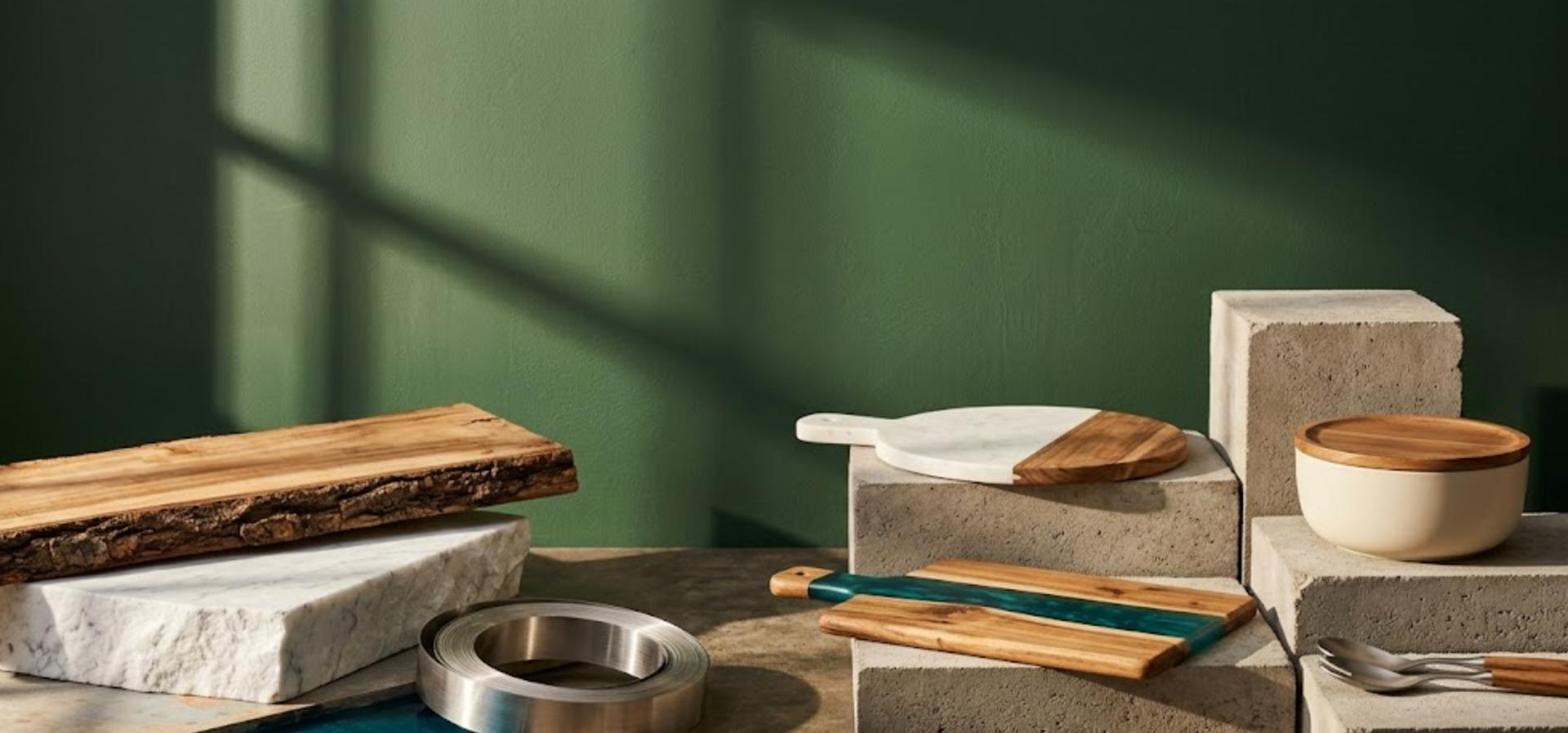
- Higher perceived value: a marble inset or a resin river turns a plain board into a gift or display piece, which supports a higher retail price than wood alone.
- Differentiation: plain acacia utensils are widely available, so a second material helps a private label range stand apart from marketplace competition.
- Function: stainless steel heads on tongs or servers last longer than all wood designs, and ceramic bowls with wooden lids add storage use.
- Set building: mixed material pieces work well as the hero item in a gift set, with plain wooden pieces filling the rest of the box.
The five mixed material combinations that sell
1. Wood and marble
Cheese boards, serving boards with a marble inset, mortar and pestle sets and utensil holders. Marble is heavy and brittle, so it raises carton weight sharply and needs stronger internal packaging. Marble is usually sourced as cut slabs and fitted into routed wood, so the joint must allow for wood movement.
2. Wood and epoxy resin
River boards, resin inlay coasters and serving trays. Resin allows custom colours and a strong visual story, but every piece is poured and cured individually, so output is slower and colour consistency needs a clear standard. Buyers selling into food contact uses should ask for test reports on the cured resin, not only on the wood finish.
3. Wood and ceramic
Bowls, jars and canisters with acacia or rubberwood lids, and ceramic dishes on wooden trays. The ceramic part often comes from a separate kiln, so two suppliers must agree on tolerances. A lid that fits perfectly in the sample can rock or stick in mass production if ceramic shrinkage is not controlled.
4. Wood and stainless steel
Salad tongs, servers, cheese knives, pizza cutters and spreaders with wooden handles. This is usually the easiest combination to scale because the metal part is standardised. The key checks are the handle joint (rivets, ferrule or glue), the steel grade and how the handle seals around the tang so water does not get trapped.
5. Wood and glass
Storage jars and spice sets with bamboo or acacia lids, and glass trays on wooden bases. Glass adds breakage risk in transit, so drop test standards and partition design matter more than with any other combination.
How a second material changes price, MOQ and lead time
- FOB price: the second material, the extra assembly step and the extra inspection point usually add more to cost than the material itself. Expect quotations to move well beyond the wooden equivalent.
- MOQ: the wood workshop may accept a low MOQ, but the marble cutter, ceramic kiln or steel supplier often has its own minimum. The effective MOQ is the highest of the two.
- Lead time: two supply chains must line up. Add time for sourcing and approving the second material, and plan around the Tet shutdown when both suppliers stop at the same time.
- Colour and tone matching: wood varies naturally, and so do marble veining, resin pours and ceramic glazes. Agree an acceptable range with reference photos, not a single perfect sample.
Freight and packaging: the hidden cost of heavy materials
Wooden kitchenware is usually a cube driven cargo, which means the container fills by volume before it reaches the weight limit. Marble and ceramic change that. A container of marble and wood boards can hit its weight limit long before it is full, so the landed cost per unit rises even if the FOB price looks reasonable. Ask the supplier to quote carton weight and dimensions with the first sample so you can model freight early. For more on this, see our guide to container loading math for Vietnam wooden kitchenware.
Packaging also has to change. Marble and ceramic need molded pulp or partitioned inserts, glass needs drop testing, and steel edges need guards. Plan for this in the quotation rather than adding it after the samples.
Compliance: test both materials, not just the wood
- Food contact: the wood finish, the resin, the ceramic glaze and the metal each need suitable test reports for the destination market, for example EU food contact regulations or LFGB style testing for Germany.
- Ceramic glazes: ask for lead and cadmium release testing on glazed food contact surfaces.
- Stainless steel: confirm the grade (commonly 304 for kitchen tools) and ask for a material certificate.
- Timber legality: EUDR and FSC requirements still apply to the wooden part. See our EUDR and timber traceability guide.
- Labelling: care instructions must cover both materials, for example hand wash only, do not soak, oil the wood regularly.
Common failures in mixed material orders and how to prevent them
- Cracks around inserts: wood expands and shrinks with humidity, marble and ceramic do not. Specify kiln dried wood at a controlled moisture content and leave a small expansion gap or flexible adhesive.
- Loose handles: steel tools with glued handles can loosen after repeated washing. Prefer riveted or ferrule joints for anything sold as dishwasher resistant, and test before approval.
- Cloudy or yellowing resin: request UV stable resin and approve a sample that has been exposed to light for a period.
- Uneven lids: ask the factory to sort ceramic pieces by size before fitting lids, and include lid fit in the AQL inspection checklist.
- Transit breakage: run drop tests on the final master carton, not only the retail box.
Briefing checklist before you request quotations
- Product drawing with dimensions for both materials.
- Wood species and finish, plus the second material grade or colour reference.
- How the materials join (inset, glue, rivet, fitted lid) and any wash claims you plan to make.
- Target retail price and target FOB range.
- Destination market and the food contact tests you will need.
- Packaging type, retail box and master carton requirements.
- Order quantity per SKU and whether plain wooden versions will ship in the same container.
Frequently asked questions
Is mixed material wooden kitchenware worth it for a first order?
It can be, if it is the hero item rather than the whole range. Many buyers start with one mixed material SKU alongside proven plain wooden pieces, which keeps the order deep enough for a competitive FOB price while testing the higher price point.
Which combination is easiest to produce at scale?
Wood with stainless steel is usually the most predictable, because the metal parts are standardised. Wood with marble or ceramic needs more coordination and more careful packaging.
Can mixed material pieces go in the same container as plain wooden kitchenware?
Yes. Mixing heavy marble or ceramic items with light wooden utensils often balances a container between its weight and volume limits.
Are resin river boards food safe?
It depends on the resin system and the cure. Ask for food contact test reports on the cured resin for your target market before you approve the sample.
How Viet Farm Vision supports mixed material wooden kitchenware projects
Viet Farm Vision works as a manufacturing network and export partner for wooden kitchenware made in Vietnam. When a buyer shares a mixed material idea, we check whether the wood workshop and the second material supplier can work to the same tolerances, ask for carton weight early so freight is modelled before the order is placed, and help line up samples, testing and inspection for both materials.
Importers, retailers and private label brands considering marble, resin, ceramic or steel combinations for 2027 are welcome to send a drawing, a reference photo or a target retail price to info@vietfarmvision.com. We will reply with feasibility notes, packaging suggestions and indicative FOB ranges.