
Most buyers meet Vietnamese quilling through a single product: the handmade greeting card. It is the natural entry point, but it is rarely where the best account value sits. The same workshop that coils paper into a card motif can also produce framed wall art, gift tags, bookmarks, seasonal ornaments and boxed gift sets. Each of these uses the same skills and paper stock, yet each opens a different shelf, a different price point and a different selling season.
This guide shows importers, gift wholesalers, museum and hotel shops, stationery brands and online sellers in the Middle East, Asia and Europe how to extend a Vietnam quilling card range into a full product family. It covers which items are worth adding, how they change MOQ, lead time and packaging, and how to build a display that lifts basket size without adding supplier complexity.
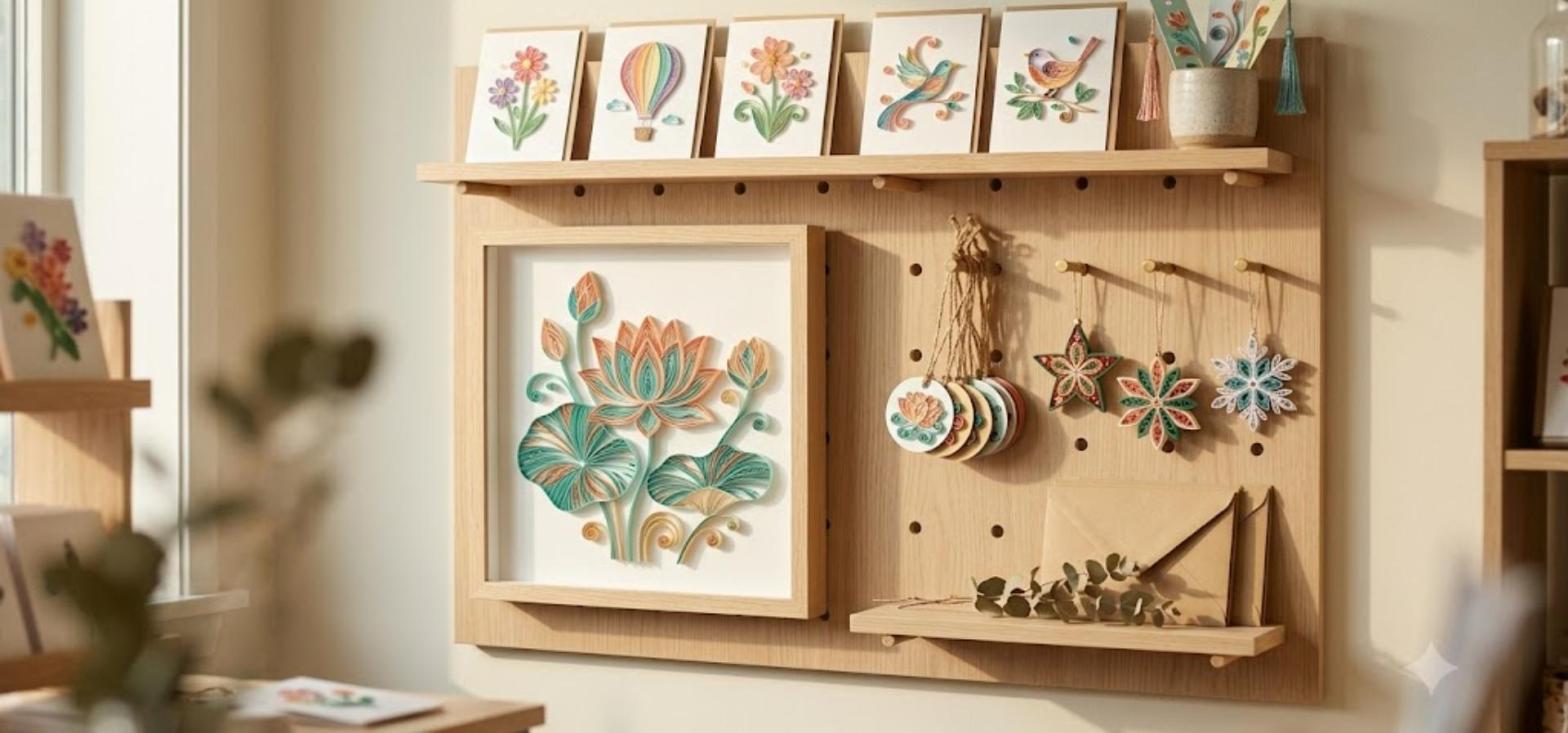
Why extend beyond greeting cards
A greeting card is a low ticket, high frequency purchase. That makes it a great traffic item but a limited margin driver on its own. Adding related quilled products solves three common problems for buyers:
- Higher basket value. A shopper who picks up a card is already sold on the craft. A matching gift tag, bookmark or small framed piece next to it is an easy add on.
- Less seasonality. Cards peak around a handful of occasions. Wall art and gift sets sell through the year and can anchor a permanent display.
- One supplier, one story. Every item comes from the same workshop, the same paper and the same design language, so the range looks curated rather than assembled from several vendors.
The quilling product family at a glance
The table below compares the most practical range extensions from a buyer’s point of view. Figures are typical working ranges for planning; the exact numbers are confirmed per design during sampling.
| Product | Best channel | Production effort vs. a standard card | Packaging need | Selling season |
|---|---|---|---|---|
| Quilling greeting card | Gift shops, stationery, online | Baseline | Cello sleeve with envelope | Occasion driven |
| Gift tags (set of 3 to 6) | Gift wrap counters, hotel shops | Lower per piece, small motifs | Header card with hang hole | Q4 and festive peaks |
| Bookmarks | Museum shops, bookstores, airports | Lower, flat and slim | Rigid sleeve to protect coils | All year, tourist driven |
| Hanging ornaments | Christmas markets, Ramadan and Eid decor, gift retail | Similar, but two sided work | Individual box or blister | Strong seasonal peak |
| Framed wall art (shadow box) | Interior and lifestyle stores, hotels, corporate gifts | Much higher, large motif and frame | Corner protectors, double wall carton | All year |
| Boxed gift set (card plus tag plus bookmark) | Corporate gifting, e-commerce bundles | Combined effort plus assembly | Printed or kraft gift box | Q4, Lunar New Year, Eid |
How each extension changes MOQ, lead time and cost
Gift tags and bookmarks are the easiest additions. They reuse motifs from your card designs at a smaller scale, so there is little new artwork to develop. Because each piece is small, the workshop can batch them alongside card production, and minimums per design are usually modest. The main cost lever is packaging: a well designed header card or sleeve often costs as much attention as the quilling itself.
Ornaments need to look good from both sides and survive handling on a tree or hook. That means extra coils on the reverse, a secure hanging loop and a stiffer backing. Plan them early: ornament orders cluster in the same weeks as Christmas card orders, so capacity is the real constraint, not materials.
Framed wall art is a different product class. A large motif can take many hours of skilled work, and the frame, glass or acrylic front and protective packing add cost and freight volume. MOQs per design are lower, but unit prices are much higher, so it suits buyers who want a premium hero piece rather than volume. Acrylic fronts are worth considering for long distance freight to reduce breakage.
Boxed gift sets combine items you already buy. The extra work is assembly and the box itself. For corporate gifting buyers, this is where custom colours and a branded insert create the most perceived value for the least added cost.
Design once, use across the range
The most efficient way to extend a range is to build a small design system rather than new artwork for every item. Pick three to five signature motifs, for example a lotus, a hot air balloon and a songbird, and a fixed palette of six to eight paper colours. Then scale each motif to fit the card, the tag, the bookmark and the frame. This approach:
- Shortens sampling, because the workshop already knows each motif.
- Keeps colour consistent across products, since the same paper batches are used.
- Makes the display read as a collection, which supports higher shelf prices.
- Simplifies reorders, because you replenish motifs rather than dozens of unrelated SKUs.
A starter assortment for a first range extension
For a buyer already stocking quilling cards, a sensible first step is a compact assortment that tests demand without tying up too much cash:
- Keep your existing best selling card designs as the anchor.
- Add a gift tag set and a bookmark in the same two or three motifs.
- Add one seasonal ornament line timed to your peak, Christmas or Ramadan and Eid depending on market.
- Add one framed piece per motif as a display hero, in small quantity.
- Optionally, bundle card, tag and bookmark into a gift box for online and corporate channels.
Track sell through by product type for one season. The data will tell you whether to deepen the small add on items, push the gift box, or expand the framed art line.
Packaging and freight considerations
Mixing product types in one shipment is efficient, but each type needs its own protection. Flat items such as cards, tags and bookmarks pack densely in master cartons. Ornaments and framed pieces are bulkier and more fragile, which increases volumetric weight on air freight. A practical approach is to consolidate everything into one order and one booking, but pack the framed art in its own reinforced cartons and decide air or sea per product type. Ask for drop tests on framed pieces and ornaments before mass production.
Questions to ask your supplier before adding new product types
- Which of my current card motifs scale well to tags, bookmarks and frames?
- What is the minimum per design for each product type, and can designs be mixed within one order?
- How does adding ornaments or framed art change total lead time in peak season?
- What frame materials and front panels are available, and which travel best?
- Can packaging carry my brand, barcode and care information?
- Can you produce a matched sample set so I can photograph the full collection before ordering?
Common mistakes when extending a quilling range
- Creating new artwork for every item instead of reusing a few signature motifs.
- Ordering ornaments too late, when the workshop is already full with festive card orders.
- Treating framed art like a card in packaging, which leads to broken glass and returns.
- Adding too many product types at once, so no single line gets enough display space to prove itself.
- Forgetting the display: a range sells best when cards, tags and frames are merchandised together.
Building a quilling collection with Viet Farm Vision
Viet Farm Vision works directly with a handmade quilling workshop in Vietnam and supplies custom handmade quilling greeting cards and related paper craft items to gift wholesalers, stationery brands, museum and hotel shops and corporate buyers across the Middle East, Asia and Europe. We help you choose signature motifs, scale them across cards, tags, bookmarks, ornaments and framed art, and plan one consolidated order with clear lead times. You can learn more about the craft itself on the history and techniques of quilling. Share your channel, target price points and the motifs you already sell, and we will propose a starter collection and quote it in one request. Contact our team to start.