
Bagasse Tableware from Vietnam: The Compostable Line That Ships Cheapest per Unit
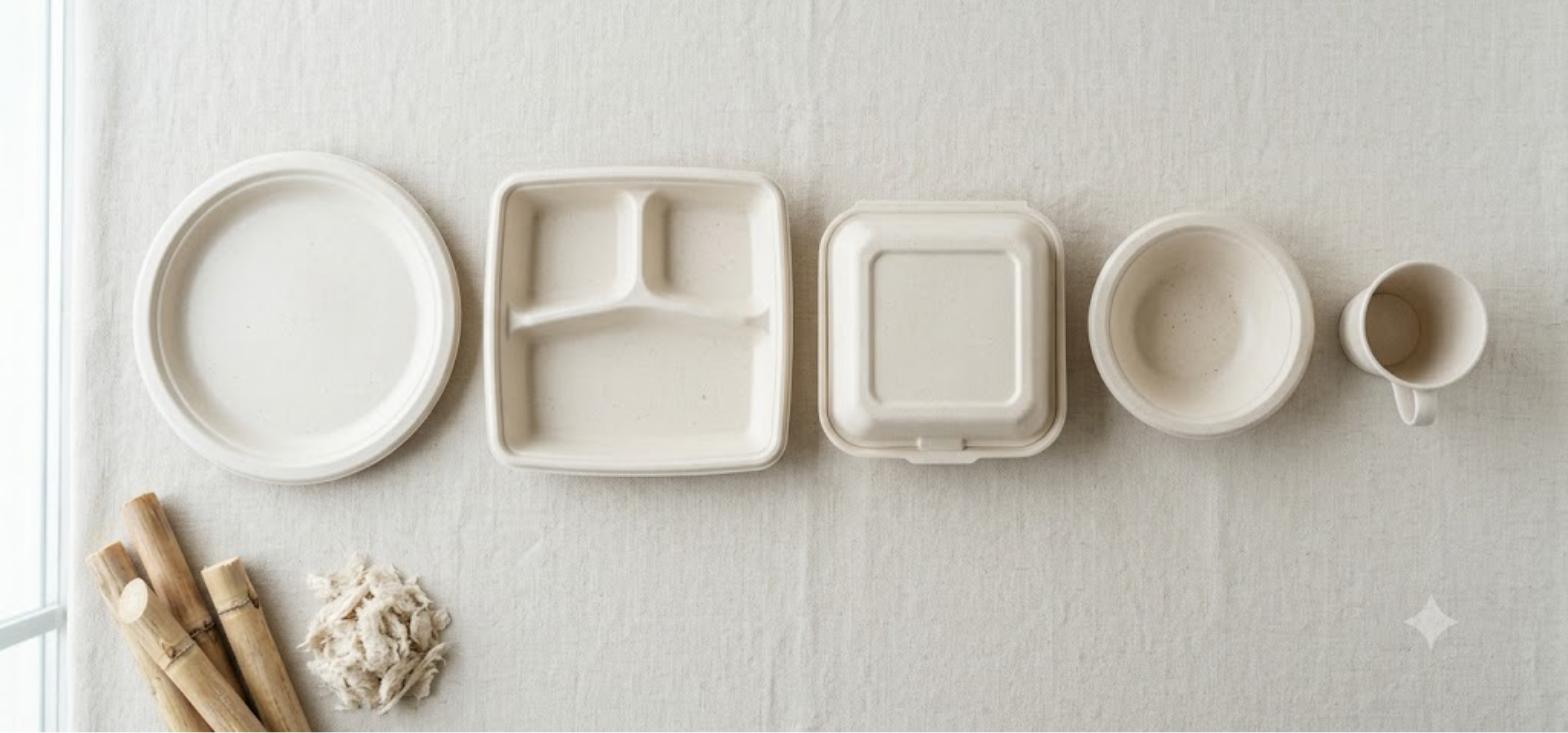
Bagasse tableware — plates, compartment trays, clamshell containers, bowls and cups moulded from sugarcane fibre left over after juice extraction — has become the workhorse of the compostable disposables category. It is the cheapest credible plastic replacement per unit, it nests and stacks for dense container loading, and unlike moulded-pulp lines made from virgin wood it carries an agricultural-waste story that procurement teams can defend to their own sustainability committees.
For importers building a foodservice or retail eco-disposables range in 2026, Vietnam has quietly become the practical alternative to Chinese supply. This guide covers what to specify, what pricing and MOQ to expect, which certificates actually matter, and how to structure a first order.
Why Vietnam for Bagasse Tableware in 2026
Three structural factors are moving this category to Vietnam. First, feedstock: Vietnam presses a large sugarcane crop annually and the mills generate bagasse as a by-product with no competing food use, so raw material cost is low and locally sourced rather than imported. Second, tariffs — Vietnamese-origin goods entering the United States face a 20% rate against 100%+ on comparable Chinese-origin product, and buyers who have already re-routed their kitchenware lines are consolidating disposables with the same suppliers. Third, trade agreements: the Vietnam–UAE CEPA signed on 3 February 2026 gives GCC importers preferential access, and RCEP covers Vietnam plus fourteen Asian partners, which matters on a low-value high-volume item where duty is a meaningful share of landed cost.
The practical consequence for buyers is capacity availability. Vietnamese moulded-pulp lines are newer, less booked, and generally more willing to run small trial quantities and custom moulds than the established Chinese plants.
What Bagasse Actually Is — and What It Is Not
Bagasse is the fibrous residue remaining after sugarcane stalks are crushed for juice. It is pulped, screened, and thermoformed under heat and pressure into rigid tableware. Because it is a by-product, no additional land or crop is grown to produce it.
Two clarifications worth making with your own sales team before the range goes to market. Bagasse is not a bioplastic — there is no PLA lining in a correctly specified product, which is why it composts in industrial and, for most items, home conditions rather than needing a dedicated PLA waste stream. And bagasse is not the same as bamboo pulp or wood pulp moulded fibre; blends exist and are legitimate, but if your marketing claim is “made from sugarcane waste” the specification sheet needs to say 100% bagasse, not “plant fibre”.
The SKU Range Buyers Order Most
- Round plates — 6″, 7″, 9″ and 10″, plain or with a raised rim. The 9″ plate is the volume driver in almost every market.
- Compartment trays — 3- and 5-compartment school, canteen and catering trays, with or without lid.
- Clamshell containers — 6×6″, 8×8″, 9×9″ hinged burger and meal boxes for delivery and takeaway.
- Bowls — 12oz to 32oz for soup, salad and rice, usually paired with a PET or bagasse lid.
- Cups and lids — 4oz to 16oz hot and cold cups.
- Portion cups, cutlery trays and sushi trays — lower volume but useful for filling out a mixed container.
The Four Specifications That Decide Quality
1. PFAS-free grease and water resistance. This is the single most important line on the specification sheet. Older moulded-fibre tableware achieved oil resistance using per- and polyfluoroalkyl substances. PFAS are now restricted or banned in food-contact applications across the EU and a growing list of markets, and a shipment that tests positive is unsellable. Require a written PFAS-free declaration plus a third-party test report referencing total fluorine content, and re-test annually rather than accepting a one-off certificate.
2. Basis weight and rigidity. Bagasse products are quoted by gram weight per piece — a 9″ plate typically runs 14–17 g depending on the grade. Cheap offers are almost always underweight product that flexes under a hot meal. Fix the target weight and tolerance (for example 15 g ±0.5 g) in the purchase order, and check it at inspection with a scale rather than by feel.
3. Temperature and liquid performance. Standard bagasse should hold from roughly −25°C to 100°C, be microwave and freezer safe, and resist liquid for 30–60 minutes without softening at the base. Ask for the test method, not just the claim, and run your own soak test on the pre-production sample with the actual food your customers serve.
4. Moisture content and packing. Moulded pulp absorbs ambient humidity. Product shipped above 10–12% moisture arrives soft and, in a hot container, mould-spotted. Specify the moisture ceiling, require polybag inner packing with desiccant on long ocean legs, and insist that cartons are palletised rather than floor-loaded on humid routes.
Indicative FOB Pricing and MOQ
- Round plates 6″–10″ — USD 0.02–0.06 per piece FOB Ho Chi Minh City
- 3- and 5-compartment trays — USD 0.05–0.10 per piece
- Clamshell containers — USD 0.04–0.09 per piece
- Bowls 12–32 oz — USD 0.03–0.09 per piece
- Cups 4–16 oz — USD 0.03–0.07 per piece
Typical MOQ is one 20ft container, which a supplier will normally allow you to split across three to five SKUs on a first order. Single-SKU minimums of 50,000–100,000 pieces are common. Prices move with sugarcane season, pulp cost and the coating specified — a PFAS-free water-and-oil barrier adds roughly 8–15% over an uncoated plate. Treat the figures above as a budgeting range and confirm against a live quotation.
Certifications to Ask For
- EN 13432 / TÜV OK compost INDUSTRIAL — the baseline compostability standard for European buyers. OK compost HOME is the stronger claim and is achievable on uncoated bagasse.
- Food-contact compliance — EU Regulation 1935/2004 and, for GCC destinations, the applicable Gulf Standard food-contact conformity.
- PFAS-free test report — total fluorine, from an accredited laboratory, dated within twelve months.
- ISO 9001 and BSCI or Sedex — quality system and social audit, increasingly requested by European and Middle Eastern retail chains.
- Halal certification — not obligatory for tableware, but GCC and Southeast Asian buyers frequently request it as part of a supplier file.
Regulatory Drivers Behind the Demand
The category is being pulled by legislation rather than by consumer preference alone. The EU Single-Use Plastics Directive removed expanded-polystyrene food containers, plastic plates and cutlery from the market. Several GCC emirates and Gulf states have introduced phased single-use plastic restrictions covering foodservice items. Vietnam itself is phasing out single-use plastics under Decree 08/2022, which is part of why domestic manufacturing capacity was built out ahead of export demand. For an importer, that means the switch is not a marketing experiment — it is a compliance deadline moving through one market after another.
Private Label and OEM Options
Moulded pulp takes branding differently from plastic. The realistic options are an embossed logo or pattern in the mould itself, food-safe printing on the product surface, and — most commonly — branded shrink sleeves, banderoles and retail cartons. Embossing requires a custom mould, which carries a one-off tooling charge and is only worth it above roughly one container per SKU per year; sleeve and carton branding costs almost nothing and is where most private-label programmes start.
If you are assembling a full eco-disposables range, bagasse pairs naturally with areca palm leaf plates at the premium end and disposable wooden cutlery as the companion SKU. Our broader compostable tableware sourcing guide compares the three material families side by side.
Verifying Genuine Vietnamese Origin
Because the tariff and duty differential is now large, transshipment risk is real in this category — semi-finished pulp or finished product imported, repacked and re-exported as Vietnamese. Ask for a Certificate of Origin Form B or the relevant preferential form, request the manufacturer’s business registration and factory address rather than a trading company’s, and arrange a video or third-party factory audit that shows the thermoforming line running your item. A supplier that cannot show you the moulds should not be shipping your order.
A Practical First-Order Sequence
- Shortlist three to five SKUs and fix target gram weight, coating type and compostability standard in writing.
- Request paid samples of every SKU and run a real soak-and-heat test with your own menu items.
- Collect the PFAS-free report, compostability certificate and food-contact declaration before issuing the purchase order.
- Place a mixed 20ft trial container rather than a single-SKU commitment.
- Book third-party pre-shipment inspection covering gram weight, moisture content and carton count.
- Scale to full-volume and custom-mould branding once the trial clears inspection and sells through.
Working with Viet Farm Vision
Viet Farm Vision supplies bagasse tableware and the wider compostable disposables range to wholesale, retail and HORECA buyers across the Middle East, Asia, Europe and Africa. We handle SKU selection, PFAS-free coating specification, compostability documentation, private-label packaging and export paperwork from a single point of contact — including gram-weight and moisture verification with pre-shipment inspection reports on every order.
To request a quotation, a product catalogue or paid samples, contact our export team at info@vietfarmvision.com or visit vietfarmvision.com/contact-us.