
A compostable tableware programme rarely fails on price. It fails at a customs desk, at a retailer compliance review, or in a consumer-protection audit, and almost always for the same reason: the certificate on file did not cover the product in the container. It covered a raw material, or a different grammage, or a sister item, or it had lapsed eighteen months earlier.
This guide sets out how compostable and disposable tableware certification actually works in 2026 for buyers sourcing from Vietnam. It explains what EN 13432 and ASTM D6400 test, what the Seedling, OK compost and BPI marks each mean, why home compostable is a separate scheme rather than a stronger grade, how the new EU PFAS limits changed the document pack this month, and exactly which papers to demand before a deposit leaves your account.
A Certificate Is Issued to a Product, Not to a Factory
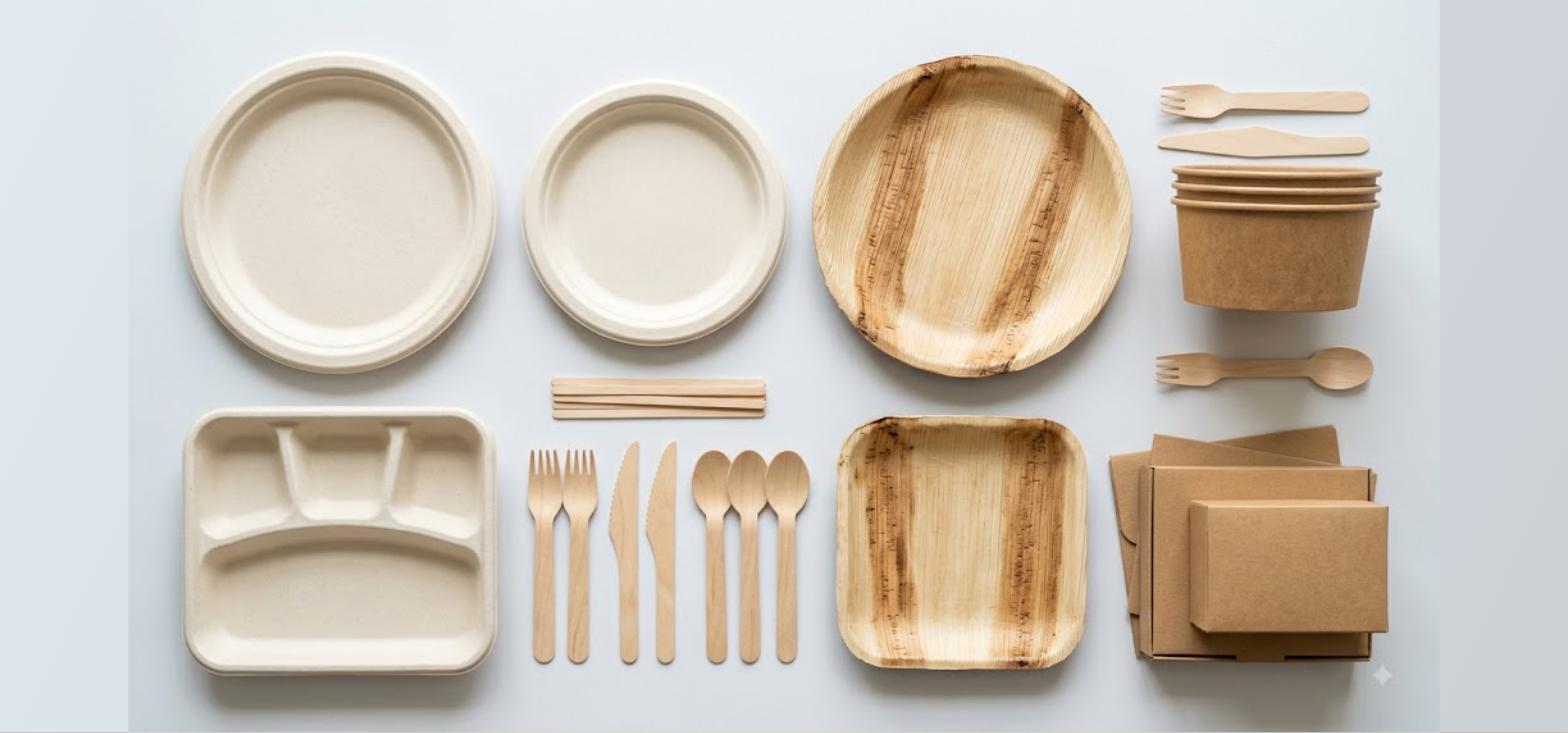
This is the single most expensive misunderstanding in the category. Compostability certification is granted against a defined article: a stated material composition, a stated thickness or grammage, a stated coating, and often a stated colour or print system. It is not a licence held by the factory that then covers everything the factory makes.
Three consequences follow, and every one of them has cost buyers money:
- A certificate held by the pulp mill or the resin producer certifies the input, not the finished plate. The converter must hold its own certificate or be formally listed as a licensed user on the raw material holder’s certificate.
- A certificate for a 25 g bagasse plate does not automatically cover a 35 g bagasse plate. Schemes certify up to a maximum thickness or weight, because disintegration behaviour changes with mass.
- Adding a coating, a barrier layer, an ink, or a lamination to a certified base article invalidates the certificate for that new article until the new construction is tested.
When a supplier sends a certificate, the first question is not whether it is genuine. It is whether its scope covers the SKU you are ordering, at the specification you are ordering it.
EN 13432 and ASTM D6400: The Two Standards Everything Else Sits On
Almost every compostability mark in world trade traces back to one of two test standards. EN 13432 is the European standard for packaging recoverable through composting and biodegradation. ASTM D6400 is its North American counterpart for plastics and products designed to be composted in municipal and industrial facilities. ISO 17088 is the international equivalent, and EN 14995 extends EN 13432 to plastics that are not packaging.
The pass criteria are broadly aligned and worth knowing in plain terms, because they explain why testing takes the better part of a year:
- Biodegradation. At least 90 per cent of the organic carbon must convert to carbon dioxide within six months under controlled industrial composting conditions, tested at roughly 58 °C.
- Disintegration. After twelve weeks in a composting trial, no more than 10 per cent of the original dry mass may remain as fragments larger than 2 mm.
- Heavy metals and fluorine. The material must sit below defined limits for regulated metals, and modern scheme rules add a total fluorine ceiling.
- Ecotoxicity. The resulting compost must not suppress plant growth in a germination and biomass test against a control.
- Composition. At least 50 per cent volatile solids, and no more than a small percentage of components that are not themselves demonstrated to biodegrade.
The Marks Buyers Actually See on a Carton
Standards are tested by laboratories. Marks are issued by certification bodies that verify conformity and license a logo. Four appear on most Vietnamese export cartons, and they are not interchangeable.
- Seedling. Owned by European Bioplastics and licensed through TUV Austria and DIN CERTCO. It signals conformity with EN 13432 for industrial composting. It is the mark European retailers recognise fastest.
- OK compost INDUSTRIAL. Issued by TUV Austria, also based on EN 13432. Functionally equivalent to Seedling in scope, different licensor.
- OK compost HOME. A separate TUV Austria scheme tested at ambient temperature rather than industrial heat. Strictly harder to obtain, and covered in the next section.
- BPI Certified Compostable. Issued by the Biodegradable Products Institute against ASTM D6400 and D6868, and the reference mark for North American composters and several US state procurement rules.
DIN CERTCO also issues a DIN-Gepruft industrial compostable mark, and buyers shipping to Australia and New Zealand will see AS 4736 and AS 5810 under the Australasian Bioplastics Association scheme. For Middle East and most Asian destinations there is no mandatory local compostability scheme, so EN 13432 conformity plus a recognised mark is the practical benchmark, and it is what GCC hospitality groups and regional supermarket chains now ask for.
Home Compostable Is Not a Stronger Version of Industrial Compostable
Buyers frequently ask for both marks assuming home compostable is simply the premium tier. It is a different test regime, and a product can hold one without the other.
Industrial composting testing runs hot, around 58 °C, in a managed facility. Home composting testing runs at ambient temperature, typically 20 to 30 °C, which slows microbial activity dramatically. The OK compost HOME scheme therefore allows twelve months for biodegradation and six months for disintegration, against six months and twelve weeks industrially. Achieving it at ambient temperature is genuinely harder, and many coated or laminated constructions that pass EN 13432 comfortably will not pass a home scheme at all.
The commercial question is which claim your market can actually honour. Home compostable is valuable where consumers have garden composters and where retailers market on it. In a market with no municipal composting infrastructure, neither mark changes what physically happens to the plate after use, and a home compostable claim that costs 15 per cent more per piece may buy nothing but a logo. Decide the claim first, then specify the construction to it.
PFAS: The Compliance Change That Reshaped the Document Pack
For years, grease and water resistance in moulded fibre and paper tableware was achieved with fluorochemical treatments. That era has closed, and 2026 is the year it closed decisively in Europe.
The EU Packaging and Packaging Waste Regulation, Regulation (EU) 2025/40, restricts per- and polyfluoroalkyl substances in food-contact packaging placed on the EU market, and that restriction became applicable in August 2026. National bans arrived earlier in Denmark and France, and a series of US states including California, New York, Washington and Minnesota already prohibit intentionally added PFAS in food packaging. BPI has required the absence of intentionally added fluorinated chemicals, with a total fluorine ceiling, since 2020.
What this means at the purchase-order level is straightforward. A compostability certificate is no longer sufficient evidence of compliance for a European or North American programme. You need a separate total-fluorine or total-organic-fluorine test report on the finished article, from an accredited laboratory, dated within a sensible window, plus a supplier declaration that no PFAS were intentionally added at any stage including release agents and coatings.
Ask specifically about release agents. Moulded fibre tooling historically used fluorinated release chemistry, and a factory that switched its coating but not its release agent can still return a positive total fluorine result on an otherwise clean product.
What Each Vietnamese Material Can and Cannot Claim
Vietnam supplies four distinct compostable tableware families, and their certification profiles differ more than their price lists suggest.
Bagasse. Sugarcane pulp, moulded under heat and pressure, and the workhorse of the category for plates, bowls, compartment trays and clamshells. Certification is well established and widely held. The variables that matter are grammage, the barrier system used for grease and water resistance, and whether the mill blends bamboo or wood pulp into the furnish. Our bagasse tableware sourcing guide covers specification and pricing in detail.
Areca palm leaf. Pressed from naturally fallen betel palm leaf sheaths using heat and water only, with no binder, no resin and no coating. It is the cleanest compostability story in the category and usually the simplest to certify, but it is a natural material, so colour, grain and slight dimensional variation are inherent rather than defects. See our areca palm leaf plate guide for tolerance expectations.
Wooden cutlery and stirrers. Birch or poplar veneer, cut and formed, typically uncoated. The compostability case is uncontroversial. Here the document pack shifts toward food-contact safety, moisture content and, increasingly, FSC chain of custody and EU deforestation-regulation evidence. Our disposable wooden cutlery guide sets out the relevant checks.
Kraft paper and board. Cups, bowls and boxes. This is where barrier chemistry decides everything. A PE-lined cup is not compostable; a PLA-lined cup is industrially compostable but generally not home compostable; a water-based dispersion barrier can achieve both, at a cost and with tighter storage requirements.
A broader comparison of the four families sits in our compostable tableware buyer guide.
Reading a Certificate Without Being Misled
Take thirty seconds over every certificate before it goes in the file. Five fields decide whether it is worth anything to you.
- Certificate holder. Is it the factory that will make your goods, or a raw material supplier, or a trading company? If it is not your manufacturer, ask for the licensed-user listing that connects them.
- Registration number. Every scheme publishes a searchable database. Look the number up yourself rather than accepting a PDF.
- Scope. Read the product description line for line. Material, article type, grammage or thickness range, coating, and print. If your SKU falls outside it, the certificate does not cover your SKU.
- Validity. Certificates expire, usually on a three to five year cycle with interim surveillance. An expired certificate is a marketing document, not evidence.
- Standard cited. EN 13432, ASTM D6400, AS 4736 and the home schemes are not substitutes for one another. Match the standard to the destination market.
Two red flags deserve a hard stop. The first is a certificate image with the holder name cropped or blurred. The second is a claim of “biodegradable” offered in place of “compostable”. Everything biodegrades eventually; compostable is a measured claim with a deadline attached, and only the second is defensible in front of a regulator.
Green Claims: What You Are Allowed to Print on the Pack
Certification governs the product. Labelling law governs the sentence you print about it, and the two are drifting apart in favour of stricter labelling. The EU has moved against vague environmental wording, and generic phrases such as eco-friendly, green or planet-safe are increasingly unusable without substantiation tied to a verified scheme.
Practical rules that keep artwork defensible in most markets: name the scheme and the certificate number rather than making a bare claim; state the disposal route the claim depends on, because industrial compostable is meaningless to a consumer with no collection stream; avoid combining a compostability mark with a recycling symbol, since the two disposal routes conflict; and never let a factory place a mark on artwork before the licence covering that specific SKU is issued in writing.
Note also that under the EU Single-Use Plastics Directive, compostable plastics such as PLA are still classified as plastic. A compostable PLA-lined cup does not escape the directive because it is compostable. Fibre-based items without a plastic lining sit in a materially different position, which is a large part of why bagasse and areca palm leaf have taken share in Europe.
The Document Pack to Request Before You Pay a Deposit
Request this as a single package at quotation stage, not after production. A supplier who can assemble it in two working days is running a compliant operation. A supplier who needs three weeks is assembling it for the first time.
- Compostability certificate for the exact SKU, with registration number, scope and validity, issued to your manufacturer or listing them as a licensed user.
- Laboratory test report behind that certificate, not only the certificate face.
- Total fluorine or total organic fluorine report on the finished article from an accredited laboratory, plus a no-intentionally-added-PFAS declaration covering coatings and release agents.
- Food-contact compliance evidence for the destination market: EU framework and the relevant national paper and board recommendations, US FDA status, or GCC and local requirements as applicable.
- Heavy metal and migration test reports where the destination market requires them.
- ISO 9001 or ISO 22000, HACCP and BSCI or Sedex audit reports for the producing site.
- Certificate of origin format confirmation, plus HS code, so preferential duty treatment is not lost at clearance.
- Artwork approval showing the mark, licence number and disposal instruction exactly as they will be printed.
Frequently Asked Questions
Does a compostability certificate prove my product is PFAS-free?
No. Compostability schemes have tightened fluorine limits, and BPI has excluded intentionally added fluorinated chemicals since 2020, but a compostability certificate is not a PFAS test report. For EU and US programmes in 2026 you need a separate total fluorine result on the finished article.
Can a supplier use its raw material supplier certificate?
Only if the converter is formally listed as a licensed user under that certificate, and only for articles within its scope. A pulp certificate alone does not certify a finished plate, and customs and retail compliance teams increasingly check the holder name.
How long does it take to certify a new item?
Budget six to twelve months for a genuinely new construction, because the biodegradation test alone runs to six months. If your launch window is shorter, specify a construction that already sits inside an existing certificate scope rather than inventing one.
Is home compostable worth paying for?
It depends entirely on the destination. In markets with domestic composting habits and retailers who merchandise on it, yes. In markets with no composting infrastructure it is a label premium with no physical outcome attached, and the money is usually better spent on grammage or packaging.
Which certification do Middle East buyers ask for?
There is no mandatory GCC compostability scheme, so most regional hospitality groups, caterers and supermarket chains have converged on EN 13432 conformity evidenced by Seedling or OK compost, alongside standard food-contact and halal-relevant documentation. Buyers supplying both Europe and the Gulf normally certify once to EN 13432 and use it for both.
Where Viet Farm Vision Fits
Viet Farm Vision is a Vietnam-based OEM manufacturer and exporter of wooden kitchenware and houseware, compostable and disposable tableware, agricultural products and handcrafts, supplying wholesale and private-label buyers across the Middle East, Asia and wider international markets.
On compliance specifically, we send the document pack with the quotation rather than after the order. That means the compostability certificate with its registration number and scope, the laboratory report behind it, the total fluorine result on the finished article, and the food-contact evidence for your destination market, all matched to the exact SKU and grammage being quoted. Where a requested claim does not match the construction, we say so at quotation stage and propose the construction that does, rather than discovering it during a retailer audit.
Send us your item list, destination market, the claim you intend to print and your annual volume, and we will return a quotation with the certification scope, the applicable standard and the lead time for any item that needs new testing set out line by line.