
A European housewares buyer reorders the same acacia serving board she bought nine months earlier. Same factory, same drawing, same finish, same quantity. The quote comes back 8.4% higher. Her first instinct is that the supplier is testing her. Her second is to open the file, benchmark three competing factories in Binh Duong and Dong Nai, and discover that all three have moved within a point of each other. Nobody is testing her. The log market moved, and every factory buying from the same plantation base moved with it.
Raw material is the largest single line in a wooden kitchenware FOB price, and it is the line buyers understand least. Labour, packaging and freight are visible and negotiable. Timber is a commodity with its own supply cycle, its own seasonality, its own competing buyers, and from 2026 its own compliance overhead. A buyer who understands what actually moves the price of an acacia billet or a rubberwood board can time orders better, write smarter contracts, and stop treating every price increase as a negotiating position.
This guide explains how the acacia and rubberwood raw material markets behave in 2026, which forces genuinely move your FOB price, and how to build raw material risk into a purchase order instead of arguing about it after the fact.
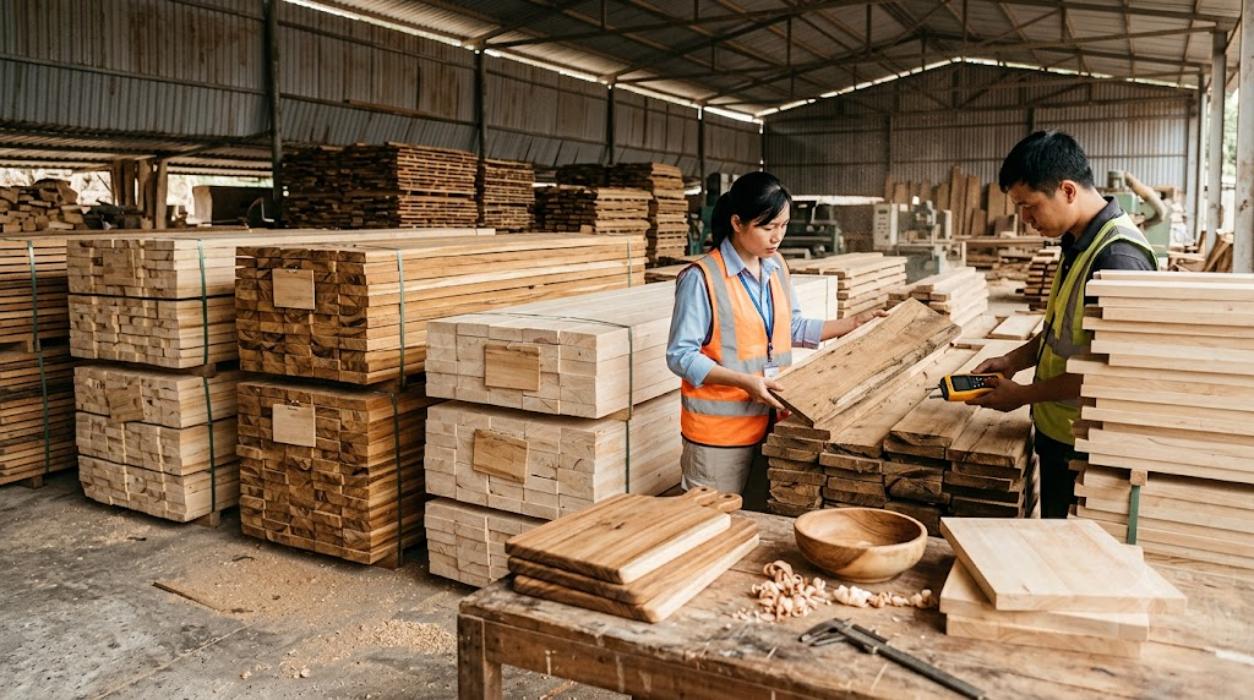
Why raw material dominates the FOB price
In a typical Vietnamese wooden kitchenware factory, timber is 35–50% of ex-works cost, depending on product geometry and yield. A thin cutting board with straight edges buries less wood per unit than a turned bowl or a deep-profile serving tray, but the same board can lose 40% of its input volume to defect cutting if the lumber grade is poor. That is why two quotes for an identical drawing can differ by 15% without either factory being unreasonable.
| FOB cost element | Typical share | Volatility | Who controls it |
|---|---|---|---|
| Kiln-dried lumber | 35–50% | High — commodity cycle | Plantation and log market |
| Direct labour (machining, sanding, assembly) | 15–22% | Low to moderate | Factory |
| Finishing (oil, wax, lacquer, curing) | 5–9% | Low | Factory and spec |
| Export packaging and retail presentation | 6–14% | Moderate — paperboard prices | Buyer spec |
| Overhead, QC, compliance, certification | 8–12% | Rising in 2026 | Shared |
| Factory margin | 6–12% | Negotiable | Factory |
The practical implication: if you want to defend a retail price point, arguing about the 6–12% margin line is far less productive than working on the 35–50% timber line through species choice, thickness, yield-friendly geometry and order timing. Our guide to cost engineering a wooden kitchenware range covers the design levers; this article covers the market underneath them.
Acacia and rubberwood are not the same market
Buyers often treat “Vietnamese hardwood” as one commodity. It is two, and they respond to completely different signals. If you understand nothing else about timber supply, understand this distinction, because it determines which species is the safer bet in any given quarter.
Acacia: a purpose-grown plantation crop
Acacia (mainly Acacia mangium and the Acacia hybrid) is planted specifically to be harvested. Vietnam’s plantation estate is dominated by smallholders, and the classic commercial rotation is short — roughly five to seven years, driven by cash-flow needs rather than optimum timber quality. Around 80–90% of the raw timber feeding Vietnam’s plywood sector now comes from domestic acacia and eucalyptus plantations, which is why acacia availability is closely tied to what the panel and chip industries are willing to pay.
Short rotations produce small-diameter logs with a high proportion of juvenile wood: more internal stress, more colour variation, narrower clear cuttings. Longer rotations of eight to ten years — increasingly promoted through FSC-linked smallholder programmes — yield larger, more stable timber suitable for wider board widths and cleaner faces. When a factory quotes you an unusually low acacia price, the first question is not “why so cheap” but “what rotation and what grade”.
Rubberwood: a by-product of the latex cycle
Rubberwood is not planted for timber at all. It is the residue of a latex plantation reaching the end of its productive tapping life, typically at 25 to 30 years. Vietnam’s rubber estate covers roughly 910,000 hectares, about 80% of which is currently in tapping age, and 488,000 hectares of that is in the hands of some 264,000 smallholder households. Rubberwood furniture and panel products already contribute over USD 2 billion a year in export value.
The consequence for buyers is counter-intuitive: rubberwood supply is driven by the latex price, not the timber price. When latex prices are strong, growers delay felling and rubberwood supply tightens. When latex is weak and replanting programmes accelerate, a wave of logs hits the market and rubberwood board prices soften. Many of the plantations established in the early 2000s are now reaching the end of their optimal yielding lifespan, which makes replanting cycles a live variable through the rest of the decade.
If you have not yet decided between them, our acacia vs rubberwood vs bamboo comparison covers the technical and aesthetic differences. The point here is commercial: they peak and trough at different times, and a range specified in only one species has no shock absorber.
Six forces that actually move your timber price
When a factory tells you “material cost went up”, ask which of these six moved. A supplier who can answer specifically is managing their supply chain. A supplier who cannot is passing on a rumour.
1. Competing demand for the same log
A single acacia log can become sawn lumber for kitchenware, a plywood veneer core, wood chips for export, or biomass pellets. These industries bid against each other for the same plantation output. Vietnam’s wood and wood product exports reached USD 17.2 billion in 2025, up almost 6% year on year, with USD 3.03 billion in Q1 2026 alone. Strong furniture and panel demand pulls logs away from the small-item kitchenware sector, which buys in far smaller volumes and has less bargaining power at the plantation gate.
2. Plantation and replanting cycles
Acacia supply follows a five-to-seven-year sawtooth in each growing region; rubberwood follows the far longer latex replanting wave. Regional replanting clusters mean a province can swing from oversupplied to tight within two harvest seasons. Factories with contracted plantation relationships ride this out; factories buying spot at the log yard do not.
3. Weather and the Central Vietnam typhoon season
The September–November storm season in central provinces disrupts harvesting, log haulage and yard drying. Windthrow can briefly flood the market with salvage logs of poor quality, then leave a hole in supply the following quarter. This is one of the most predictable seasonal patterns in the market and one of the easiest to plan around.
4. Kiln capacity and energy cost
Green lumber is not usable. Kiln drying to a stable 8–12% moisture content is a capital- and energy-intensive step, and kiln capacity is the real bottleneck in peak season, not sawing. When kiln queues lengthen, factories either quote longer lead times or buy pre-dried lumber at a premium. Under-dried wood is the single most common root cause of warping and cracking claims — see our guide to moisture content and cracking.
5. Certification and traceability overhead
This is the fastest-growing cost line in 2026. The EU Deforestation Regulation applies to large operators from 30 December 2025 and to small and medium-sized importers from 30 June 2026. Vietnam’s Department of Forestry and Forest Protection issued EUDR compliance guidance for the wood sector under Decision No. 29/QD-LNKL of 7 February 2026. Meeting it requires geolocation data, plot-level records and a due diligence statement — work that has to be paid for somewhere in the chain.
6. Currency and freight
Timber is bought domestically in Vietnamese dong and sold in US dollars. A weaker dong flatters FOB pricing for a period; a stronger dong compresses it. Ocean freight does not affect FOB directly but changes landed cost and therefore the price point you can defend at retail. Our breakdown of FOB price versus landed cost sets out the full calculation.
Grade and yield: why identical drawings get different quotes
“Acacia” is a species, not a specification. Quotes that look wildly different usually reflect different grades and therefore different cutting yields. Insist that the quotation states grade, not just species.
| Lumber tier | Typical characteristics | Cutting yield | Best use |
|---|---|---|---|
| Premium / clear face | Even honey tone, minimal knots, wide clear cuttings | 75–85% | Charcuterie boards, visible faces, gift sets |
| Standard commercial | Some sound knots and colour variation, mixed widths | 60–72% | Everyday cutting boards, utensils, trays |
| Economy / defect-heavy | Frequent knots, pith, sapwood contrast, short cuttings | 45–60% | Finger-jointed panels, low-price promo lines |
| Salvage / storm logs | Unpredictable internal stress and staining | Variable | Avoid for food-contact kitchenware |
A factory quoting from economy lumber can look 12% cheaper on paper and still deliver a worse landed cost once you count rejects, replacement shipments and the retail returns that come from a board splitting in a customer’s kitchen. Ask for the yield assumption behind the quote. A supplier who knows their own yield number is a supplier who controls their process.
The 2026 certification premium, quantified
Certified material is no longer a niche request from a handful of European buyers; it is becoming the default requirement for EU-bound goods and a growing expectation elsewhere. The supply is real but finite. FSC currently covers roughly 310,000 hectares of forest in Vietnam alongside about 1,730 chain-of-custody certificates, and the combined FSC and PEFC certified commercial forest base is around 700,000 hectares, against a national target of one million hectares by 2030.
| Material status | Typical raw material premium | Documentation required | Practical availability |
|---|---|---|---|
| Uncontrolled plantation lumber | Baseline | Supplier declaration only | Wide |
| Verified legal, non-certified | +0–3% | Harvest records, transport documents | Wide |
| EUDR due-diligence ready | +3–7% | Plot geolocation, DDS, risk assessment | Growing but constrained |
| FSC Mix / Controlled Wood | +5–10% | Valid CoC certificate and claim on invoice | Moderate |
| FSC 100% | +8–15% | Full CoC chain, segregated stock | Limited — book early |
Two practical warnings. First, a factory holding a chain-of-custody certificate is not the same as your order being produced from certified stock — the claim has to appear on the invoice and packing list for the specific shipment. Second, certified lumber is booked, not bought on demand; if you need FSC 100% for a Q4 programme, the material conversation belongs in Q1, not in the week you place the PO. Our EUDR and FSC compliance guide covers the documentation in detail.
Writing raw material risk into the purchase order
Most disputes about price increases are really disputes about an unwritten assumption. Four clauses remove almost all of that friction, and no reputable Vietnamese factory will object to them.
- Price validity window. State how long the quoted FOB price holds — 60 or 90 days from quotation is normal for timber. An indefinite “price valid” line is a promise the factory cannot keep and will quietly break.
- Material specification, not just species. Name the species, the grade tier, target moisture content with tolerance, minimum clear-cutting width, and whether finger-jointing is permitted on visible faces. This is where 80% of quality disputes originate.
- Adjustment band and trigger. Agree that the price is fixed unless the factory’s verified kiln-dried lumber cost moves more than an agreed percentage (5–8% is a common band), and that any adjustment must be evidenced with purchase invoices, not asserted.
- Substitution consent. Prohibit species or grade substitution without written approval. A rubberwood board delivered against an acacia specification is a substitution, even if the customer might not notice on day one.
- Certification claim wording. If certified material is required, specify the exact claim that must appear on the commercial invoice and packing list, and make it a condition of payment.
A buyer’s hedging playbook
You cannot control the plantation cycle, but you can stop being its passenger. Five moves, in rough order of effort.
- Time your order calendar against the harvest, not the trade show. Placing large wooden kitchenware orders in the middle of peak furniture season and immediately after the central typhoon season is the most expensive way to buy. Booking earlier, against a forecast, is usually worth more than any discount you can negotiate.
- Dual-species your range. Specify a core range that can be produced in acacia or rubberwood with the same tooling and finish. When one market tightens, you move volume rather than absorb a price increase.
- Commit volume, not just intent. A rolling 12-month forecast with a firm first quarter lets a factory contract lumber ahead. Factories price certainty cheaply and uncertainty expensively.
- Ask the factory to forward-book lumber. For programmes above a container per quarter, some factories will buy and kiln lumber against your forecast if you underwrite the material. This converts a variable cost into a known one.
- Design for yield. Straight edges, standard thicknesses, widths that fit common board dimensions and tolerance for natural colour variation can move landed cost more than any negotiation. Insisting on perfectly uniform tone across a plantation hardwood is an expensive preference.
Reading the raw material story: red flags
When you audit a quote or a new supplier, the way they talk about timber is diagnostic.
- They cannot name the province or region their lumber comes from.
- They quote a single price for “acacia” with no grade, moisture or yield reference.
- They offer FSC material at a nominal premium with no chain-of-custody certificate number.
- Their price is materially below three benchmarked competitors on the same drawing — almost always a grade or moisture difference, not efficiency.
- They will not put the price validity window in writing.
- They present a certificate belonging to a trading partner rather than to their own legal entity.
Frequently asked questions
Is acacia or rubberwood cheaper in 2026?
There is no permanent answer, which is the point of this article. Rubberwood has historically been the lower-cost option because it is a by-product, but supply depends on latex economics and replanting cycles rather than timber demand. The safest position is a range specified so that either species can be produced, with the factory quoting both at the time of order.
How far ahead should I fix a price for a wooden kitchenware programme?
Ninety days is realistic for a fixed FOB price. Six to twelve months is achievable only with a volume commitment that allows the factory to contract lumber forward, and usually carries a small premium for that certainty. Beware of any supplier offering a fixed twelve-month price with no volume commitment; the price is either padded or will not hold.
Does FSC certification actually change the wood?
No. Certification is a claim about forest management and chain of custody, not about density, colour or stability. Buyers sometimes expect certified material to look better; it does not, and specifying appearance grade separately from certification avoids a great deal of disappointment.
Will EUDR affect me if I am not importing into the EU?
Not legally, but commercially it already does. Producers are building traceability systems for their EU-bound volumes, and the compliance overhead is spread across the factory’s cost base. Buyers in the Middle East, Asia and other markets are seeing part of that cost regardless, and increasingly find that the documentation is useful for their own retail customers.
Why did my price rise when published timber indices were flat?
Published indices usually track logs or commodity sawn timber. Your factory buys kiln-dried, graded lumber in specific widths and thicknesses. Kiln capacity, grade availability and width premiums can move sharply while the headline log index is flat. Ask for the kiln-dried purchase invoices, not the index.
Is storm-salvage lumber ever acceptable?
For structural or hidden components in non-food applications, sometimes. For food-contact kitchenware, no. Salvage material carries unpredictable internal stress and staining, and the failure usually appears months later in the end customer’s home, which is the most expensive place for it to appear.
Further Reading and Standards
- Forest Trends — Vietnam timber trade data — independent trade flow and risk analysis for Vietnamese wood products
- FSC Chain of Custody certification — how certified claims are substantiated through the supply chain
- EU Deforestation Regulation (EUDR) — scope, obligations and application dates
- PEFC facts and figures — certified forest area by country
- ISO 187 — standard atmosphere for conditioning and testing, relevant to moisture equilibrium testing
- EU Access2Markets — duty rates and import requirements by HS code