
Almost every wooden kitchenware negotiation is conducted against a single number: the FOB unit price. Buyers compare quotations line by line, push for two or three percent, and close. Six months later the programme is unprofitable, and the reason is almost never the FOB price. It is the ocean freight paid on air inside cartons, the duty rate on a code nobody checked, the inspection billed twice, and the payment terms that funded the factory’s working capital instead of the buyer’s.
This guide takes a Vietnamese wooden kitchenware and houseware order apart at the cost level. It sets out what actually sits inside an FOB price, which components are negotiable and which are not, how the Incoterm shifts risk as well as cost, how cube efficiency moves freight cost per piece further than unit price negotiation usually can, and how to build a landed cost model that survives a full season. The same structure applies to compostable and disposable tableware programmes, where cube dominates even more heavily.
The FOB Price Is Not a Price. It Is Six Costs Stacked Together
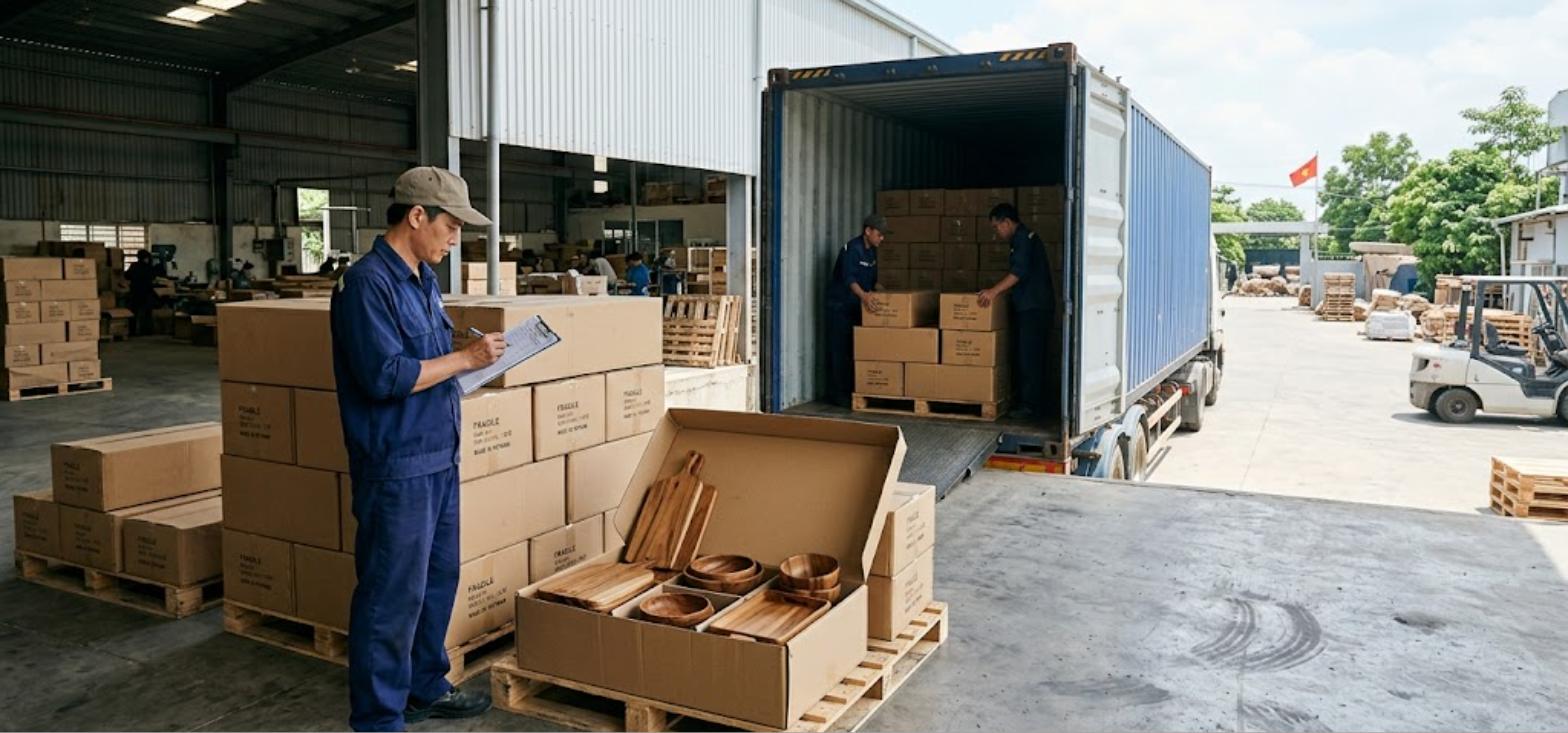
A quoted FOB Ho Chi Minh City price for an acacia serving board or a wooden salad bowl is the sum of six distinct cost pools. Each behaves differently under negotiation, and knowing which is which separates a buyer who saves money from one who quietly erodes quality.
- Raw material, roughly 40 to 55 percent. Kiln-dried acacia, rubberwood or bamboo panel, plus the sorting loss that never reaches a finished piece. This pool moves with log prices and with your own defect tolerance, not with negotiation.
- Direct labour and machining, roughly 15 to 25 percent. Cutting, profiling, sanding, drilling and hand finishing. Complex profiles, deep juice grooves and multi-radius edges raise sanding time disproportionately, because sanding is manual on almost every Vietnamese line.
- Finishing, roughly 5 to 10 percent. Mineral oil, an oil and beeswax blend, or water-based lacquer, plus the cure and rest time before packing. A lacquer system costs more in material and far more in floor space and elapsed time.
- Packaging, roughly 5 to 15 percent. Polybag, sleeve, colour box, insert and master carton. On gift-tier programmes packaging can exceed the finishing cost and occasionally approach the material cost.
- Factory overhead and margin, roughly 10 to 18 percent. Depreciation, dust extraction, kiln operation, QC staff, compliance documentation and profit.
- Export handling to the rail, roughly 2 to 5 percent. Inland trucking to port, terminal handling, customs declaration, certificate of origin, and heat treatment on pallets.
The practical conclusion is that only two pools are genuinely elastic: packaging and, to a lesser degree, machining complexity. Pressing the material pool means accepting looser grain selection, thinner stock or a wider moisture band. That is not a saving. It is a deferred claim.
Wooden Kitchenware Has No Tooling to Amortise, and That Changes the Volume Curve
Buyers arriving from plastics, ceramics or metal housewares expect a tooling conversation: pay for the mould, amortise it over volume, watch unit price fall sharply as quantity rises. Solid wood does not work that way. A board is cut from panel with a saw and a router template, the template costs very little, and there is almost nothing to amortise. The volume discount curve is therefore much flatter than in moulded categories.
As a working expectation, doubling order quantity on a solid wood SKU typically moves unit price by a single-digit percentage, not by twenty or thirty percent. Where volume genuinely helps is packaging print runs, container utilisation and scheduling continuity. That is why a buyer who consolidates six SKUs into one shipment usually saves more than a buyer who doubles quantity on one SKU.
Cube, Not Weight, Is What Your Freight Budget Actually Buys
A 40ft high cube container offers roughly 76 cubic metres of usable internal volume and a payload far above anything wooden kitchenware will reach. Bowls, trays and boards are bulky and light, so the container fills volumetrically long before it approaches its weight limit. Compostable and disposable tableware behaves the same way, only more extremely.
The consequence is one most buyers underweight. Freight cost per piece is set by how many pieces fit in the container, and packaging design controls that number. Moving a serving board from a kraft sleeve to a rigid two-piece gift box can reduce units per 40HC by fifteen to twenty-five percent. At that point the freight added per piece frequently exceeds the packaging cost per piece, and the buyer pays twice for the same decision.
- Require units per master carton, carton external dimensions in millimetres, carton gross weight and calculated cartons per 40HC on every quotation. A quotation without these numbers cannot be compared to another quotation.
- Ask whether bowls and trays are nested. Nesting is the largest single cube lever in wooden houseware and is often not applied unless requested.
- Check carton dimensions against the container floor plan. A carton 30 mm too wide to fit three across wastes a full row for the entire shipment.
- Where a range mixes bulky and dense SKUs, ask the factory to plan a mixed load rather than shipping each SKU in its own individually optimal carton.
The Incoterm Decides Who Pays for Surprises
Under Incoterms 2020, four terms cover almost all Vietnamese woodware and tableware trade: EXW, FOB, CFR and CIF. The headline difference is cost allocation. The difference that matters more is where risk transfers and who controls the carrier.
- EXW. Lowest quoted number, highest buyer workload. The buyer arranges export clearance in a country where it has no legal presence, which in practice means paying the factory’s forwarder anyway, without visibility of the margin.
- FOB Vietnamese port. The standard, and usually the right choice. Risk transfers when goods are loaded on board, and the buyer nominates the carrier, which means the buyer sees the real ocean rate rather than a marked-up one.
- CFR and CIF. Convenient for buyers without a forwarder relationship, but the freight element becomes a supplier line item and is rarely benchmarked. On a lane where rates move weekly, a CIF price quoted three months earlier is a bet rather than a saving.
One frequent and expensive misunderstanding: insurance under CIF in Incoterms 2020 defaults to Institute Cargo Clauses (C), which is minimum cover and does not respond to many of the loss scenarios buyers assume are included. If cover matters, specify Clauses (A) explicitly in the contract.
Building a Landed Cost Model That Survives the Season
Landed cost is FOB plus everything that happens after the rail. A workable model for a wooden kitchenware programme has nine lines, and every line should be a number the buyer can source rather than an allowance.
- FOB unit price at the agreed quantity and written specification
- Ocean freight per container, divided by units per container
- Origin and destination terminal handling, documentation and bill of lading fees
- Marine insurance, typically a small fraction of a percent of CIF value
- Import duty at the applicable rate for the correct tariff code
- Import VAT or sales tax, recoverable in some jurisdictions and not in others
- Customs brokerage and any inspection or quarantine fees
- Inland haulage to the warehouse, plus unloading and palletisation
- Compliance and testing costs amortised across the order, including laboratory reports and third-party inspection
On classification, wooden tableware and kitchenware sits under HS heading 4419, wooden trays and boxes under 4420, and other articles of wood under 4421. The distinction is not academic. Preferential duty under an applicable free trade agreement is only available if the code is right and a valid certificate of origin accompanies the shipment. Buyers in the European Union, the United Kingdom, the Gulf under the Vietnam-UAE CEPA signed in February 2026, and RCEP partner markets should confirm both the rate and the origin document format before the deposit rather than at clearance.
Payment Terms Are a Cost, and They Are Rarely Priced
The prevailing structure in Vietnamese woodware is thirty percent deposit against the proforma invoice and seventy percent against a copy bill of lading, or an irrevocable letter of credit at sight on larger programmes. Both are reasonable. What is not reasonable is treating them as free.
A thirty percent deposit paid ninety days before shipment is ninety days of the buyer’s capital financing the factory’s raw material purchase. Priced at a normal working capital rate, that is a real and calculable cost per unit, and it belongs in the comparison when two suppliers quote different FOB prices on different terms. Equally, a supplier offering longer terms is carrying that cost and has priced it into the FOB number, whether or not it is itemised.
Two practical points. A letter of credit is only cheap if the document set is achievable, because a discrepancy fee plus a delayed shipment usually costs more than the interest saved. And the deposit should be tied to a defined milestone, such as an approved golden sample and released artwork, rather than to the calendar. That converts a financing cost into a control.
The Costs Buyers Forget Until the Second Order
- Sampling and sample freight. Express courier on a set of heavy wooden samples to a distant market is not trivial and is frequently billed at cost.
- Laboratory testing. Food-contact migration testing under EU Regulation 1935/2004, an LFGB report or an FDA substance file each carries a per-report cost. Repeat testing after a finish change is the item most often forgotten.
- Third-party inspection. Budget per man-day, and budget for the possibility of a re-inspection.
- Packaging tooling. Print plates, die-cut tooling and colour proofs, usually one-off but always at the start of a programme.
- Pallet treatment. ISPM 15 heat treatment and marking on wooden pallets, mandatory for most destinations.
- Demurrage and detention. Free time is finite, and a document error at destination converts a clean landed cost model into a daily charge.
Six Levers That Actually Reduce Landed Cost
- Redesign the carton before renegotiating the unit price. A ten percent gain in cube efficiency is usually available and is worth more than the two percent a hard negotiation delivers.
- Consolidate SKUs into full container loads. LCL shipping carries disproportionate handling charges, and a mixed FCL almost always lands cheaper per piece.
- Standardise dimensions across the range. Common panel thicknesses and a shared carton footprint reduce both material waste and loading loss.
- Fix the specification early. Changes after production planning are the most expensive form of saving, because they consume line time that has already been costed.
- Verify the tariff code and origin documentation before deposit. Duty is often larger than the entire negotiable margin on the FOB price.
- Buy against a season plan rather than an order. A supplier that can schedule kiln capacity and panel purchasing across a known volume prices differently from one quoting a single unplanned order.
Frequently Asked Questions
Why do two Vietnamese factories quote the same product thirty percent apart?
Almost always because they are not quoting the same product. Panel thickness, grain selection grade, sanding grit, finish system, moisture band and packaging tier differ. Ask both to quote against one written specification including carton data, and the gap usually narrows to a few percent.
How much does ocean freight add per piece?
It depends entirely on cube. Divide the all-in container cost on your lane by units per 40HC from the factory’s carton data. For bulky wooden houseware this can be a meaningful share of landed cost; for flat, densely packed items it is small. The calculation takes two minutes and changes packaging decisions.
Is FOB or CIF better for a first order?
FOB, if you have a forwarder. It keeps the ocean rate visible and separates the product negotiation from the freight negotiation. CIF is defensible for a first trial shipment where simplicity outweighs the rate, provided the insurance clause level is specified.
Does a larger order always reduce the unit price?
Not materially, in solid wood. With no tooling to amortise, the curve is flat. Volume helps most through packaging print runs, container utilisation and production scheduling rather than through the machining cost itself.
Should compliance testing be paid by the buyer or the supplier?
Either is workable, but it should be stated. The common arrangement is that the supplier holds and pays for general product compliance reports, while market-specific or buyer-specific testing is at the buyer’s cost. What causes disputes is silence, not the split.
Where Viet Farm Vision Fits
Viet Farm Vision is a Vietnam-based OEM manufacturer and exporter of wooden kitchenware and houseware, compostable and disposable tableware, agricultural products and handcrafts, supplying wholesale and private-label buyers across the Middle East, Asia and wider international markets.
On costing specifically, we quote with the carton data attached rather than on request, so units per master carton, carton dimensions, gross weight and cartons per 40HC arrive with the price. We quote EXW, FOB and CIF side by side against the same specification so the freight element stays visible rather than embedded. We flag the applicable HS heading and the certificate of origin format for your market before the deposit. And where a packaging decision would cost more in freight than it adds in shelf presence, we say so at quotation stage rather than after the first container lands.
Send us your SKU list, target market, annual volume and preferred Incoterm, and we will return a costed quotation with full carton and container data plus an indicative landed cost model for your port. Related reading: choosing between acacia, rubberwood and bamboo, private label, packaging and MOQ, and quality control and pre-shipment inspection.
Contact us at vietfarmvision.com/contact-us or email info@vietfarmvision.com.