
Acacia, Rubberwood or Bamboo: The Material Decision Comes Before the SKU Decision
Most wooden kitchenware enquiries that reach a Vietnamese factory start the same way. A buyer sends a photograph of a cutting board or a salad bowl, asks for a price, and waits. The quotation comes back either too expensive to hit the target retail price, or suspiciously cheap. In the overwhelming majority of cases the gap has nothing to do with the factory or its margin. It is the material. Acacia, rubberwood and bamboo can be machined into visually similar products, but they behave very differently in a kiln, on a sanding line, inside a sea container crossing the equator, and in a dishwasher in a customer kitchen.
This guide compares the three materials that account for the large majority of Vietnam wooden kitchenware and houseware exports. It sets out what each one costs, how each one fails, which retail price points each one supports, and which documents a wholesale buyer should collect for each material before releasing a deposit.
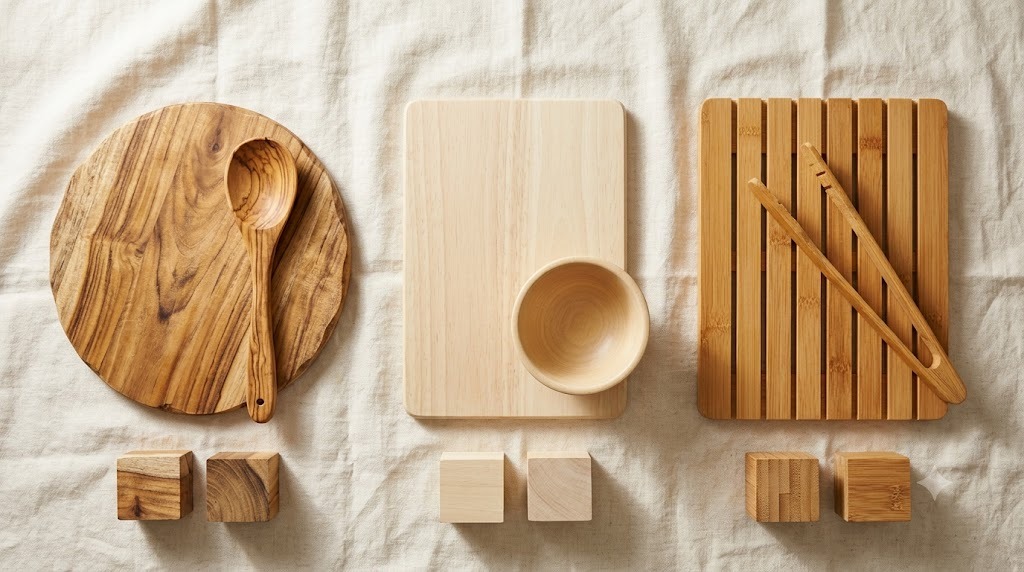
Why Material, Not Design, Sets Your Landed Cost
In a typical wooden kitchenware FOB price, raw material accounts for roughly 40 to 55 percent of the total. Labour, finishing, packaging and factory overhead share the remainder. Because wooden kitchenware requires no moulds and no tooling amortisation, there is very little in the cost structure that a buyer can negotiate away once the species is fixed. Changing the design of a cutting board moves the price by a few percent. Changing the species moves it by twenty to forty percent.
The second cost driver is yield. Every board that comes off a rip saw with an unacceptable knot, a colour mismatch or an internal check is either downgraded or scrapped. Acacia, with its dramatic natural colour variation, carries a materially higher sorting loss than rubberwood, which is pale and uniform by nature. That yield difference is invisible on a specification sheet but fully priced into every quotation you receive.
Acacia: The Premium Grain That Justifies a Retail Price
Acacia mangium and acacia hybrid are plantation grown across central and northern Vietnam, and they are the reason Vietnamese wooden serving boards have taken shelf space from Southeast Asian and Eastern European competitors over the past decade. The wood has a Janka hardness in the region of 1100 to 1200 lbf, which places it comfortably above rubberwood and in the same band as many temperate hardwoods used for premium boards.
Commercially, the value of acacia is visual. The contrast between the pale sapwood and the deep golden brown heartwood means no two boards are identical, which is exactly what a gift buyer or a home decor merchandiser wants. It photographs well, it holds an oil finish beautifully, and it supports a retail price that thinner or paler materials cannot. The trade-off is sorting: expect the factory to reject or downgrade fifteen to twenty-five percent of blanks on colour and knot criteria for a tightly specified programme, and expect that to show up in the price.
Acacia is the right choice for serving and charcuterie boards, salad and serving bowls, gift sets, cheese board sets and any SKU where the wood itself is the selling point. Our detailed acacia wood kitchenware sourcing guide covers grading, finish options and inspection criteria for this species in full.
Rubberwood: The Volume Workhorse Most Buyers Underrate
Rubberwood, from the Hevea brasiliensis tree, is a by-product of the latex industry. Plantations are felled and replanted after roughly twenty-five to thirty years of tapping, and the timber that used to be burned as waste is now one of the most widely used furniture and housewares materials in Asia. Vietnam has one of the largest rubber plantation estates in the world, which gives local factories a deep, stable and traceable domestic supply. For buyers who need a genuine circular-material story on pack, rubberwood is far easier to substantiate than most alternatives.
Physically, rubberwood is pale cream to light straw in colour with a fine, remarkably even grain and a Janka hardness around 950 to 1000 lbf. That uniformity is its commercial advantage. It accepts stain, colour wash and paint far more evenly than acacia, so it is the correct base material for any programme where the finish, not the grain, carries the design. It is almost always supplied as finger-jointed and edge-glued panel, which makes it exceptionally dimensionally stable and keeps the price low.
The one point that separates a competent rubberwood supplier from a risky one is treatment. Freshly sawn rubberwood has a high starch and sugar content and will develop blue stain, mould or insect attack if it is not boron treated and kiln dried promptly after felling. If a rubberwood quotation looks unusually low, treatment is the first place to look.
Bamboo: Not Technically Wood, Commercially a Separate Category
Bamboo is a grass, not a timber, and that single botanical fact drives most of its commercial behaviour. It is harvested at three to five years rather than twenty-five, which gives it the fastest renewal cycle of the three materials and a legitimate sustainability position. It cannot be used in solid form for flat products, so every bamboo board, tray or organiser is a laminate: strips are cut, boiled or carbonised, dried, then glued under pressure in flat-press, side-press or strand-woven construction.
Because bamboo products are engineered rather than sawn, the adhesive is the quality variable, not the fibre. Strand-woven bamboo is extremely hard and can exceed most hardwoods, while flat-pressed bamboo is moderate. Both will delaminate at the glue line if the adhesive specification is weak or the press cycle is rushed, and delamination in a humid destination market is the single most common bamboo claim. Ask for the adhesive standard in writing, and ask for the formaldehyde emission class.
Bamboo is the right material for slatted boards and trays, drawer and cutlery organisers, price-fighting cutting boards and any programme where the eco message is on the front of pack. Our bamboo kitchenware and houseware guide covers construction types and adhesive specification in detail.
Side by Side: How the Three Materials Compare
| Attribute | Acacia | Rubberwood | Bamboo |
|---|---|---|---|
| Source | Plantation hardwood, 8 to 12 years | Latex plantation by-product, 25 to 30 years | Grass, 3 to 5 years |
| Indicative Janka hardness | 1100 to 1200 lbf | 950 to 1000 lbf | 1300 to 3000 lbf depending on construction |
| Colour and grain | High contrast, golden to dark brown, every piece unique | Pale cream, fine and very uniform | Honey to caramel, straight linear striations with node lines |
| Typical construction | Solid or edge-glued panel | Finger-jointed and edge-glued panel | Laminated strip, flat-press, side-press or strand-woven |
| Main failure mode | Checking and colour mismatch across a batch | Blue stain or mould if untreated | Glue-line delamination |
| Finish behaviour | Excellent with oil and wax, grain is the feature | Excellent with stain, paint and colour wash | Accepts oil, limited stain penetration |
| Relative FOB index | 100 | 65 to 80 | 60 to 85 depending on construction |
| Best retail positioning | Premium, gifting, home decor | Mid-market private label, painted programmes | Value, eco-positioned, e-commerce |
Matching Material to Channel and Price Point
Department stores, gift retailers and premium home categories should default to acacia. The material carries the story, the photography and the margin, and a buyer in this channel will not accept a painted or uniform surface at the price point they need to hit.
Supermarket and hypermarket private label programmes should default to rubberwood. Uniform colour means a consistent planogram across thousands of units, finger-jointed panel keeps the piece flat through a long shelf life, and the cost base supports a competitive everyday price. Any programme with a painted, stained or two-tone design belongs here.
Discount, promotional and e-commerce programmes are usually best served by bamboo, particularly where the sustainability claim is doing marketing work and where the flat, lightweight laminate reduces volumetric shipping cost. For HORECA and food service, specify thickness before species: a twenty millimetre acacia or rubberwood board will outlast a thin bamboo laminate in a commercial kitchen regardless of surface hardness.
Moisture, Glue Lines and the Two Ways Wooden Kitchenware Fails
Almost every quality claim on wooden kitchenware traces back to one of two causes: moisture movement or adhesive failure. Neither is visible at final inspection, which is why both must be specified on the purchase order rather than discovered at the destination port.
Moisture content should be matched to the destination, not to the factory. A board dried to twelve percent and shipped to Dubai, Riyadh or Kuwait will shrink and check as it equilibrates to a much drier ambient condition. For Gulf and dry Middle Eastern markets, specify a six to eight percent band. For humid Southeast Asian and coastal markets, eight to twelve percent is appropriate. Our guide to wood moisture content and kiln drying standards explains how to write this into an inspection scope.
On adhesives, ask for a water-resistance class in writing. An EN 204 D3 or D4 rated PVAc adhesive is the practical benchmark for edge-glued and finger-jointed panel, and the adhesive should be declared food-contact compliant. For bamboo laminate, additionally request the formaldehyde emission class. Rubberwood shipments should carry kiln and anti-sapstain treatment records, and every wooden kitchenware container should ship with desiccant and moisture-barrier interleaving.
Indicative FOB Pricing and MOQ by Material
The figures below are indicative FOB Ho Chi Minh City or Hai Phong ranges for 2026, based on standard oil or wax finish, plain export carton and typical first-order volumes. Final pricing depends on grade, thickness, finish system, branding and packaging.
| Product | Acacia | Rubberwood | Bamboo | Typical MOQ |
|---|---|---|---|---|
| Rectangular cutting board, 30 x 20 x 1.8 cm | USD 2.60 to 3.80 | USD 1.80 to 2.60 | USD 1.60 to 2.50 | 1,000 to 2,000 pcs |
| Round serving board, 30 cm diameter | USD 3.20 to 4.60 | USD 2.20 to 3.20 | USD 2.10 to 3.00 | 1,000 pcs |
| Salad or serving bowl, 25 cm diameter | USD 4.50 to 7.00 | USD 3.20 to 4.80 | Not typically produced | 500 to 1,000 pcs |
| Cooking spoon or spatula, 30 cm | USD 0.55 to 0.95 | USD 0.38 to 0.65 | USD 0.30 to 0.55 | 2,000 to 5,000 pcs |
| Slatted tray, 40 x 28 cm | USD 3.80 to 5.50 | USD 2.60 to 3.80 | USD 2.40 to 3.60 | 1,000 pcs |
For mixed programmes, note that MOQ is normally applied per SKU and per colourway rather than per container. Buyers building a first range are usually better served by four to six SKUs in one material than by twelve SKUs spread across three materials, because each material change introduces a separate sample round, a separate document set and a separate quality risk profile. Our wooden kitchen utensils guide and wooden tray and houseware guide set out SKU ranges for each category.
Certification and Document Set by Material
All three materials can be supplied with chain of custody certification. Acacia and rubberwood are widely available under FSC or PEFC chain of custody from Vietnamese plantations, and certified bamboo supply has expanded significantly. Chain of custody is now effectively mandatory for European buyers under deforestation-free supply chain rules, and increasingly requested by Middle Eastern and Asian retail groups as well.
On food contact, ask for migration testing against the standard your market recognises: EU Regulation 1935/2004 and the LFGB method for Europe, or the relevant FDA 21 CFR provisions for the United States. The test must cover the finish system actually shipped, not the bare substrate, which is the mistake most first-time buyers make. Bamboo laminate and finger-jointed rubberwood panel should additionally carry a formaldehyde emission classification.
Complete the file with a certificate of origin in the correct form for your trade agreement, a packing list, a fumigation or heat treatment certificate for wooden pallets under ISPM 15, and a third-party pre-shipment inspection report with moisture readings and glue-line checks written into the scope.
Five Material Mistakes That Cost Wooden Kitchenware Importers Money
Writing wood on the purchase order instead of a species. A purchase order that says wooden cutting board gives the factory legitimate freedom to substitute. Name the species, the construction and the thickness.
Comparing quotations across materials without normalising the specification. An eighteen millimetre acacia board and a twelve millimetre bamboo laminate are not the same product. Normalise thickness, finish and packaging before you compare a single price.
Ignoring destination climate when setting the moisture band. This is the single most common cause of cracked boards in Gulf markets, and it is entirely preventable at specification stage.
Assuming bamboo is automatically the sustainable option. Bamboo grows fast, but an uncertified laminate bonded with a high-emission adhesive is a weaker environmental claim than FSC certified rubberwood recovered from a latex plantation. Check the adhesive and the chain of custody before the claim goes on pack.
Approving a sample in one finish and shipping in another. Oil, wax, lacquer and stain each change colour, texture and food-contact status. Approve and seal a retained sample in the exact production finish.
A Practical Material Selection Checklist
- Define the retail price point and channel first, then work back to the material rather than the other way round.
- Name the species, construction method, thickness, finish system and moisture band in writing on the purchase order.
- Set the moisture band from the destination climate, not from the factory default.
- Request the adhesive water-resistance class and, for bamboo and finger-jointed panel, the formaldehyde emission class.
- Collect the FSC or PEFC chain of custody certificate and the food-contact migration report on the shipped finish before deposit.
- Order paid samples in the exact production finish and keep one sealed as the retained reference.
- Book a third-party pre-shipment inspection with moisture readings and glue-line checks written into the scope.
Working With Viet Farm Vision
Viet Farm Vision is a Vietnamese OEM manufacturer and exporter of wooden kitchenware and houseware, supplying acacia, rubberwood and bamboo ranges to wholesale, retail and HORECA buyers across the Middle East, Asia, Europe and Africa. We advise on material selection against your target retail price, handle SKU and finish specification, food-contact documentation, private-label packaging and export paperwork from a single point of contact, and write moisture verification and glue-line checks into the pre-shipment inspection report for every order.
To request a quotation, a product catalogue or paid samples, contact our export team at info@vietfarmvision.com or visit vietfarmvision.com/contact-us.