
A European stationery buyer signs off a 40,000-piece quilling card programme across 38 designs and asks for delivery in 45 days. The supplier says yes. Ninety-four days later, 31,000 cards have shipped, eleven designs have been quietly substituted for simpler artwork, and the Christmas window has closed. Nobody lied. The buyer asked a question about units and the supplier answered a question about ambition. Neither party ever did the only calculation that matters in this category: how many trained artisan-hours the order actually consumes, and how many of those hours the factory genuinely controls in the weeks concerned.
Quilling cards are one of the last genuinely hand-built products in mainstream retail. There is no machine that rolls a paper coil to a consistent tension, no press that seats a 90-element bouquet in registration, no line speed to increase. Output is a direct function of trained hands multiplied by available minutes, degraded by a learning curve and by every design change you introduce. That makes capacity planning a commercial discipline rather than a logistics afterthought, and it is where most first-time quilling programmes fail.
Headcount Is Not Capacity. Artisan-Hours Are.
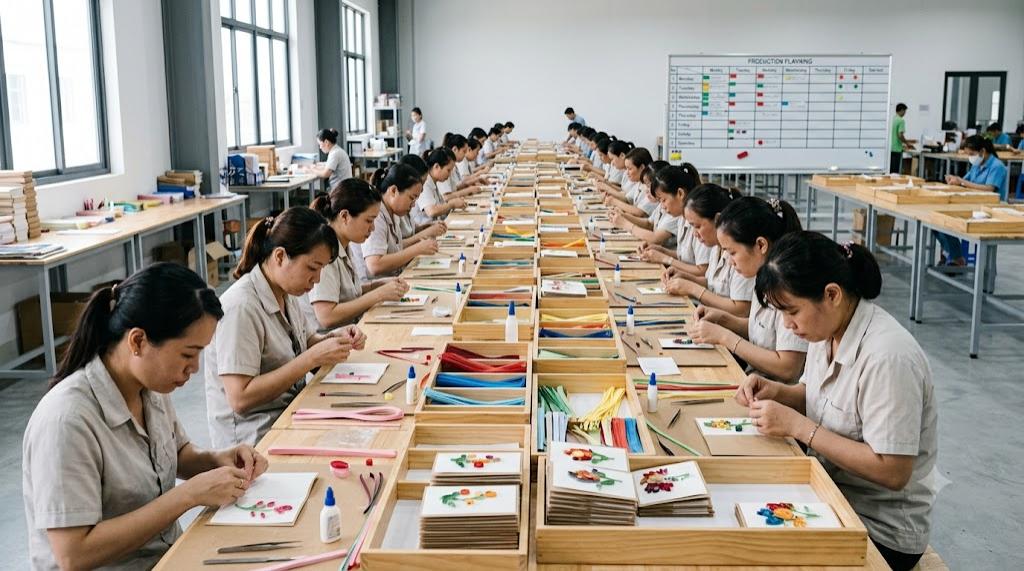
A supplier who answers “how much can you make?” with a headcount is telling you almost nothing. A workshop of 400 people may contain 90 artisans qualified to build a Tier C landscape design, 180 who can competently execute a standard floral, and 130 doing strip cutting, blank preparation, envelope insertion, inspection and packing. Only the first two groups produce cards, and only the first group produces your complex hero design.
The number you need is qualified artisan-hours available in your production window, by skill tier. Everything else — floor area, total employees, number of buildings — is decoration. Ask for it in this form: how many artisans are certified on this design tier, how many hours per artisan per week, and what percentage of those hours is already committed to other orders in weeks 1 through 12?
A credible supplier can answer that in a single email. A supplier who cannot has not planned capacity for anyone, including you.
What a Quilling Card Actually Costs in Minutes
Before you can size an order you need a defensible minutes-per-card figure for each design, agreed in writing during sampling. The ranges below reflect skilled artisans working at steady state on an approved design with pre-cut strips supplied to the bench. They are planning figures, not promises — your own designs must be timed during the first-off run.
| Complexity tier | Typical artwork | Quilled elements per card | Minutes per card (steady state) | Cards per artisan per 8h day |
|---|---|---|---|---|
| Tier A — simple motif | Single flower spray, monogram, minimal icon | 15–30 | 12–18 | 28–38 |
| Tier B — standard retail | Bouquet, birthday cake, seasonal scene | 40–80 | 25–40 | 12–19 |
| Tier C — complex scene | Landscape, architectural, multi-layer relief | 100–180 | 55–90 | 5–9 |
| Tier D — showpiece / bespoke | Wedding, corporate commission, deep 3D relief | 200+ | 120–240 | 2–4 |
Two implications follow immediately. First, a mixed range is not a single lead time — a 5,000-piece Tier C design consumes more capacity than 20,000 pieces of Tier A. Second, artwork decisions taken at the design stage are capacity decisions. Removing thirty coils from a hero design can shorten a programme by two weeks without a buyer ever noticing the difference at retail.
The Learning Curve Nobody Prices In
A new design does not reach its steady-state rate on day one. Artisans build muscle memory for a specific sequence: which coil is seated first, where the jig registers, how much adhesive a particular relief will take before it bleeds. On a Tier B design the curve is roughly as follows, and it repeats every time you introduce new artwork.
| Production week on a new design | Output vs steady-state rate | Practical effect |
|---|---|---|
| Week 1 | 50–60% | First-off approval, jig and sequence settling, highest defect rate |
| Week 2 | 70–80% | Sequence stable, adhesive control improving |
| Week 3 | 85–95% | Approaching plan rate; in-process QC findings drop sharply |
| Week 4 onward | 100% | Steady state; this is the only rate a quotation should be built on |
For a four-week run, average output lands near 80–85% of the steady-state figure. If your supplier planned at 100%, you are structurally two to four working days short before a single card is made. Insist that the production plan states the assumed ramp explicitly.
Design Count Is Your Real Constraint, Not Unit Count
Buyers instinctively negotiate on units. In quilling, the variable that destroys schedules is the number of distinct designs. Every additional design carries a fixed cost in capacity that is independent of how many pieces you order of it:
- A colour and paper reference must be matched and a dye lot sealed, so the strip cutting run is set up separately.
- A first-off sample must be built, photographed and approved before the bench is released — typically half a day of elapsed time even when the buyer answers quickly.
- The learning curve restarts, costing roughly 15–25% of the first week of output on that design.
- Bench layout, tray allocation and packing profile change, and inspection criteria must be re-briefed to the QC team.
A workable rule of thumb: each additional design in a purchase order consumes between one and two days of effective factory capacity before it produces a single saleable card. A 40,000-piece order across 8 designs and the same order across 38 designs are completely different manufacturing problems, and any supplier quoting the same lead time for both has not planned either.
The commercial answer is not to shrink the range. It is to phase it — release the eight highest-volume designs first and stagger the long tail into a second and third bench release, so the learning curves overlap instead of stacking. This is exactly the logic behind a properly built seasonal range plan and order calendar.
Worked Example: Sizing a 40,000-Piece Programme
Take the order from the opening paragraph and do the arithmetic honestly. Assume 40,000 pieces, predominantly Tier B artwork at an agreed 30 minutes per card, produced by artisans working an eight-hour day, six days a week.
- Total requirement: 40,000 × 30 minutes = 20,000 artisan-hours, or 2,500 artisan-days.
- With 60 qualified artisans dedicated to the programme: 2,500 ÷ 60 = 42 working days at steady state.
- Apply an 85% ramp factor across the run: approximately 49 working days on the bench.
- Add strip preparation and first-off approval for the design set, plus in-process QC, final inspection, envelope insertion, poly-sleeving, cartoning and documentation: 10–14 working days, partially overlapping.
- Realistic ex-works window: 58–63 working days, or roughly 10 to 11 calendar weeks — before ocean transit.
The same 60 artisans, working six-day weeks, represent a ceiling of roughly 1,560 artisan-days per month, or about 25,000 Tier B cards per month. If a supplier offers you 40,000 pieces in 45 days from a team of that size, one of three things is true: they are planning to subcontract to workshops you have not audited, they intend to simplify your artwork, or they will be late. It is worth asking which, politely, in writing, before the deposit moves.
Peak Season: You Are Competing for the Same Hands
Quilling demand is violently seasonal and the peaks are shared across every buyer in the category. Artisan capacity does not expand in step, because training a competent Tier B artisan takes months, not weeks.
| Retail event | Production window in Vietnam | Capacity pressure |
|---|---|---|
| Christmas & year-end gifting | June – September | Highest; competes with autumn wedding programmes |
| Valentine’s Day | October – November | High; overlaps Tet material and labour planning |
| Mother’s Day | January – February | Constrained by Tet factory shutdown and post-Tet return rates |
| Weddings & graduations | March – May | Moderate; best window for new design development |
Two dates deserve a note in every buyer’s calendar. Tet removes one to two full production weeks and post-holiday return rates are never 100%, which compresses February output. And because Christmas and autumn wedding work collide between June and September, a booking made in April buys materially more capacity than the identical order placed in July.
How to Reserve Capacity Instead of Hoping for It
Capacity that is not contractually reserved is capacity you share with whoever confirms first. Buyers running repeat programmes should move from transactional POs to a reservation structure:
- Rolling forecast. A 12-week rolling forecast, with the first four weeks firm, the next four weeks committed to a ±20% band, and the last four indicative. This is standard practice in apparel and works equally well here.
- Named capacity block. Agree a stated number of artisan-days per week reserved for your programme, with a written mechanism for what happens if either party fails to use or supply it.
- Phased release with fixed first-off dates. Tie each design release to a first-off approval date rather than a single blanket deadline, so a slow artwork approval on design 27 does not stall designs 1 to 26.
- Blank and envelope buffer. Card blanks, envelopes and coloured strip stock have their own lead times. Holding an agreed buffer at the factory removes the most common cause of an idle bench.
- Partial shipment permitted. Allow the first 60–70% to ship on schedule rather than holding a full container for the long tail. This single clause has saved more retail launch dates than any other.
These points belong in the same conversation as artwork ownership and exclusivity, which should also be settled before the first PO — see our guide to custom artwork, IP ownership and design exclusivity.
Warning Signs a Supplier Has Over-Committed
- They quote an identical lead time for 8 designs and 38 designs.
- They cannot state minutes per card for your specific artwork after sampling.
- Headcount is offered as the answer to a capacity question.
- No ramp assumption appears anywhere in the production plan.
- First-off photographs are slow, generic, or arrive after bulk production has clearly started.
- Weekly output reporting is offered only as a total, never split by design.
- Sub-contracting to satellite workshops is mentioned late, vaguely, or only after a delay.
None of these is proof of a problem. All of them are reasons to ask a second question. Sub-contracting in particular is not inherently wrong — much of Vietnam’s handcraft sector is built on village workshops with genuine skill — but it must be disclosed, audited and reflected in your social compliance position, not discovered when a shipment slips.
Commercial Protection When Capacity Is Missed
Even well-planned handmade programmes slip. What separates a manageable delay from a lost season is what the contract says beforehand:
- A delivery schedule expressed as staged quantities by date, not one final date.
- A written escalation trigger — for example, cumulative output below 90% of plan at the end of week two obliges the supplier to notify the buyer and propose a recovery plan within 48 hours.
- An agreed air-freight cost-sharing formula for the shortfall, capped, so the remedy is proportionate rather than punitive.
- A liquidated damages schedule that steps with the number of days late, agreed at contract stage rather than argued at shipment.
- Clear treatment of quality-related delay, cross-referenced to your inspection standard — the specifications in our guide to quilling card quality control are the right place to define what a rejectable card is before it becomes a schedule argument.
Buyers sometimes worry that raising these clauses signals distrust. In practice the opposite is true: a supplier who welcomes a staged schedule and an escalation trigger is a supplier who believes their own plan.
Frequently Asked Questions
How many quilling cards can a Vietnamese factory realistically produce per month?
For a dedicated team of 60 qualified artisans working six-day weeks, roughly 25,000 standard Tier B cards per month at steady state, or 8,000–12,000 complex Tier C cards. The figure scales with qualified artisan-hours, not with total headcount, and should always be confirmed against your specific artwork after sampling.
Why does adding designs extend the lead time more than adding units?
Each new design triggers a separate colour and dye-lot match, a strip cutting set-up, a first-off approval cycle and a fresh learning curve on the bench — typically one to two days of effective capacity regardless of order quantity. Additional units of an existing, already-running design carry none of that overhead.
Can capacity be reserved before artwork is finalised?
Yes. Capacity is reserved in artisan-days against a complexity tier, so a block can be booked on the basis of an indicative tier mix while designs are still being developed. The reservation is then converted to specific designs as artwork is approved, which is why early booking in the March–May window is so valuable for Christmas programmes.
Is any part of quilling card production automated?
Only the preparatory stages. Paper strip cutting, card blank die-cutting, envelope converting and some packing operations are machine-assisted. Coiling, shaping, placement and adhesion remain entirely manual, which is precisely what gives the category its retail value — and why capacity cannot be bought at short notice.
Further Reading and Standards
- ISO 9001:2015 — Quality management systems, the framework under which production planning and capacity records should be documented.
- amfori BSCI — the social compliance system most European gift and stationery buyers apply to handcraft supply chains, including subcontracted workshops.
- ILO international labour standards — the baseline for working hours and overtime assumptions behind any capacity calculation.
- International Trade Centre — market and sourcing intelligence for handcraft and gift categories.
Working With Viet Farm Vision
Viet Farm Vision manufactures and exports handcrafted quilling cards, wooden kitchenware and houseware, and compostable and disposable tableware from Vietnam for buyers across the Middle East, Asia, Europe and Africa. On quilling card programmes we quote capacity in artisan-days rather than in slogans: after sampling we give you a timed minutes-per-card figure for each approved design, a production plan that states its ramp assumption, and weekly output reporting split by design rather than as a single total. Where a range is large we will propose a phased bench release rather than accept a date we cannot defend.
We will also tell you when a requested window is not achievable, and what artwork or phasing change would make it achievable — before a deposit is placed rather than after. Buyers are welcome to audit our production planning records and to nominate their own third-party inspection agency. If you are building a quilling card range for a gift, stationery, wedding or corporate programme, start with our handmade greeting cards range or our quilling cards OEM sourcing guide, then request a quote with your target volumes, design count and in-store date.