
Online card shops, marketplace sellers and gift subscription brands buy handmade cards differently from a high street stationer. Their customer never touches the card before paying. The decision is made on a photo, a short description and a delivery promise, and the card then travels alone in a mailer through a parcel network that was never designed for raised paper art. A handmade quilling card can be one of the strongest sellers in an online range, because the coiled paper detail looks remarkable in close up photography, but only if the product, the packing and the data are planned for selling online from the start.
This guide is written for e-commerce buyers, marketplace sellers, gift box curators and online stationery brands in the Middle East, Asia and Europe who want to source handmade quilling cards from Vietnam. It covers which designs convert on screen, how to get usable product imagery from the workshop, how to pack a raised card so it survives single parcel shipping, how to size orders for online demand and what to put in the listing so returns stay low.
Why quilling cards work well online
Most printed cards look flat and interchangeable in a thumbnail. A quilled card has depth, shadow and visible handwork, which makes it stand out in a search grid and gives the shopper a clear reason to pay more than they would for a printed card. That depth is the selling point, so every decision below is about protecting it: keeping it visible in photos, keeping it intact in transit and explaining it honestly in the listing.
Quilling also suits the way online shops grow. One strong motif can be offered in several colourways, as a single card, a boxed set or part of a gift bundle, without new tooling. For a seller testing demand, that flexibility matters more than the lowest unit price.
Choosing designs that convert on screen
Designs that sell in a physical shop do not always sell online. On a phone screen the shopper sees the card at roughly the size of a stamp first, so the motif has to read instantly.
- One clear focal point. A single bird, flower or animal reads better in a thumbnail than a busy scene with many small elements.
- Strong contrast with the card base. Bright coils on a white or kraft base photograph better than pale coils on a pastel base.
- Occasion that matches search intent. Shoppers search by occasion first: birthday, thank you, wedding, new baby, Eid, Lunar New Year, sympathy. Build the range around the occasions your store already ranks for.
- A clear hero and a few variants. Launch one hero design per occasion with two or three colourways rather than ten unrelated designs with one unit each.
Getting product imagery that sells
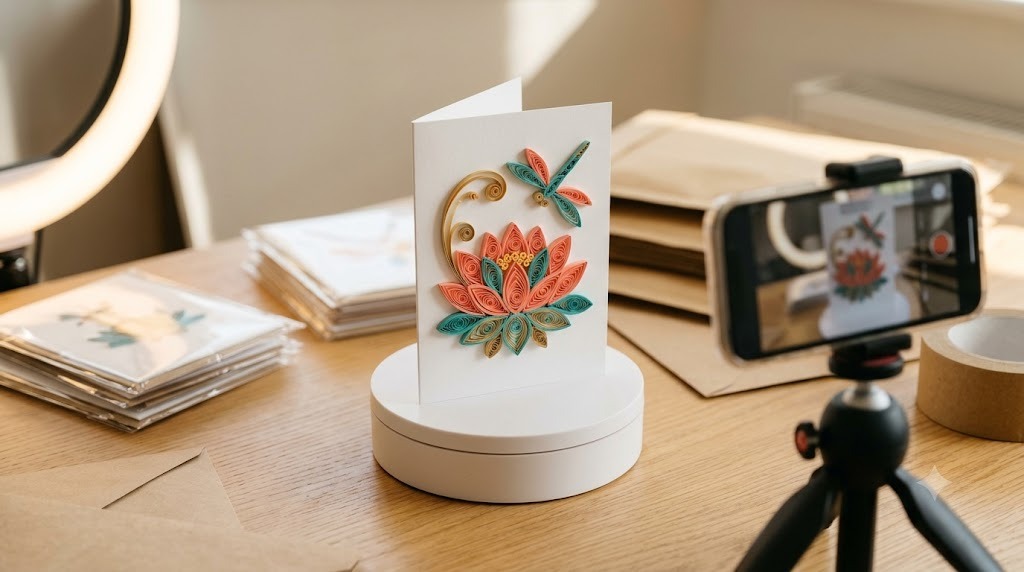
Online sellers need images before stock arrives, so plan photography into the sample stage. A good approach is to ask the workshop for reference photos and short videos of the approved sample, then reshoot the golden sample yourself or with your studio once it lands. For each design, aim for this set:
- A clean front view on a plain background for the main listing image.
- A low angle side view with directional light that shows the raised coils and shadow.
- A close up of the coil detail so the shopper can see it is handmade, not printed.
- A scale shot with a hand, envelope or common object so the size is obvious.
- An inside view showing the blank or printed message area.
- A short turntable or tilt video, which often does more for conversion than any still image.
Make sure your agreement covers who owns the photography and whether the design itself is exclusive to your store. Our guide to sampling and golden sample approval for quilling cards explains how to lock the approved look before mass production, so the card the customer receives matches the photo they bought from.
Packing a raised card for single parcel shipping
Bulk export packing protects cards inside cartons. Online orders add a second journey: one card, alone, in a mailer, through sorting machines. Plan both layers together.
| Layer | What to specify | Why it matters online |
|---|---|---|
| Card sleeve | Clear sleeve with a stiff backer board sized to the card | Stops coils catching and keeps the card flat while it is picked and packed |
| Envelope | Envelope with enough depth for the raised design, packed beside the card | A shallow envelope crushes the coils when the customer inserts the card |
| Mailer | Rigid board mailer or small box, not a soft poly bag | Sorting machines bend soft parcels and flatten raised paper |
| Inner unit | Pack the master carton in inner bundles that match your typical order size | Speeds picking and reduces handling of individual cards in your warehouse |
| Labelling | Barcode on every sleeve, design code and colourway on every inner | Prevents wrong design dispatches, the most common cause of online returns |
For carton level protection on the export leg, see our guide to packaging and protection for quilling card export shipments, and for barcodes and sleeve branding, the guide to retail ready barcodes, branding and pack ratios.
Sizing orders for online demand
Online demand is spiky. A design can sit quietly for weeks and then sell out after a social post or a holiday spike. Instead of one large order, most online sellers do better with a smaller opening order across several designs, a clear reorder trigger for each design, and a production slot agreed in advance for peak seasons. Because quilling is made by hand, reorders need lead time, so set the trigger level early enough to cover production and transit.
Air freight usually makes sense for opening orders and urgent top ups, while sea freight suits planned seasonal stock once sell through is proven. Our guide to reorders, repeat minimums and SKU rationalisation covers how to keep the range lean, and the guide to air, sea and express freight for quilling cards compares shipping options.
Writing listings that keep returns low
Most complaints about handmade cards bought online come from expectations, not quality. A clear listing prevents them.
- State the card size and the envelope size in centimetres and inches.
- Explain that each card is handmade, so small variations in coil shape are normal and part of the character.
- Say whether the inside is blank or printed, and whether the card fits a standard frame.
- Note that the design is raised and needs a larger envelope or postage class if the customer mails it on.
- Tell the story of the craft and the artisans in one or two lines. Shoppers who understand the handwork accept the price more easily.
Common mistakes when selling quilling cards online
- Listing a design before the golden sample is approved, then shipping cards that look different from the photo.
- Using soft poly mailers that save postage but flatten the raised design.
- Ordering many designs in tiny quantities, which makes reordering slow and photography expensive.
- Hiding the handmade nature of the card instead of using it as the main selling point.
- Forgetting to plan peak season production slots early, then running out in the busiest weeks.
Sourcing online ready quilling cards with Viet Farm Vision
Viet Farm Vision works directly with a handmade quilling workshop in Vietnam, where artisans create custom handmade quilling cards in the workshop itself. For online shops and marketplace sellers we can develop designs around your best selling occasions, supply reference photos and videos of approved samples, add your branding and barcodes to sleeves, pack inner bundles to suit your fulfilment and plan production slots ahead of your peak seasons. For background on the craft, see the history and techniques of quilling. Send us your target occasions, opening quantities and launch dates, and we will come back with design suggestions, a sample plan and a quotation.