
A homeware importer in the Gulf placed a first order for acacia salad bowls in three sizes. The samples looked perfect on the desk in Dubai. Six weeks after the container arrived, a handful of the largest bowls had developed hairline cracks along the rim, and the medium bowls did not nest inside the large ones because the wall thickness had drifted between batches. Nothing was wrong with the wood itself. What was missing was a bowl specific spec: how the bowl is built, how thick the wall should be, how long the blank rests before final turning, and how the sizes relate to each other.
Wooden salad and serving bowls are one of the most reliable sellers in a wooden kitchenware range, and also one of the easiest to get wrong. This guide explains the three ways Vietnam workshops build bowls, how to plan a size ladder that nests and ships efficiently, the dimensions and tolerances worth writing down, and what to check before goods leave the factory.
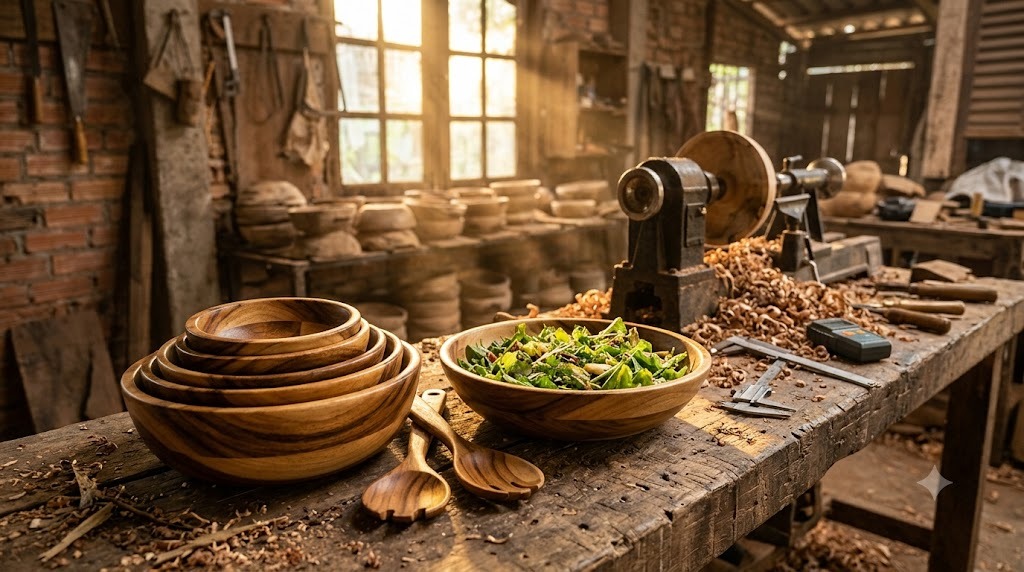
Why wooden salad and serving bowls deserve a hero slot in your range
- They sell all year. Salad bowls move in everyday homeware, then peak again in gifting seasons, Ramadan and Eid hosting, and year end holidays.
- They anchor sets. A large bowl plus a pair of servers is one of the simplest gift sets to build, and smaller bowls extend the same design into snack, dip and nut bowls.
- They carry a higher retail price than utensils. A well finished acacia bowl is a visible centrepiece on a table, so it supports better margins than spoons or spatulas.
- Vietnam has the skills. Workshops around the Southeast and Central regions have turned acacia and rubberwood bowls for export for many years, with lathe, CNC and lamination capacity under one roof.
Three ways to build a wooden bowl, and when to choose each
1. Solid one piece turned bowls
The bowl is turned from a single block of acacia. It shows the most natural grain and feels the most premium, which suits gift and premium retail. The trade off is raw material cost and stability: large one piece bowls need thick, well dried blocks, and they are the most likely to move or crack if moisture is not controlled. Most buyers keep one piece construction for bowls up to about 25 to 28 cm and use a different method above that.
2. Laminated or glued block bowls
Several strips of wood are glued into a block before turning. The result shows the striped look many buyers associate with acacia, uses smaller timber more efficiently, and is more stable in large diameters. The key spec is the glue: ask for a food contact suitable, water resistant adhesive and request the glue documentation along with the finish documentation.
3. Segmented and ring construction bowls
Rings of small segments are stacked and glued, then turned. This allows very large or decorative bowls with patterned rims, and keeps timber use low. It takes more labour per piece, so it fits statement serving bowls, hotel buffet ware and limited collections more than high volume retail.
If you are still deciding on forming methods in general, our guide to hand carved, lathe turned and CNC shaped wooden kitchenware covers the wider picture.
Plan a size ladder that nests, sells and ships
Most successful bowl ranges are built as a ladder of three to five sizes from the same design. A typical starting point looks like this:
- Snack or dip bowl: about 12 to 15 cm diameter, for nuts, olives, dates and sauces.
- Individual salad bowl: about 16 to 18 cm, often sold in sets of two or four.
- Medium serving bowl: about 22 to 25 cm, the everyday family size.
- Large salad bowl: about 28 to 32 cm, the hero piece for gift sets with servers.
- Statement or buffet bowl: 35 cm and above, usually laminated or segmented.
Design the ladder so each size nests inside the next with a gap of at least 8 to 10 mm on every side. Nesting cuts carton volume sharply, which matters for freight on bulky items like bowls. Our article on container loading and cube efficiency shows how much a nested pack can change the cost per unit.
The specs worth writing down before sampling
- Outer diameter and height with a tolerance, for example plus or minus 3 mm on diameter.
- Wall thickness at the rim and at the base. Consistent walls are what keep the ladder nesting batch after batch.
- Base design: flat base, foot ring or slightly raised foot. A foot ring improves stability and airflow when drying after washing.
- Rim profile: rounded, flat or slightly flared. Rounded rims resist chipping in transit.
- Wood species and grade: acacia, rubberwood or another species, with a clear rule on knots, colour variation and sapwood.
- Moisture content at final turning, with a target range agreed in writing.
- Finish: food safe mineral oil, oil and beeswax blend, or a food contact lacquer, with the supplier’s documentation.
- Branding: laser engraving or a branded sticker on the base, if required.
Drying and rest time: the step that prevents cracked rims
Bowls are thicker than most wooden kitchenware, so they hold moisture longer. Good workshops rough turn the bowl first, leave thick walls, and let the blank rest and dry before the final turning pass. Skipping or shortening that rest is the most common reason bowls look perfect at the factory and crack or go oval weeks later in a dry, air conditioned market. Ask your supplier how long blanks rest, how moisture is measured, and what reading is required before final turning. Our guide to moisture content and food safe finishes explains the targets in more detail.
Finishes and care instructions buyers should agree on
Most salad bowls ship with a food safe oil or oil and wax finish, which looks natural and is easy to refresh at home. A food contact lacquer gives more water resistance for hotel and restaurant use but changes the feel of the surface. Whichever finish you choose, put a short care card in the pack: hand wash, dry immediately, do not soak, no dishwasher, re oil occasionally. Clear care instructions reduce returns more than any other single change.
Pairing bowls with servers and building sets
The strongest bowl ranges sell as families. A large bowl with matching servers is a natural gift set, a set of four individual bowls suits wedding and housewarming gifting, and a snack bowl trio works well for hospitality and Ramadan hosting. Keep the wood, finish and rim profile consistent across the family so pieces look right together. For more set ideas, see our guide to wooden kitchenware gift sets and bundles.
Quality checks before shipment
- Measure diameter, height and wall thickness on a sample from every size and every batch.
- Test nesting by stacking the full ladder.
- Check rims and bases for hairline cracks under good light, especially on the largest size.
- Confirm the bowl sits flat without rocking.
- Check finish coverage inside and outside, and that no sticky or uneven oil remains.
- Read moisture on a sample of finished bowls before packing.
- Drop test a packed master carton to confirm the nesting and dividers protect the rims.
For sampling plans and defect classes, our article on pre shipment inspection and AQL is a useful reference.
A short brief to send to a Vietnam bowl supplier
Before asking for prices, send a one page brief that lists: the construction method for each size, outer diameter and height with tolerances, wall thickness, base and rim profile, wood species and grade rules, target moisture content, finish type and documentation required, branding, care card, retail packaging, nesting and master carton requirements, order quantity per size and target delivery month. A brief like this gets you comparable quotes and fewer sample rounds.
FAQ: wooden salad and serving bowls from Vietnam
Are acacia salad bowls dishwasher safe?
No. Wooden bowls should be hand washed and dried straight away. High heat and long soaking in a dishwasher will dry out the finish and can crack the wood. State this clearly on the care card and the packaging.
Is a laminated bowl lower quality than a one piece bowl?
Not necessarily. Laminated bowls made with a suitable adhesive are often more stable than one piece bowls in large sizes. One piece bowls show more natural grain and suit premium positioning. Many ranges use one piece for smaller sizes and laminated construction for the largest.
What MOQ should I expect for a bowl range?
It depends on the workshop and the number of sizes, but buyers usually plan per size quantities rather than one total. Starting with three sizes from one design keeps the first order manageable. See our guide to MOQ, samples and golden samples.
Can bowls be customised with my brand?
Yes. Laser engraving on the base or outer wall, branded care cards and custom retail packaging are common for private label bowl ranges.
How Viet Farm Vision supports wooden bowl projects
Viet Farm Vision works as a manufacturing network and export partner for wooden kitchenware made in Vietnam. For bowl ranges we help buyers turn a reference photo into a measurable spec, plan a size ladder that nests efficiently, coordinate sampling with the workshop, and add bowl specific checks such as wall thickness and rim cracks to the inspection plan.
Importers, homeware retailers, gift brands and hospitality suppliers planning wooden salad and serving bowls for 2027 are welcome to send a drawing, a reference photo or a target retail price to info@vietfarmvision.com. We will reply with feasibility notes, construction suggestions and indicative FOB ranges.