
A stationery wholesaler in Northern Europe placed a 24,000 piece quilling card order in June, signed off the golden sample in July, and asked for the goods to be in the warehouse by the middle of September. The cards were finished on time. The shipment was not, because nobody had decided how the goods would travel until the cartons were already sealed and sitting on the workshop floor. Air freight, quoted three weeks later than it should have been, came in at roughly four times the budget line. Ocean freight, booked in the middle of the Asia to Europe peak season, landed in the first week of November. A Christmas range that missed its window by six weeks went onto markdown in January.
Cards break the freight maths people expect
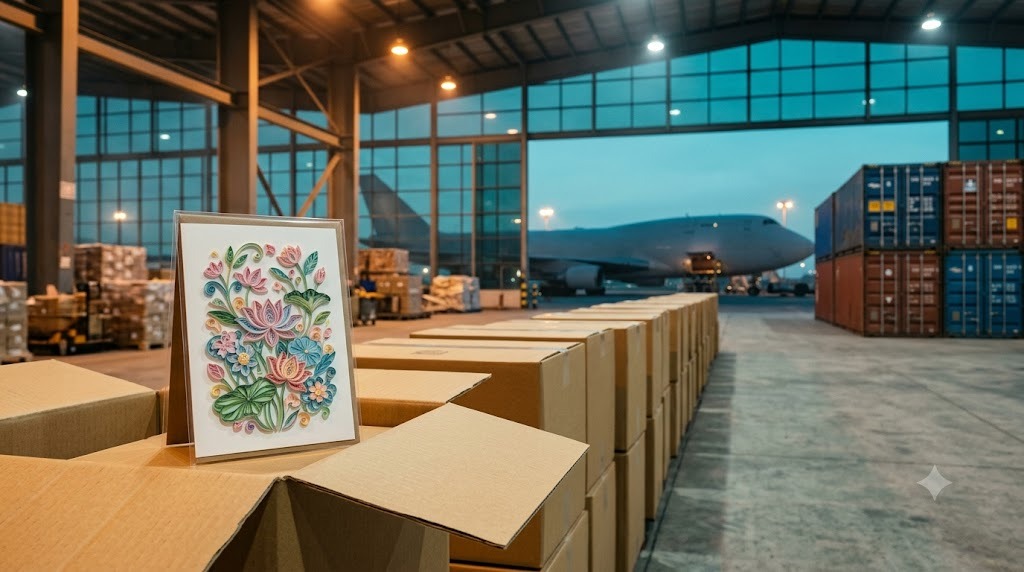
Freight is the part of a handmade card programme that buyers tend to settle last, and it is the part least forgiving of a late decision. Greeting cards are light, and light products feel like they should be cheap to move. The problem is that cards are also bulky relative to their weight once they are sleeved, backed, interleaved and boxed with enough protection to survive a 30 day ocean transit. Low density is exactly the characteristic that freight pricing penalises, because carriers sell space, not mass.
The result surprises buyers on their first shipment. A carton of handmade cards can be charged as though it weighed 40 to 60 per cent more than it does, and in express courier tariffs the gap is wider still. On a card with a landed cost target measured in cents, that difference decides whether the programme works. Everything below assumes you have already fixed the export packing specification, because carton dimensions are the input to every freight calculation on this page.
1. Chargeable weight: the number your quote is actually based on
Every mode prices the same shipment differently, and each one applies its own rule for converting volume into a billable figure. Four rules cover almost everything a card buyer will meet.
- Air freight. Volume in cubic centimetres divided by 6,000 gives a volumetric weight in kilograms. The airline bills whichever is greater, actual or volumetric. This 1:6,000 divisor is the long standing IATA convention.
- Express courier. DHL, FedEx, UPS and their peers normally divide by 5,000, not 6,000. The same carton therefore carries a higher chargeable weight by courier than by airline.
- Ocean LCL. Less than container load is sold by revenue ton, also written W/M for weight or measure. You pay for whichever is greater, one cubic metre or one metric ton. Cards are almost always billed on volume.
- Ocean FCL. A full container is a flat price per box regardless of what is inside, so the only question is how much of it you fill.
One carton, three different answers
Take a standard master carton of 60 x 40 x 40 cm holding 500 sleeved quilling cards with corrugated dividers. Volume is 96,000 cubic centimetres, or 0.096 cubic metres. Actual gross weight is around 12 kg.
- By airline rules the volumetric weight is 96,000 divided by 6,000, which is 16 kg. You pay for 16 kg, a third more than the scale says.
- By express courier rules it is 96,000 divided by 5,000, which is 19.2 kg. You pay for 19.2 kg, 60 per cent more than the scale says.
- By ocean LCL rules the revenue ton is the greater of 0.096 cubic metres and 0.012 metric tons, so you pay for 0.096 cubic metres.
Now scale that to a 20,000 card order, which is 40 cartons, 3.84 cubic metres and 480 kg actual. Air chargeable weight becomes 640 kg. Ocean LCL stays at 3.84 revenue tons. Using indicative rates that move constantly, air at USD 3.00 to 4.50 per kg into Europe puts the airline bill somewhere around USD 1,900 to 2,900 before origin and destination charges, which is roughly 10 to 15 US cents per card. The same consignment moving LCL will usually land between USD 500 and USD 900 all in, closer to 3 or 4 cents per card. On a card invoiced at USD 1.35 that swing is worth more than most buyers manage to negotiate off the unit price.
Two practical conclusions follow. First, carton dimensions are a commercial variable, not a packing detail. Reducing a carton from 40 cm to 32 cm of height by tightening the card pitch takes 20 per cent off the volumetric weight and the same off an LCL bill. Second, ask for the packing list with carton dimensions and gross weights before you ask for a freight quote, not after.
2. Air freight: when the speed is worth paying for
Air is the right answer more often than its reputation suggests, but only for specific situations. It suits a first production run where the buyer wants the range on shelf while the second, larger order moves by sea. It suits replenishment on a design that has sold through unexpectedly fast, where the alternative is an empty fixture for six weeks. It suits any consignment where the margin lost to freight is smaller than the margin lost to being late for a dated occasion such as Valentine or Mother Day.
What air does not suit is a routine bulk programme. At 10 to 15 cents per card, air freight on a full seasonal buy quietly removes a point or two of gross margin across the whole range. If your order calendar is drawn correctly, air should be the exception you plan for rather than the rescue you pay for.
A detail worth knowing: airlines apply density rules to the shipment as a whole, not to individual cartons, so mixing a few dense items such as display units or printed catalogues into the same air consignment can pull the average down and lower the chargeable weight. Your forwarder should be doing this calculation for you. Ask to see it.
3. Express courier: the samples and emergencies lane
Courier is not really freight, it is a door to door service with customs clearance bundled in, and it is priced accordingly. For samples, golden sample approvals, artwork proofs and any consignment under roughly 50 kg chargeable it is usually the cheapest and always the simplest option. Above that the tariff turns punishing, especially with the 1:5,000 divisor working against a low density product.
Two things catch buyers out. The first is that the courier clears customs on your behalf and then invoices duty, VAT and a disbursement or advancement fee afterwards, which can arrive weeks later and is easy to miss in reconciliation. The second is that courier shipments are still imports: they need the correct commodity code, a commercial invoice showing real transaction value, and the same origin evidence as any other consignment. Under-declaring a sample box because it is small is the fastest way to attract attention to everything else you import. The classification and rules of origin file applies to a 3 kg sample box exactly as it applies to a container.
4. Ocean freight: LCL, FCL and the point where the maths flips
Almost every serious card programme travels by sea. The only real question is whether it travels as part of someone else consolidation or in a box of its own.
LCL is the default below roughly 12 to 15 cubic metres. Above that, the per cubic metre cost of LCL plus its fixed destination charges starts to approach the flat cost of a 20 foot container, which offers around 28 to 30 usable cubic metres. A 20 foot box filled with cards would hold somewhere near 300,000 pieces, which is far beyond what most buyers order in a single design run. In practice card buyers reach FCL economics only by combining categories, which is a separate discussion covered in the guide to mixed containers and consolidated orders.
One warning specific to paper products. A container is a humid, temperature cycling environment, and cards sitting against a steel wall for five weeks will absorb moisture, curl and mark. Cartons must be stowed away from the doors and walls, on pallets rather than on the container floor, with desiccant in the load. Specify it in writing. A forwarder will not do it because it seems sensible.
The destination charges nobody puts in the quote
The single most common freight complaint from first time LCL importers is the bill that arrives after the goods do. An ocean LCL rate quoted as USD 45 per cubic metre sounds excellent until the destination agent issues an invoice for terminal handling, deconsolidation or CFS charges, documentation, a delivery order fee, customs entry and sometimes a chargeable storage period. On a small consignment these fixed charges can exceed the ocean freight itself.
The protection is simple and buyers routinely skip it. Ask any forwarder quoting LCL for an all in figure to your named delivery point, itemised, in writing, with a statement that no other charges will be raised. If they will not put it in writing, assume there are charges they have not mentioned.
5. Consolidation: the lever mid-size card buyers usually ignore
Cards are an excellent consolidation product precisely because they are light. A buyer taking wooden houseware, ceramics or packaging from Vietnam in the same period can add card cartons to an existing container almost free of weight penalty, filling void space above heavier goods rather than paying for a separate LCL booking with its own fixed charges.
This works only if it is planned. Consolidation requires the card production schedule to be aligned with the other supplier delivery date, a single cargo ready date, agreement on who acts as consolidator, and clarity on how freight cost is apportioned between suppliers on the commercial invoices. It is a scheduling exercise more than a logistics one, and it needs to be raised at the purchase order stage rather than the week before shipment.
6. Incoterms 2020: which three letters you should actually be using
Incoterms are published by the International Chamber of Commerce and the current edition is Incoterms 2020. They do not decide who pays what in any moral sense. They decide, precisely, where cost and risk pass from seller to buyer, and which party is responsible for export and import formalities. Getting the wrong one is not a pricing mistake, it is a liability mistake.
Always write the rule with a named place and the edition, for example FOB Ho Chi Minh City Incoterms 2020, or FCA Tan Son Nhat Airport Incoterms 2020. A rule without a named place is ambiguous, and a rule without an edition can be argued over.
EXW
Ex Works means you collect from the workshop and take on Vietnamese export clearance yourself. For a handmade card supplier in the Mekong Delta this is almost always a bad idea for a foreign buyer, because a non resident company cannot easily act as exporter of record in Vietnam and the export declaration has to be filed by a local entity. Use EXW only if you have your own Vietnamese agent who is willing and able to file. Otherwise it creates a paperwork gap that surfaces at the worst moment.
FCA and FOB
This is where most card buyers should be. FOB is a maritime rule only: risk passes when the goods are loaded on board the vessel. It is therefore correct for a sea shipment and technically wrong for an air shipment, a fact that matters when a claim is made. For air, courier or container handover at an inland depot, the correct equivalent is FCA at a named place, where risk passes when goods are handed to the carrier you have nominated.
Under both rules the Vietnamese supplier handles export clearance and delivers to the named point, and you control the main carriage and therefore the rate. For any buyer shipping regularly this is the right structure, because your own forwarder contract is almost always cheaper than a supplier marked up all in price.
CFR, CIF, CPT and CIP
Under these rules the seller books and pays the main carriage. CFR and CIF are maritime only, CPT and CIP are the equivalents for any mode including air. The important subtlety is risk: under all four, risk passes to the buyer at origin even though the seller is paying the freight. A buyer who assumes CIF means the seller carries the risk to destination has misread the rule.
CIF suits a first order, a small buyer without a forwarder relationship, or a market where the supplier genuinely has better rates. It is a reasonable place to start and a poor place to stay, because freight becomes an invisible margin line inside a price you cannot audit. If you buy CIF, ask for the freight component to be shown separately on the quotation so you can benchmark it.
DAP, DPU and DDP
These deliver to your door or your nominated terminal. DDP goes furthest: the seller clears import, pays duty and, in principle, import VAT. It looks like the easy option and is usually the wrong one for a card programme.
The reason is that a Vietnamese supplier cannot normally reclaim import VAT in your country and is not registered there, so either the VAT is buried in the price and lost to you as a recoverable input, or the arrangement quietly puts a non resident company into a position it is not entitled to occupy. DDP also hands control of the import entry, the commodity code and the declared value to a party who has no exposure to the consequences of getting them wrong. For a product where classification is genuinely contestable, that is a poor trade. DAP is the sensible compromise if you want a delivered price without giving up the import entry.
7. Insurance, and what CIF actually covers
Cargo insurance is priced in fractions of a per cent and buyers still forget it. Two points matter for cards.
First, the level of cover. Under Incoterms 2020 the seller obligation under CIF is only the minimum, Institute Cargo Clauses (C), a narrow named perils cover. CIP was upgraded in the 2020 edition to require Clauses (A), which is all risks. If you are buying CIF and assuming all risks cover, you are wrong unless you asked for it in writing. Specify ICC (A) explicitly, at 110 per cent of invoice value, which is the market convention.
Second, what invalidates a claim. Water damage, crushing and mould are the realistic loss events for paper cards, and insurers will look at packing before they look at anything else. A claim on cartons that were stowed on the container floor without pallets or desiccant, or packed below the specification in the purchase order, is a claim that will be argued. Your packing specification is part of your insurance cover whether or not anyone describes it that way.
8. Transit times and the calendar that governs them
Indicative port to port transit from Ho Chi Minh City, before origin handling and destination clearance:
- Intra-Asia: 3 to 10 days
- Middle East, Jebel Ali: 14 to 22 days
- US West Coast: 18 to 26 days
- US East Coast: 30 to 40 days
- North Europe: 30 to 40 days, and longer whenever Red Sea routing pushes services around the Cape of Good Hope
- Air, any of the above: 1 to 3 days in the air, 5 to 9 days realistically door to door
Add 7 to 14 days to any LCL figure for consolidation at origin and deconsolidation at destination. Add your own customs clearance window. Then add the two Vietnamese calendar effects that catch new buyers every year: the Tet holiday, when workshops close for one to two weeks and the pre-holiday rush compresses quality control, and the Asia to Europe and transpacific peak season from roughly August to October, when rates rise and space gets tight at exactly the moment Christmas card programmes need to move.
Work backwards from the in-warehouse date, not forwards from the cargo ready date. For a handmade product where artisan capacity sets the production window, the freight leg is the only part of the timeline you can still compress, and compressing it costs roughly ten cents a card.
9. The freight annex to put in your purchase order
None of this needs a long contract. It needs one page attached to the order, agreed before production starts.
- The Incoterms rule in full, with named place and the words Incoterms 2020
- Cargo ready date, defined as goods packed, marked and available for collection, not goods finished
- Carton dimensions and gross weight per carton, with a tolerance, and the total cubic metres and gross weight for the consignment
- Who nominates the forwarder, and the contact details of the nominated party at both ends
- Stowage requirements: palletised, away from container doors and walls, desiccant specified by quantity and type
- Insurance basis, ICC (A) at 110 per cent of invoice value, and who is arranging it
- Document set and deadline: commercial invoice, packing list with carton level detail, bill of lading or air waybill, certificate of origin, and any product specific certificates, issued within a stated number of days after departure
- A named remedy if the cargo ready date slips, usually that the supplier bears the cost difference between the booked mode and the mode required to recover the schedule
The last line is the one that changes behaviour. A supplier who knows that a four day delay converts into an air freight bill they carry will manage the finishing sequence differently from one who knows the buyer will simply absorb it.
Working with Viet Farm Vision
Viet Farm Vision is a Vietnamese OEM manufacturer and exporter of handmade paper quilling and 3D pop-up greeting cards, supplying importers, wholesalers, retail chains, museum and gallery shops and corporate gifting programmes across the Middle East, Asia and other global markets. We quote freight as a visible, separate line because a card programme that looks profitable at FOB and loses money at landed cost has not really been priced.
- Packing lists issued with carton dimensions, cartons per pallet, cubic metres and gross weights before the freight quotation is requested, so the chargeable weight is known in advance rather than discovered on the invoice
- Carton architecture reviewed against volumetric weight, with pitch and stack height adjusted where a dimensional change takes cost out of the freight without weakening protection
- FCA and FOB shipments handed to the buyer nominated forwarder with full export clearance completed by our side, and CIF or DAP offered with the freight element shown separately for benchmarking
- Stowage specification applied as standard: palletised, desiccated, stowed clear of container doors and walls, with loading photographs issued before the doors are closed
- Consolidation with other Vietnamese product lines arranged where the buyer programme supports it, with a single cargo ready date and apportioned freight documented on the commercial invoices
- Full document set including certificate of origin issued to the deadline agreed in the purchase order annex
If you are planning a 2027 season, settle the freight annex now, in the same conversation as price and lead time. It takes an hour, it costs nothing, and it is the cheapest margin you will find all year.
To discuss a quilling card programme, request the freight and Incoterms annex template, or arrange samples, contact Viet Farm Vision at info@vietfarmvision.com or through the enquiry form at vietfarmvision.com/contact.