
A German houseware buyer we spoke with earlier this year had a problem that will sound familiar to anyone running a mid-size import programme. Their 2026 wooden kitchenware range was approved: six acacia serving boards, four rubberwood utensil sets, a chopping block and two bamboo-free trivets. Retail wanted a March landing. The factory quoted good FOB prices, on one condition that the buyer had not budgeted for, namely a full 40ft high cube per shipment.
Run the numbers on that and the picture gets uncomfortable. At the volumes the buyer actually needed, a full 40HQ of those thirteen SKUs represented roughly seven months of forecast sell-through. Ordering it meant tying up working capital and warehouse space for half a year on a range that had never been retail-tested. Ordering less meant shipping LCL, and once the destination charges landed, the freight cost per unit rose enough to break the price points the range had been engineered around.
This is the single most common commercial trap for buyers in the 50,000 to 500,000 USD annual range sourcing from Vietnam. It is not a pricing problem and it is not a quality problem. It is a container economics problem, and it has a well-established solution that most first-time and second-time buyers never get offered: the mixed container, also called a consolidated order.
This guide covers how mixed containers actually work in Vietnam, the four consolidation structures available to you, how to build a loading plan that does not arrive damaged, the documentation discipline that makes customs clearance uneventful, and a worked 40HQ example with real cube figures. It is written for procurement managers, importers and retail buyers who need container economics without committing to seven months of stock.
Why a Half-Empty Container Costs More Than You Think
The instinct when volumes are too small for a full container is to ship LCL, less than container load, and pay only for the space used. On the quotation that looks efficient. In practice LCL carries a cost structure that punishes anything above modest volumes.
Three things drive this. First, LCL is charged on a revenue ton basis, meaning you pay on whichever is greater, one cubic metre or one metric ton. Wooden kitchenware sits at roughly 250 to 350 kg per CBM once cartoned, so volume is normally the billing basis, and light compostable tableware at 80 to 120 kg per CBM is volumetric by a wide margin. Second, the destination charges are where LCL quietly gets expensive: container freight station handling, deconsolidation, documentation, terminal handling and often a chargeable delivery order fee, most of which are levied per shipment or per CBM at rates set by the destination agent rather than by your freight forwarder. Third, LCL cargo is handled more times. Every additional handling is an additional opportunity for a carton corner to be crushed or a pallet to be broken down and restacked badly.
The practical crossover point varies by lane and by season, but as a working rule, once a shipment from Vietnam passes roughly 13 to 15 CBM, the all-in landed cost per CBM of LCL starts to approach and then exceed the equivalent cost inside a 20ft container. Above 20 CBM the comparison is usually not close. Buyers who have only ever compared the ocean freight line item, and not the full destination charge schedule, tend to discover this on the first arrival notice.
Which leaves the real question. If LCL is inefficient above 15 CBM and a 40HQ holds around 66 usable CBM, how does a buyer who needs 40 CBM get container economics without buying 66 CBM of one product?
The Four Consolidation Structures Available in Vietnam
Consolidation is not one thing. There are four distinct structures, they carry different costs and different risks, and the right one depends on how many suppliers and how many product categories your order touches.
1. Multi-SKU consolidation inside one factory
The simplest structure. One factory, one purchase order, many SKUs, loaded directly at the factory. There is no additional handling, no consolidation warehouse fee, one commercial invoice and one packing list. Wooden kitchenware factories in Vietnam are well suited to this because a single workshop typically runs boards, utensils, trays, bowls and storage items off the same timber supply and the same finishing line.
The constraint is per-SKU minimums. A factory that will happily accept an order-level minimum of 40 CBM may still require 500 to 1,000 pieces per SKU, because each SKU carries its own setup: jig preparation, sanding profile, finishing batch, printed carton and barcode artwork. Thirteen SKUs at 300 pieces each is usually a harder conversation than six SKUs at 650 pieces each, even when the total cube is identical.
2. Multi-factory consolidation at a bonded or CFS warehouse
Your wooden kitchenware comes from a workshop in Binh Duong, your compostable tableware from a plant in Long An, your handmade cards from a workshop in the Mekong Delta. Each supplier delivers to a nominated consolidation warehouse near Cat Lai or Cai Mep, where the goods are checked, re-palletised if needed and stuffed into one container.
This is the workhorse structure for mid-size buyers and it is well supported around Ho Chi Minh City. Expect to pay a consolidation handling fee on a per CBM or per pallet basis, plus inland trucking from each supplier, plus storage if goods arrive early. Budget for it honestly at quotation stage rather than discovering it later, because a badly sequenced consolidation where one supplier is three weeks late can generate more storage cost than the consolidation saved.
The discipline that makes this work is a delivery window, not a delivery date. Give every supplier the same three-day window to arrive at the warehouse, schedule the stuffing for the day after the window closes, and hold a named contact at each factory accountable for that window.
3. Cross-category consolidation through one export partner
A variant of the above, but with a single commercial counterparty. Instead of contracting three factories and a warehouse separately, you place one order with an export partner who holds the supplier relationships, manages the delivery windows, inspects at consolidation and issues one set of documents.
The advantage is not only administrative. When one party is accountable for the whole container, the incentive to let a late supplier slip is removed, because the delay is theirs to explain. The cost is a margin on the consolidated value. Whether that is worth paying depends on how much of your own team’s time the alternative consumes, and on whether you have anyone in Vietnam able to walk into a workshop when a delivery window is missed.
4. Co-loading with another buyer
Two importers to the same destination port share one container, each with their own bill of lading issued against a single master. Attractive in theory and genuinely useful in some lanes, but it introduces a dependency you do not control. Your cargo is now tied to another company’s production schedule, their documentation accuracy and their customs behaviour at destination. If their entry is flagged, your goods sit in the same box.
Use co-loading when the other party is known to you, when both cargoes are documentary simple, and when the schedule risk is acceptable. Avoid it for a first-season range with a fixed retail launch date.
Container Capacity: The Numbers to Plan Against
Loading plans fail when they are built on nominal container volume rather than usable volume. Nominal figures assume perfect cube with no pallet, no dunnage and no stacking limit. Plan against the usable column.
- 20ft GP Internal dimensions approximately 5.90 x 2.35 x 2.39 m. Nominal 33 CBM, realistic loaded volume 26 to 28 CBM palletised. Payload typically around 28 tonnes, but road weight limits at destination usually bind first.
- 40ft GP Approximately 12.03 x 2.35 x 2.39 m. Nominal 67 CBM, realistic 54 to 58 CBM palletised.
- 40ft HC Approximately 12.03 x 2.35 x 2.69 m. Nominal 76 CBM, realistic 64 to 68 CBM palletised, more if floor-loaded.
Two rules follow from this. First, palletised loading costs you roughly 12 to 15 percent of usable cube compared with floor loading, and you should only pay that price where it buys something, namely faster discharge, safer handling or a destination warehouse that will not accept loose cartons. Second, wooden kitchenware and compostable tableware are almost always volume-constrained rather than weight-constrained, so your loading plan is a cube exercise. Handmade quilling cards, being light and small-cube, are the exception that can be used to fill the awkward spaces a cube plan leaves behind.
Ask your supplier for a cube per carton figure and cartons per pallet for every SKU before you finalise quantities, not after. The arithmetic that turns a wish list into a container plan is simple, but it has to happen before the purchase order, because the moment quantities are confirmed the cube is fixed.
Building a Mixed Container Loading Plan
A mixed load is not a full load with more variety. It behaves differently, and three things need explicit attention.
Weight distribution and stacking order
In a single-product container, weight distributes itself. In a mixed container it does not. Solid acacia chopping blocks at 400 kg per CBM and bagasse clamshells at 90 kg per CBM in the same box will produce an unevenly loaded container unless someone plans it. Heavy dense cartons go low and distributed along the container length, not concentrated at one end. Light bulky cartons go on top. This is not only a container stability question, it is also what stops a pallet of boards crushing a pallet of tableware on a rough crossing.
Ask for a written stow plan showing block positions, and ask for stuffing photographs at three stages: empty container with the door seal visible, half loaded, and fully loaded before the doors close. Those photographs settle almost every damage dispute that follows.
Segregation by supplier and by SKU block
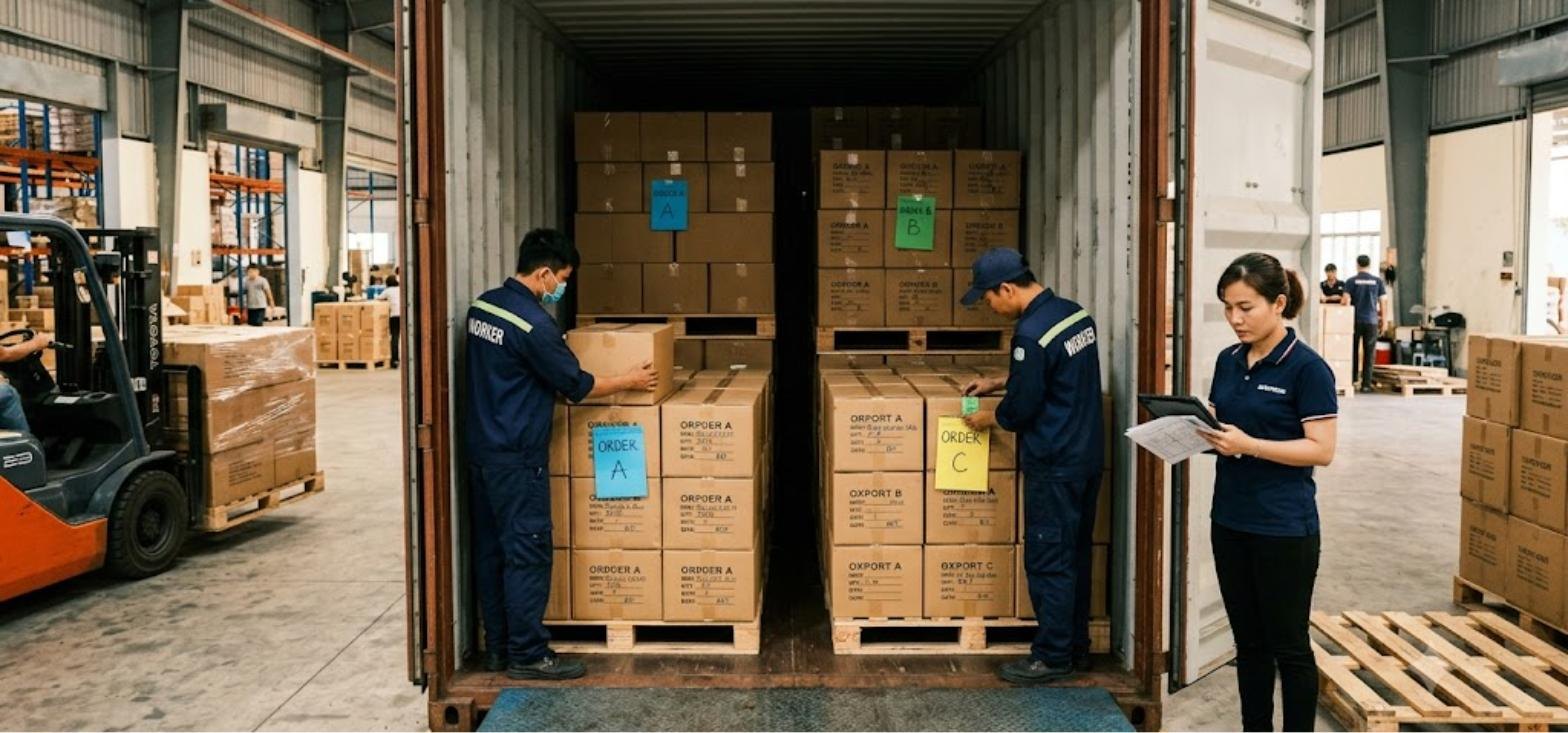
Load each supplier’s goods and each SKU as a contiguous block, and label the blocks. The photograph at the top of this article shows the discipline in practice: separate pallet blocks, coloured order labels, a supervisor working from a loading plan rather than from memory. When the container is discharged at destination, a warehouse team that can identify blocks visually will check the shipment in a fraction of the time, and a shortage claim becomes a specific claim about a specific block rather than a vague dispute about the whole load.
Moisture and cross-contamination
Mixed loads raise a risk that single loads do not. Wooden products shipped with a moisture content that is acceptable in isolation can release moisture into a sealed container across a four to six week ocean transit, and paper-based or board-based goods in the same container absorb it. That is how a buyer ends up with warped card stock or softened bagasse packaging and no obvious cause.
The controls are straightforward. Hold wooden items to a verified moisture content specification before stuffing rather than accepting a general assurance, use container desiccant sized to the load and the lane, and keep paper-based goods off the container floor and away from the doors where condensation collects. If you are shipping handmade quilling cards in a mixed load, treat this as a specification item, not a precaution.
The Documentation Discipline Mixed Containers Require
Most consolidation problems do not happen at sea. They happen at the destination customs entry, and they are documentary.
A mixed container of wooden kitchenware, compostable tableware and paper goods will cross several tariff lines. Wooden tableware and kitchenware generally sits under heading 4419, bagasse and moulded fibre tableware under headings in chapter 48, and greeting cards under 4909. Each line may carry a different duty rate and, depending on your market, a different set of entry requirements. Getting the HS classification right per line item is the single highest-value piece of preparation you can do, and it needs to happen before the commercial invoice is issued, not after the entry is rejected.
Four documentary rules for consolidated shipments:
- One packing list, itemised by block. Carton numbers, SKU, quantity per carton, net and gross weight, cube, and the block or pallet identifier. A packing list that says “13 SKUs, 780 cartons” is not a packing list.
- Invoice line items that match HS lines. Group the invoice by tariff classification, not by supplier convenience, so the broker can lift lines straight into the entry.
- Origin documentation per product line. If you intend to claim preferential duty, the certificate of origin has to cover the specific goods, and the rules of origin differ by product. A Form covering the wooden items does not cover the paper items.
- Fumigation and packaging declarations. Wooden pallets and wooden dunnage need ISPM 15 treatment and marking. This catches buyers out when a supplier substitutes an untreated pallet at the last minute.
One further point that costs mid-size buyers real money. If your shipment includes goods from more than one supplier and you are buying on FOB terms, agree in writing who is the exporter of record on the bill of lading and who issues the invoice. Two suppliers each issuing their own invoice against one container is legal in most markets but it doubles the entry work and it is the most common reason a consolidated shipment sits an extra two days at the port.
Negotiating Commercial Terms for a Consolidated Order
The commercial conversation for a mixed container is different from a single-product order, and buyers who use the single-product playbook leave value on the table.
Separate the order minimum from the SKU minimum. These are two different constraints serving two different purposes. The order minimum exists to make the shipment worth the factory’s administrative and logistics effort. The SKU minimum exists to cover setup and to keep the production run efficient. Negotiate them separately. A factory that will not move on a 40 CBM order minimum will often move on a 500-piece SKU minimum if you commit to fewer SKUs at higher depth, or if you accept a per-SKU setup charge on the small lines instead of a higher unit price across the range.
Price the range, not the item. In a mixed order the factory’s real cost driver is changeover, not volume. Two SKUs sharing a timber thickness, a finishing spec and a carton size cost materially less to run together than two SKUs that do not. Ask which of your SKUs share inputs, then consolidate your range around those families. This is the same logic that drives cost engineering a wooden kitchenware range to hit retail price points, applied to the loading plan.
Be explicit about who pays consolidation costs. Inland trucking from each supplier, warehouse handling, re-palletising, storage beyond the free period, stuffing supervision and stow photography all cost something. On FOB terms these sit on the seller side of the ship’s rail in principle, but in practice they are often quoted separately or absorbed into unit price. Ask for them itemised once, so you know what you are paying, then decide whether you want them itemised or absorbed. Read this alongside your payment terms and Incoterms position, because the Incoterm determines where the cost boundary sits and the payment terms determine who finances it.
Tie inspection to the consolidation point, not the factory. Inspecting at three separate factories is three inspection fees and three sets of travel. Inspecting at the consolidation warehouse before stuffing is one visit, and it is the last moment at which a problem can be fixed without a claim. Build the inspection window into the delivery window schedule.
Worked Example: A 40HQ for a Mid-Size Houseware Buyer
Take the German buyer from the opening. Thirteen SKUs, a March landing, and a forecast that supports roughly four months of cover rather than seven. Here is how the container was rebuilt.
Target usable cube for a 40HQ, palletised: 66 CBM.
- Core wooden kitchenware, 6 SKUs, 38 CBM. The six highest-confidence lines from the range, at four months of forecast depth. Acacia serving boards and rubberwood utensil sets, all sharing two timber thicknesses and one finishing spec. Dense cartons, loaded low and distributed.
- Wooden houseware, 3 SKUs, 14 CBM. Storage caddies and a chopping block, same factory, same finishing line, no additional setup beyond carton artwork.
- Compostable tableware, 2 SKUs, 11 CBM. Bagasse plates and bowls from a second supplier, delivered to the consolidation warehouse. Light, bulky, loaded on top of the wooden blocks. This line was already on the buyer’s purchase plan for a different quarter and was simply pulled forward into the same box.
- Handmade quilling cards, 3 CBM. Small cube, high value density, used to fill the void space behind the door blocks. Packed per the export packaging specification, desiccant protected, kept off the floor.
Total 66 CBM, four SKU families, two suppliers plus one workshop, one container, one bill of lading, one inspection at the consolidation point.
What changed commercially: the buyer’s stock cover fell from roughly seven months to roughly four on the wooden range, the freight cost per unit stayed at full-container level rather than LCL level, and the two lines that were never going to justify their own shipment, the compostable tableware and the cards, travelled at effectively marginal freight cost. The trade-offs were real and worth naming. The buyer accepted a per-SKU setup charge on four of the thinner lines, and accepted a fixed three-day delivery window that one supplier had to be pushed to meet.
Once the container lands, the discipline moves to your own warehouse. Mixed loads arrive with mixed shelf lives and mixed rotation requirements, which is a separate problem covered in our guide to warehousing, shelf life and stock rotation.
Red Flags in a Consolidation Offer
- No cube per carton figures. A supplier who cannot tell you carton dimensions and cartons per pallet per SKU cannot build a loading plan, which means someone at the warehouse will improvise one on the day.
- A single blended unit price across very different products. This usually means the consolidation costs have been absorbed somewhere you cannot see, and it makes the next order’s price negotiation impossible.
- Willingness to skip the pre-stuffing inspection. The consolidation point is the last controllable moment. A partner who treats inspection there as optional is telling you something.
- Vague answers on exporter of record. If nobody will say clearly who issues the invoice and appears on the bill of lading, expect a slow entry.
- Untreated wooden pallets. ISPM 15 marking is not negotiable and substituting a non-compliant pallet at the last minute is a recurring, avoidable failure.
- No stuffing photographs. Cheap to provide, invaluable in a claim, and a reliable signal of how the rest of the operation is run.
Frequently Asked Questions
At what volume does a mixed container stop making sense?
Below roughly 13 to 15 CBM, LCL is usually still the cheaper route and the consolidation overhead is not worth it. Between 15 and 26 CBM, a consolidated 20ft container is normally the better answer. Above 40 CBM you are into 40ft territory and the question becomes which additional lines to bring forward rather than whether to consolidate at all. These are working thresholds, not rules, and they move with freight rates and with your destination’s charge schedule.
Can I mix suppliers from different provinces in one container?
Yes, and it is routine around Ho Chi Minh City, where the wood cluster in Binh Duong and Dong Nai, the packaging plants in Long An and Tay Ninh and the handcraft workshops in the Mekong Delta all feed the same port complex. The cost is inland trucking and the risk is schedule. Manage it with a common delivery window and a named accountable contact per supplier rather than with individual delivery dates.
Does a mixed container complicate preferential duty claims?
It adds work rather than complication. Each product line needs origin documentation that actually covers it, and the rules of origin differ by tariff line. For buyers in markets with a Vietnam trade agreement, including EVFTA in the EU, UKVFTA in the UK, RCEP across Asia Pacific and the Vietnam UAE CEPA signed in February 2026, the saving is normally worth the paperwork. Confirm the position per line with your broker before the invoice is issued.
Who is liable if damage occurs inside a mixed load?
It depends on where the damage originated and what your terms say, which is exactly why the stow plan and the stuffing photographs matter. Damage caused by a heavy block stowed above a light one is a stuffing failure at the consolidation point. Damage caused by inadequate carton specification is a supplier failure. Without stuffing evidence, both become a negotiation. Agree the claims and replacement position in your contract before the first shipment.
How far ahead should I plan a consolidated order?
Take your longest supplier lead time, add the delivery window, add three to five days for consolidation, inspection and stuffing, then add the sailing time and destination clearance. For a European or Middle East landing from Vietnam, working backwards from the required in-store date with 14 to 16 weeks of runway is comfortable for a repeat range and tight for a new one. Around Tet, when factories shut for one to two weeks and the pre-holiday port rush compresses schedules, add three to four weeks.
Should I floor load or palletise a mixed container?
Palletise if your destination warehouse discharges by forklift, if you are shipping into a retailer or marketplace facility with pallet requirements, or if the load mixes very different densities. Floor load if you control the discharge, if labour at destination is available and if the extra 12 to 15 percent of cube genuinely changes the order economics. For most mid-size mixed loads the answer is palletise, and remember that pallets themselves need ISPM 15 treatment.
Working With Viet Farm Vision
Viet Farm Vision works with importers, retail groups and distributors sourcing wooden kitchenware and houseware, handmade quilling cards and compostable tableware from Vietnam, and consolidation is a normal part of how we structure an order rather than an exception. For buyers building a mixed container that means:
- Cube per carton and cartons per pallet for every SKU at quotation stage, so the loading plan is built before quantities are confirmed rather than after
- A single commercial counterparty across multiple production partners, with one delivery window, one set of documents and one accountable contact
- Pre-stuffing inspection at the consolidation point, with a written stow plan and stuffing photographs at three stages
- HS classification reviewed per line item before the commercial invoice is issued, and origin documentation arranged per product line
- Moisture control and desiccant specification where wooden and paper-based goods travel in the same box
If you are sizing a first order from Vietnam and the full-container requirement is the thing standing in the way, send us the SKU list and the depth you actually want to carry. We will come back with a cube plan and tell you honestly whether a consolidated container, a 20ft or LCL is the right answer for that volume.
Related reading: container loading and ocean freight, annual price agreements and escalation clauses, and supplier scorecards and vendor management. External reference: the ICC Incoterms rules and the IPPC ISPM 15 standard for wood packaging material.