
The best greeting card display ideas for a gift shop come down to three rules: show the full card face, group cards by occasion, and put your most detailed handmade cards at eye level, where shoppers can see the craft. For handmade quilling cards, whose raised coils of paper are the main selling point, the display also has to protect that texture.
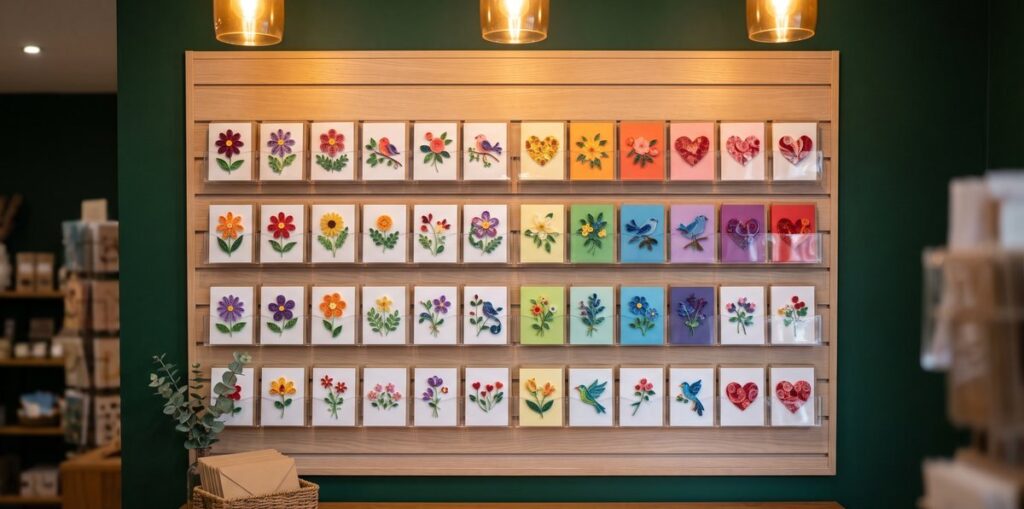
Why does card display matter so much in a physical shop?
Greeting cards are still mostly a browse-and-pick purchase made in person. The UK Greeting Card Association’s market report for 2023 put single card sales at around £1.51 billion in retail value and roughly 800 million cards, and found that over 80% of single cards were bought in physical stores (PG Buzz, reporting the GCA Market Report). In the US, the Greeting Card Association estimates consumers buy about 6.5 billion cards a year (USPS News).
When shoppers choose in front of a fixture, the fixture does much of the selling. For quilling cards, the visible hand-rolled detail justifies the price, so a display that hides or stacks them throws that advantage away.
Greeting card display ideas that work for handmade quilling cards
1. Face-out pockets on a wall or slatwall
A wall of clear face-out pockets is the workhorse for card retail. Every design shows its full front, and the depth of each pocket lets you hold a few units behind the display card. Keep quilled cards in pockets deep enough that the paper relief is not pressed against the card in front.
2. A small tiered stand beside the till
A tabletop stand of six to twelve designs near the counter catches the shopper who has already chosen a gift and now needs a card to go with it. Use it for your best-selling everyday designs, such as birthday, thank you and “just because” florals.
3. Occasion stories with a companion gift
Place a card next to a product it suits: a floral quilling card beside candles or tea, a new-baby card beside soft toys, a wedding card beside photo frames. The card becomes part of a ready-made gift.
4. A spinner for everyday categories
Spinners save floor space and work well for broad, steady categories. Put quilled cards on the upper tiers rather than the bottom ring, where they are harder to see and more likely to be knocked.
5. A seasonal feature table or window
Ahead of Valentine’s Day, Mother’s Day, Eid or Christmas, give the season its own table or window. Themed designs on small easels read as a curated collection.
Where should each type of card go in the shop?
| Fixture | Best for | Placement tip | Watch out for |
|---|---|---|---|
| Face-out wall pockets | Full everyday range by occasion | Hero handmade designs at eye level | Pockets too shallow for raised paper |
| Tiered stand by the till | Impulse add-on cards | Six to twelve best sellers only | Overcrowding the counter |
| Gift pairing (cross-merchandising) | Florals, baby, wedding, thank you | One card per paired product | Cards drifting out of their sleeves |
| Spinner | Birthday and general categories | Quilled cards on upper tiers | Knocks and scuffs on the lowest ring |
| Seasonal table or window | Valentine’s, Mother’s Day, Eid, Christmas | Small easels or open boxes | Direct sun fading coloured paper |
How do you protect quilled cards on display?
- Use clear sleeves. A cello sleeve keeps dust and fingerprints off while still showing the relief. Many buyers ask their supplier to pack each card in a sleeve with its envelope.
- Keep one display sample. One unsleeved card per design, placed out of easy reach, lets shoppers see the texture without handling stock.
- Avoid stacking cards flat. Weight on top of a quilled card can flatten coils over time.
- Keep cards out of strong sunlight. Coloured paper can fade in a sunny window, so rotate window stock regularly.
Retail-ready packaging is easiest to plan before production. Our handmade quilling greeting cards can be supplied in private label packaging with your logo, so cards arrive ready for the shelf.
How do you tell the handmade story at the shelf?
Shoppers often cannot tell a quilled card from a printed one until they look closely. A small shelf card that says the designs are hand-quilled by artisans in Vietnam, most of them local women working at a partner workshop near their homes, gives them a reason to pick the card up. Keep it to one or two lines.
You can also add meaning to the motifs. A note explaining what lavender, daisies or roses traditionally stand for helps shoppers choose the right card for the moment; our guide to flower meanings for greeting cards is a useful starting point. For staff who want to explain how the cards are made, see quilling techniques explained for card buyers.
Common greeting card display mistakes to avoid
- Mixing handmade and mass-printed cards in the same pocket row, so the handmade cards lose their premium look.
- Leaving empty pockets after a design sells out, which makes the whole wall look tired.
- Sorting only by design instead of by occasion. Most shoppers arrive knowing the occasion, not the design.
- Putting seasonal cards out too late. Seasonal ranges need to be ordered months ahead, so plan display space and stock together.
Planning the display with your card supplier
A good display starts at the order stage. When you brief a supplier, share how you plan to display the cards: pocket depth, whether you want a sleeve, and which occasions you will feature. We can produce custom designs to your brief, print or attach your logo, and supply private label packaging. Every order goes through four quality checks: sample approval before production, an in-process check at the workshop, inspection of each card before packing, and a carton count with photos and video sent to you before shipment. For setting shelf prices, our article on retail margin and shelf price points covers the principles.
Frequently Asked Questions
How many card designs should a small gift shop display?
There is no fixed number; it depends on wall space and how quickly you sell through. A focused range shown face-out usually sells better than a crowded wall. Start with your core occasions and add seasonal designs as space allows.
Should handmade cards be displayed separately from printed cards?
Yes, ideally. A dedicated block or shelf for handmade quilling cards signals that they are a different, premium product.
Do quilling cards need special packaging for retail?
A clear sleeve with the envelope inside is the most common retail format, as it protects the raised paper and keeps the card and envelope together. You can also ask for private label packaging with your logo. Agree on the format before production so it is included in your quotation.
When should I set up a seasonal card display?
Set up the display a few weeks before the occasion, but order the stock much earlier. Wholesale buyers usually place seasonal handmade card orders three to five months ahead to allow for design approval, production and shipping.
Ready to build a card wall that sells?
If you are planning a handmade card range for your shop, tell us your occasions, display format and packaging needs. Request a quote and we will reply within one business day.