
Flower meanings for greeting cards come mostly from the 19th-century “language of flowers”, a system in which each bloom carried a coded sentiment: a red rose for love, a forget-me-not for remembrance, a daisy for innocence. For a wholesale buyer planning a range of handmade quilling cards, these meanings are a practical tool. They help you match each floral design to the right occasion, write better product copy, and avoid motifs that quietly send the wrong message.
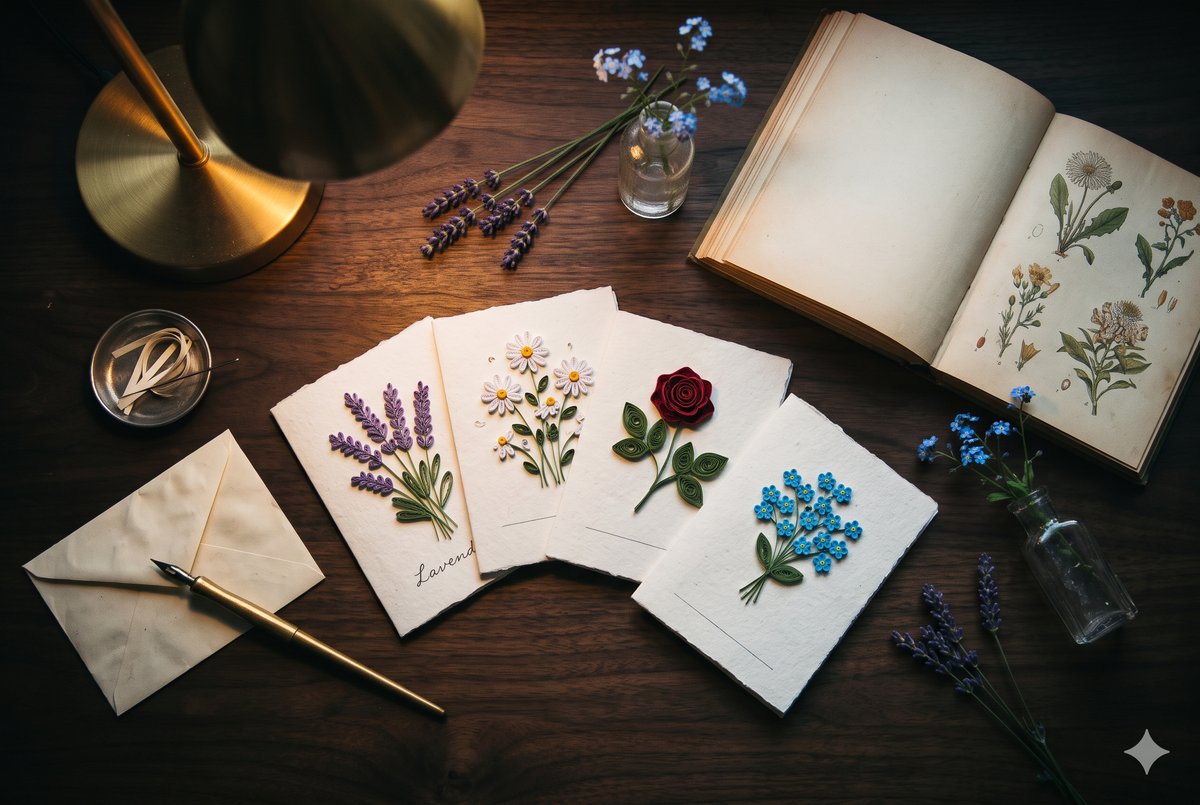
Where do flower meanings on greeting cards come from?
The idea that flowers can “speak” is old, but the version that shaped modern card design is European and fairly recent. According to the history summarised on Wikipedia, interest grew after the Ottoman court’s fascination with tulips in the early 18th century and the Turkish sélam tradition of sending messages through objects. Lady Mary Wortley Montagu brought the fashion to England in 1718 after her stay in Constantinople.
The real turning point was a book. In 1819 Louise Cortambert, writing as Charlotte de la Tour, published Le Langage des Fleurs. Cornell University Library’s “Written in Petals” exhibit describes it as the first book devoted entirely to floriography, widely translated, and the basis for the popular British systems that followed. The same exhibit notes that modern scholarship points to a more European origin than the “Turkish love letter” story suggests.
During Queen Victoria’s reign the hobby became mainstream. West Virginia University Extension notes that dozens of flower dictionaries were published and that small bouquets called tussie-mussies were built around one “focus flower” carrying the main message. In the United States, Elizabeth Wirt’s Flora’s Dictionary appeared in 1829. Greeting cards inherited this vocabulary, which is why florals still dominate the card aisle today.
Why do flower meanings differ between sources?
There was never one official dictionary. Each Victorian author added, borrowed or changed meanings, so most flowers ended up with several. Lavender is a good example: the Old Farmer’s Almanac chart lists it as “distrust”, while WVU Extension gives “purity, silence, serenity”. Meanings also shift by culture. Wikipedia points out that the rose is the “queen of flowers” in the West, while in China that title belongs to the tree peony, and Japan has its own system, hanakotoba.
For a buyer, the lesson is simple. Use the meaning most shoppers already recognise, and when you print a meaning on a card or tag, frame it as tradition (“in the Victorian language of flowers…”) rather than as a fixed fact.
Flower meanings for greeting cards by occasion
The table below pairs common quilling motifs with their most widely cited meanings, drawn from the Old Farmer’s Almanac, Iowa State University Extension and WVU Extension, and the card occasions they fit best.
| Flower motif | Commonly cited meaning | Card occasions it suits |
|---|---|---|
| Red rose | Love | Valentine’s Day, anniversary, engagement |
| Pink rose | Happiness, grace, gentleness | Birthday, thank you, Mother’s Day |
| White rose | Innocence, new beginnings | Wedding, new baby |
| Red tulip | Declaration of love, perfect love | Valentine’s Day, engagement |
| Daisy | Innocence, loyalty, purity | New baby, friendship, birthday |
| Forget-me-not | True love, memories, “remember me” | Thinking of you, farewell, sympathy |
| Iris | Faith, hope, friendship | Encouragement, graduation, get well |
| Sweet pea | Thanks for a lovely time, farewell | Thank you, leaving, retirement |
| Pink carnation | Remembrance (carnations in general: a mother’s love) | Mother’s Day |
| White poppy | Consolation | Sympathy |
| Sunflower | Devotion, sunshine | Friendship, cheer up |
| Lavender | Serenity, silence (meanings vary) | Thinking of you, self-care, everyday |
Which flower motifs need a second look?
A few blooms carry Victorian meanings that clash with how a card will be used. Many shoppers will not know them, but customers who enjoy floral symbolism, such as wedding clients and museum-shop visitors, may well notice.
- Yellow rose: jealousy or waning love in older dictionaries, though the Almanac notes modern use as friendship. Fine on a friendship card, risky on a romantic one.
- Yellow and striped carnations: listed as disdain, rejection and refusal. Avoid them on Mother’s Day and wedding designs.
- Orange lily: listed as hatred by both Iowa State and the Almanac.
- Dark crimson rose: associated with mourning, so keep it for sympathy ranges, not Valentine’s.
- Marigold: Iowa State lists grief and jealousy in the Victorian system, so it is a poor choice for romantic cards in Western markets.
Colour matters as much as species. A quilled rose made in red strips and the same rose made in yellow strips say different things, so always state the colour in your brief. If you sell into several regions, our guide to quilling card designs by market covers motif and colour preferences beyond the Victorian tradition.
How can buyers use flower language in a quilling card range?
Plan by occasion, then by flower. Start with the occasions that sell best in your store, then choose flowers whose meaning supports each one. A Valentine’s range built on red roses and red tulips tells a consistent story; see our Valentine’s quilling card order guide for timing.
Turn meaning into product copy. A short line on the card back or a hang tag (“Forget-me-not: in the Victorian language of flowers, true love and memories”) gives shoppers a reason to choose one handmade card over another. With private label packaging, this line can sit on your own branded sleeve or insert.
Brief your supplier precisely. When you send a custom design, name the flower species, the strip colours and the occasion. At Viet Farm Vision, every custom design starts with a sample you approve before production, so you can check that the quilled flower reads correctly before any order is made. Browse our handmade greeting cards to see the floral styles our partner workshop’s artisans already produce.
Frequently Asked Questions
What is the most popular flower for greeting cards?
The rose is the most versatile, because its meaning changes with colour: red for love, pink for happiness, white for new beginnings. That lets one motif cover Valentine’s, birthday and wedding cards. Daisies and forget-me-nots are strong second choices for everyday and thinking-of-you designs.
Which flowers are best for sympathy cards?
Traditional choices include white poppy (consolation), forget-me-not (remembrance) and dark crimson rose (mourning). Soft, muted strip colours suit these designs better than bright tones. Keep sympathy florals visually separate from celebration ranges on the shelf.
Should I print flower meanings on the card?
It often helps, especially in gift shops and museum shops where shoppers enjoy the story. Keep it short and frame it as tradition, because sources disagree on many meanings. A back-of-card line or hang tag works better than text on the front, which should stay clean for the quilled artwork.
Can quilling cards be made with a specific flower and colour I choose?
Yes. Viet Farm Vision accepts custom designs based on your own artwork or brief, including specific flowers, colours and logo placement. Each design is sampled and approved by you before production starts.
Build a floral range that says the right thing
Flower meanings for greeting cards are a small detail with a real effect on sell-through: the right bloom for the right occasion makes a card easier to choose and easier to talk about at the counter. If you are planning a floral quilling range for your store or brand, send us a request for a quote with your occasions and preferred flowers, and our team will reply within one business day.