
Most quilling card programmes are costed backwards. A buyer receives an FOB quotation, multiplies it by four, compares the result to what sits on a competitor’s spinner rack, and decides on the spot whether the category works. That shortcut has sunk more handmade card ranges than any quality problem ever has — because on a 20-gram paper product shipped out of Ho Chi Minh City, the distance between FOB and the price on the shelf is not a single multiplier. It is a stack of six or seven line items, and three of them are entirely inside your control.
This guide rebuilds that stack in the order a procurement or category manager should actually build it: landed cost first, then the margin architecture your channel demands, then the retail price points that handmade cards can realistically hold, and only then back to the factory to negotiate the number you started with.
Why “FOB × 4” breaks on handmade cards
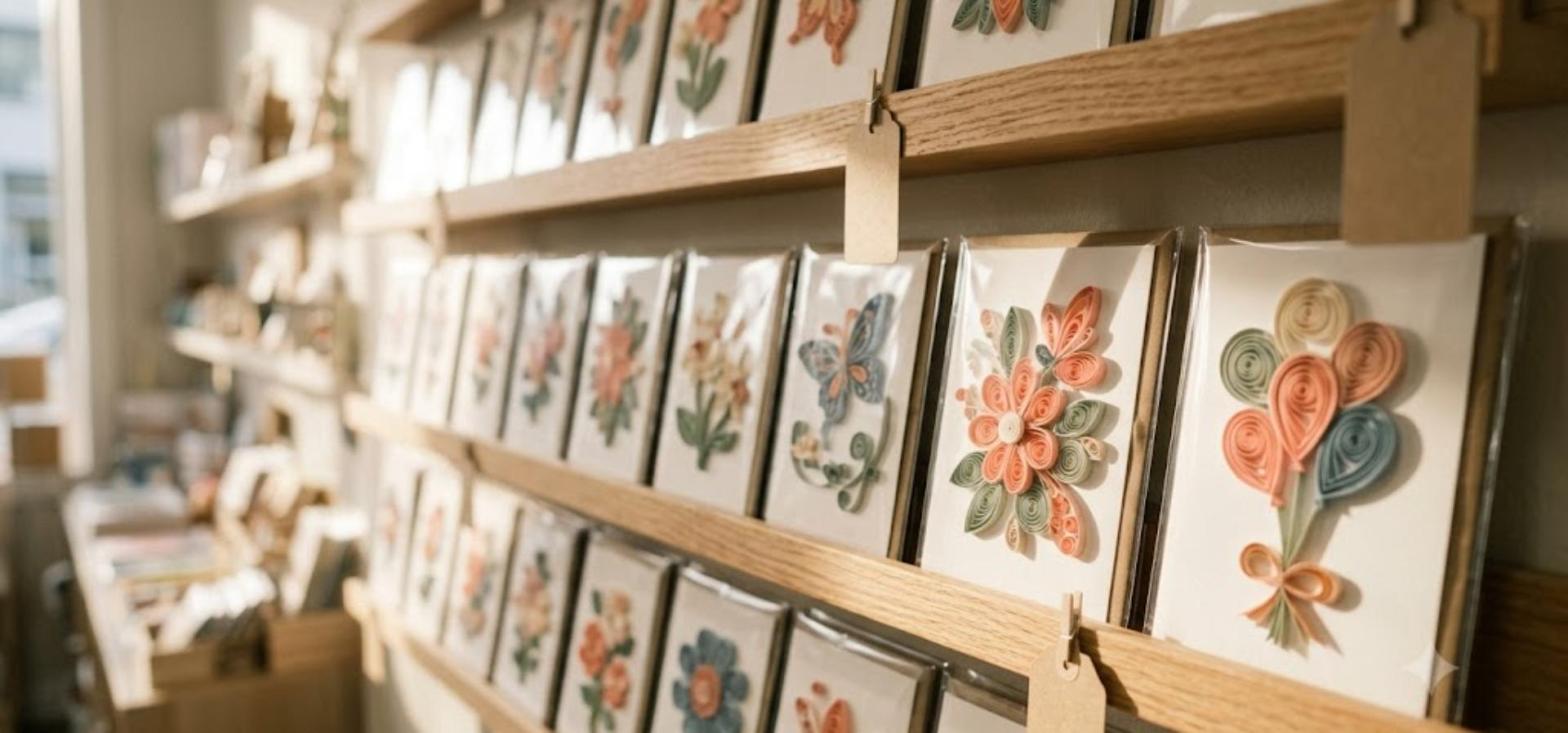
The keystone-and-a-half rule of thumb was built for goods where freight is a rounding error and the unit is interchangeable. Quilling cards fail both tests.
- They are light but bulky. A three-dimensional card in a protective sleeve is mostly air. Freight is charged on volumetric weight, not actual weight, so the shipping line item behaves like a furniture item, not a paper item.
- Unit cost is labour, not material. Paper and adhesive are a small fraction of the FOB price. The rest is artisan hours, and artisan hours do not fall at the same rate as machine time when you double the order.
- Sell-through is uneven by design. Three designs out of twelve will carry the range. Your blended margin, not your per-card margin, is what has to clear.
Step 1: Build the true landed cost per card
Before any margin conversation, convert everything to one number: cost per saleable card, delivered to your warehouse. The illustrative stack below assumes a 5,000-piece mixed order of mid-complexity cards moving by sea in a consolidated LCL shipment. Your own figures will differ, but the shape of the stack rarely does.
| Line item | Typical share of landed cost | Who controls it |
|---|---|---|
| FOB card cost (artisan labour, paper, adhesive, sleeve) | 62–74% | Specification & volume |
| Export packing, master cartons, pallet | 3–5% | Spec — often over-engineered |
| Ocean or air freight (volumetric) | 8–18% | Mode, consolidation, carton cube |
| Import duty & clearance | 0–6% | Classification & origin paperwork |
| Inbound handling, QC, warehousing | 3–6% | Your operation |
| Shrinkage, damage, unsaleable units | 1–4% | Export packing spec |
Two line items deserve more attention than they usually get. The first is freight: because quilling cards are dimensioned rather than weighed, switching from a 40 mm display box to a 25 mm sleeve-and-backer can remove a double-digit percentage from the freight line without touching the product. We covered that arithmetic in detail in our guide to air, sea or express shipping for Vietnam quilling cards.
The second is duty, and here classification is everything. Printed and illustrated greeting cards generally fall under HS heading 4909, which carries a zero or near-zero MFN rate in many destination markets — but a handmade three-dimensional card can be argued into other headings, with very different outcomes. Verify your own line against the published schedule (the US Harmonized Tariff Schedule and the EU’s TARIC database are both public), and read our note on HS codes and rules of origin for quilling and pop-up cards before you assume a rate.
Step 2: The margin stack your channel actually requires
Once landed cost per card is fixed, the required shelf price is a function of how many parties sit between you and the consumer. Three structures cover most quilling card programmes:
- Direct retail (own store or own web shop). One margin to cover. Specialty gift retailers typically work on a 55–62% gross margin on handmade stationery, which implies a shelf price of roughly 2.3–2.7× landed cost.
- Wholesale to independent retailers. Two margins. You sell at a wholesale price that gives you 40–50%, the retailer keystones or better. The shelf price lands near 4.0–4.8× your landed cost — which is exactly where the naive “FOB × 4” accidentally arrives, and why it looks right until freight or duty moves.
- Distributor or national account. Three margins, plus listing and promotional allowances. Shelf price commonly needs 5.5–6.5× landed cost, and that is where handmade cards start to price themselves out unless the perceived value is unmistakable at arm’s length.
The practical implication: decide the channel before you decide the specification. A card built for a distributor model has to justify a materially higher shelf price than the same card sold direct, and the cheapest way to build that justification is in the design and the presentation — not in a cost reduction at the workshop.
Step 3: The price points handmade cards can hold
Mass-market printed greeting cards and handmade quilling cards do not compete in the same price band, and trying to make them do so destroys the category. Quilling cards sell as a small gift that happens to be a card — frequently kept, framed or re-gifted rather than discarded. Buyers who merchandise them accordingly find three workable bands:
- Entry tier. Simpler single-motif designs, slim profile, lower coil density. Positioned as the impulse purchase next to the till; carries the unit volume that keeps the workshop’s line efficient.
- Core tier. Mid-complexity multi-element designs — the bulk of a well-built assortment, and the tier that determines the blended margin for the whole programme.
- Statement tier. High coil count, layered or dimensional construction, premium envelope and sleeve. Low volume, high margin, and its real job is to anchor perceived value for the two tiers below it.
A range with no statement tier tends to get compared to printed cards. A range with only a statement tier never builds the repeat volume that makes the supply relationship worth running. The ratio matters more than the absolute prices, and a 20/60/20 split by SKU count is a sound starting hypothesis to test against your own sell-through data.
Step 4: The four levers that move the FOB you started with
Only after the stack is built does it make sense to go back to the workshop. On handmade goods, four levers actually move the number; everything else is noise.
- Coil count and element count. The single largest driver. Removing one decorative sub-element from a busy design can cut meaningful minutes per card with almost no loss of shelf impact — but it must be decided at artwork stage, not after the golden sample.
- Design repetition across the range. Artisans get faster on a motif they have already made a thousand times. A range that reuses a common floral base across four seasonal variants costs less per card than four unrelated designs at the same total volume.
- Order depth per design, not total order size. A 6,000-piece order split across 30 designs is a different cost structure from 6,000 across 10. Depth per SKU is what unlocks the learning curve.
- Packaging specification. Sleeve material, backer board weight, insert cards and belly bands are all optional and all compound into both FOB and freight.
For a line-by-line reading of how these show up on a quotation, see what actually drives the price of a Vietnam quilling card.
Step 5: Assortment economics — why a tighter range earns more
The instinct on a first order is breadth: more designs, more chances to find a winner. On handmade product the maths runs the other way. Every additional design adds a sampling round, an approval cycle, a separate minimum, a separate artisan learning curve and a separate line on the packing list — while splitting the same shelf space into thinner facings.
A disciplined first range of ten to fourteen designs, deliberately split across the three tiers and weighted toward evergreen occasions rather than narrow seasonal windows, gives you a cleaner read on sell-through and a stronger position on the reorder. Breadth is something you earn with data on the second PO — a theme we develop in our guide to repeat-order minimums and SKU rationalisation.
Three mistakes that quietly break the stack
- Costing on the sample shipment. Air-freighting 200 samples produces a per-card freight figure that has nothing to do with a production shipment. Model the production freight separately, from the real carton cube.
- Ignoring the cash-flow cost of the deposit. On handmade goods with long artisan lead times, the gap between deposit and sale is a real financing cost that belongs in the stack. See our note on payment terms and cash flow on quilling card orders.
- Treating damage allowance as optional. A crushed card is not a discounted card; it is a zero. Budget a shrinkage line and spend the few cents on export packing that keeps it small.
The checklist before you commit
- Landed cost modelled per saleable card, on production volumes and production carton cube — not on the sample shipment.
- Channel structure fixed, and the required multiple on landed cost written down before the first quotation is reviewed.
- Assortment split across three tiers, with the statement tier present even at low volume.
- Design complexity decided at artwork stage, with cost impact priced before golden-sample sign-off.
- HS classification confirmed against your own tariff schedule, with origin documentation agreed with the supplier.
- Packaging specification reviewed for both shelf presentation and carton cube, as one decision rather than two.
Sourcing quilling cards from Vietnam
Viet Farm Vision works directly with a handmade quilling card workshop in the Mekong Delta, producing custom and own-design handmade greeting card ranges for gift, stationery and museum-shop buyers worldwide. We quote the full stack — FOB, export packing specification and carton cube — so that your landed cost model is built on production numbers from the start, and we support custom artwork development, sampling and golden-sample approval before any volume commitment.
To discuss a quilling card programme, request a quotation or ask for the current design catalogue, contact us at info@vietfarmvision.com or request a quote.