
Good greeting card packaging does three jobs at once: it protects a handmade card from fingerprints and crushing, it makes the card easy to price, scan and hang, and it tells the shopper what they are buying before they pick it up. For quilling cards, where the design stands off the surface in rolled paper coils, the packaging decision matters more than it does for a flat printed card.
This guide explains the main greeting card packaging formats wholesale buyers choose for handmade quilling cards, how each one affects display, damage and shrinkage, and what to specify on your purchase order so the cards arrive retail-ready.
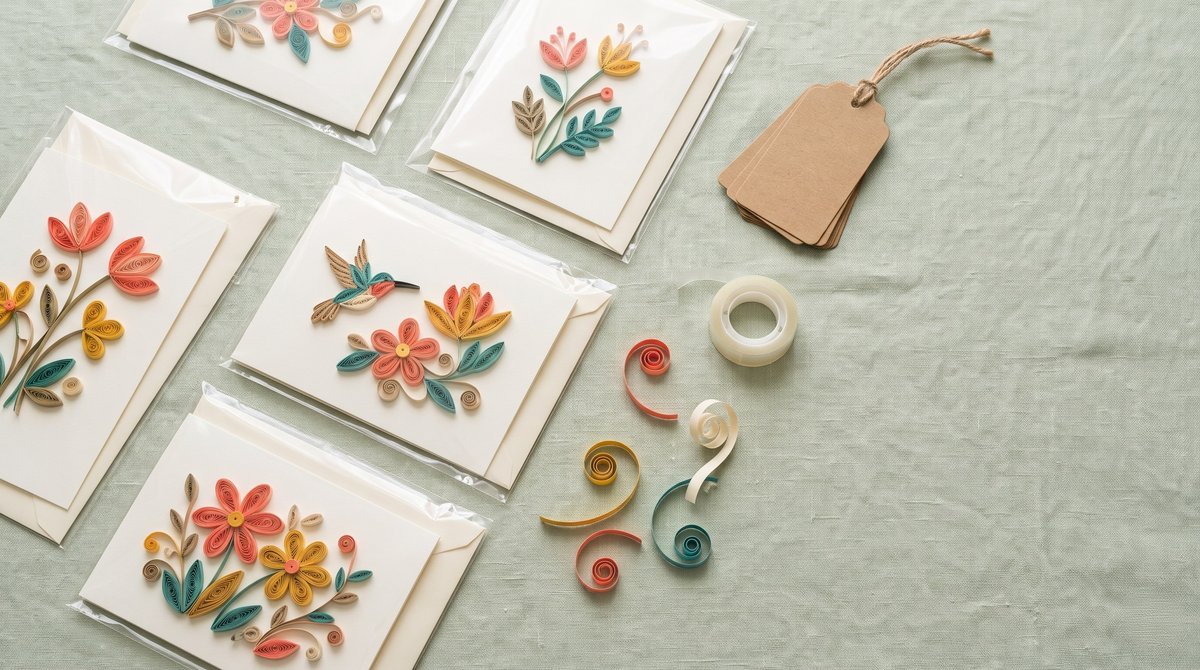
Why does packaging matter more for quilling cards?
A printed card is flat. A quilled card has relief: petals, leaves and wings are made from paper strips rolled into coils and glued edge-on to the card front, so the design rises a few millimetres above the surface. That depth is the selling point, and it is also the vulnerable part. Shoppers like to touch textured cards, and a coil that is pressed repeatedly or squeezed in a tight rack can lose its shape. If you want a refresher on how those coils are formed, see our guide to how quilling cards are made.
Volume is the other reason. According to Greeting Card Association figures reported by USPS News, US consumers buy around 6.5 billion greeting cards a year. In a category that busy, a card has a few seconds to earn attention on a crowded spinner or wall rack. Packaging that shows the design clearly, keeps it clean and carries the right price and barcode information helps a premium handmade card hold its place next to cheaper printed stock.
What are the main greeting card packaging options?
Most retail-ready handmade cards use one of five formats. The right choice depends on where the card will be sold, how much handling it will get, and whether you sell singles, sets or gift boxes.
| Packaging format | Best for | Protection for quilled relief | Display fixture |
|---|---|---|---|
| Clear sleeve with envelope | Single cards in gift and stationery shops | Good: keeps hands and dust off | Card racks and spinners |
| Sleeve with header card | Stores using peg walls; branded ranges | Good, plus room for brand and barcode | Peg hooks |
| Open card with band or backer | Boutiques that want shoppers to feel texture | Limited: needs frequent tidying | Shelves and small stands |
| Boxed set (4 to 8 cards) | Gift counters, museum shops, corporate gifting | Very good: rigid and stackable | Tables and shelves |
| Single card gift box with window | Premium occasions such as weddings | Very good, highest perceived value | Gift tables and counters |
Clear sleeve with envelope
The most common format for single cards. The card and its envelope slide into a clear resealable sleeve, usually with a self-adhesive flap. The shopper sees the full design, the envelope stays with the card, and the sleeve keeps hands off the quilled surface. For relief designs, ask for a sleeve sized with a little allowance for depth so the coils are not flattened when the flap is sealed.
Sleeve with header card
A header card is a folded strip stapled or sealed across the top of the sleeve, with a punched hole for hanging on peg hooks. It gives you space for your brand, a short craft story and a barcode without printing anything on the card itself. This format suits stationery stores and supermarkets that use peg walls rather than card racks.
Open card with backer and wrap band
Some boutique shops prefer cards unwrapped so shoppers can feel the texture. A light paper band around the card and envelope, or a small backer board, keeps the pair together and carries the label. This looks premium but gives the least protection, so it works best in low-traffic boutiques where staff can restock and tidy often.
Boxed sets and gift boxes
A box of four to eight cards, or a single card in a rigid box with a window, moves the product from a card purchase to a gift purchase. Boxes protect quilled designs best and stack well on tables and shelves. They take more carton space, so weigh perceived value against freight volume.
How should private label greeting card packaging be specified?
If you sell under your own brand, the packaging is where the brand lives. With our handmade greeting cards, buyers can have a logo printed or attached, use their own designs, and supply private label packaging artwork. To avoid back-and-forth, put these points in writing before the pre-production sample is made:
- Format: sleeve only, sleeve plus header, band, or box, and whether the envelope sits behind or beside the card.
- Artwork files: logo, header or band design, and colour references, supplied as print-ready files.
- Barcode: the GTIN number and where it goes, such as on the back of the sleeve, the header or a sticker on the box.
- Inside message: blank, printed greeting, or your brand line on the back of the card.
- Inner and outer packing: how many packaged cards per inner pack, how many inners per export carton, and how cartons are marked.
- Assortment: whether each inner pack holds one design or a mix, which changes how fast stores can restock a rack.
Do I need my own barcodes?
Usually, yes, if you sell through other retailers or online marketplaces. GS1 UK explains that when a retailer asks for a UPC, it is really asking for a GTIN, and that GS1 is the only authorised provider of these numbers. North American retailers typically expect 12-digit UPC codes, while many other markets use 13-digit EAN codes. Register the numbers in your company’s name and send them with your artwork, so they can be printed on the header or applied as stickers during packing.
How does packaging affect damage, returns and shrinkage?
For handmade cards, most damage happens in two places: in transit and on the shop floor. Export packing handles the first. In our workflow, every card is checked before it is packed, then cartons are counted and photographed, with photos and video sent to the buyer before shipment. Retail packaging handles the second.
A few practical points to plan for:
- Sleeved cards tend to stay saleable longer on busy racks, because fingerprints, dust and bent corners are the most common reasons a card ends up marked down.
- Unsleeved textured cards invite touching. That can help sales in a quiet boutique, but plan for more frequent tidying.
- Header cards and boxes make cards harder to slip into a pocket and easier to see from the till, which can help with shrinkage in larger stores.
If you also hold back stock, the way it is stored matters as much as how it is packed. Our stockroom care guide for quilling cards covers humidity, stacking and rotation.
How does packaging affect display?
Match the packaging to the fixture you already have. Card spinners and slot racks suit sleeved singles. Peg walls need header cards. Tables, gift counters and museum shop shelves suit boxed sets, which also photograph well for your website. If you sell online, a sleeve with a neat back label makes product photography and pick-and-pack easier. For more ideas on fixtures and grouping, see our article on greeting card display ideas for gift shops.
What packaging details affect price and lead time?
Packaging is one of the factors that changes a unit quote and the production schedule, even though the card design stays the same. The main drivers are:
- The number of packaging components per card: a sleeve alone is simpler than a sleeve, header and sticker.
- Custom printed items such as headers, bands and boxes, which need their own artwork approval and print time.
- Box construction, since rigid or windowed boxes take longer to source and assemble than sleeves.
- Carton volume, because boxed sets ship fewer units per carton than sleeved singles.
We do not publish fixed prices because every packaging mix is different. The quickest way to get an accurate figure is to send your preferred format and quantities with your enquiry. If you are importing into a specific market, our country guides, such as importing quilling cards into South Korea, cover documents and labelling points to plan alongside packaging.
Greeting card packaging checklist before your first order
- Choose one format per sales channel: sleeves for racks, headers for peg walls, boxes for gift tables.
- Confirm the sleeve or box allows for the relief of the quilled design.
- Send logo, header and box artwork as print-ready files.
- Register GTIN barcodes in your company name and confirm placement.
- Agree inner pack quantity and whether designs are mixed or single.
- Approve a packaged pre-production sample, not just the card.
- Ask for carton photos and video before shipment.
Frequently Asked Questions
What is the best packaging for handmade greeting cards?
For most retail racks, a clear sleeve with the envelope inside is the best balance of protection, visibility and cost. Peg-wall stores do better with a header card, and gift counters suit boxed sets. Choose based on the fixture and how much the cards will be handled.
Can quilling cards be packed in cellophane sleeves without damage?
Yes, as long as the sleeve is sized with allowance for the raised design. A sleeve that is too tight can press the coils flat when the flap is sealed. We confirm the fit on the pre-production sample before full packing starts.
Can you print my logo on the packaging?
Yes. We can print or attach your logo and use your private label artwork on sleeves, header cards, bands or boxes. Artwork is approved before production so the packaging matches your brand.
Who provides the barcodes for retail packaging?
Barcodes should be registered by the brand owner, usually through their national GS1 office, so the numbers are linked to your company. You send us the codes and placement, and they are printed on the packaging or applied as stickers during packing.
Does packaging change the lead time?
It can. Custom printed headers, bands and especially boxes need their own artwork approval and sourcing time. Sharing your packaging choice at the enquiry stage helps us give a realistic schedule from the start.
Get retail-ready quilling cards packed your way
Packaging is the last thing you design and the first thing your customer sees. If you know your format, fixture and quantities, we can quote cards that arrive ready for the shelf, with a packaged sample for your approval and photos of every carton before it ships. Request a quote with your preferred packaging and we will reply within one business day.