
The short answer to how to store quilling cards: keep each card in its own sleeve, stand or lay the cards so nothing presses on the raised paper coils, and hold stock in a cool, dry, dark room with relative humidity below 50%. Rotate stock first-in, first-out and handle cards by their edges. Do those five things and a quilled card bought for spring will look as crisp on the shelf as the day it was approved.
Quilled cards are not difficult to look after, but they are not printed cards either. The design stands proud of the card face, it is made of many small glued paper elements, and it is built from coloured paper that reacts to light and moisture. This guide is written for gift shops, stationery stores, museum shops and distributors who hold handmade card stock for weeks or months between delivery and sale.
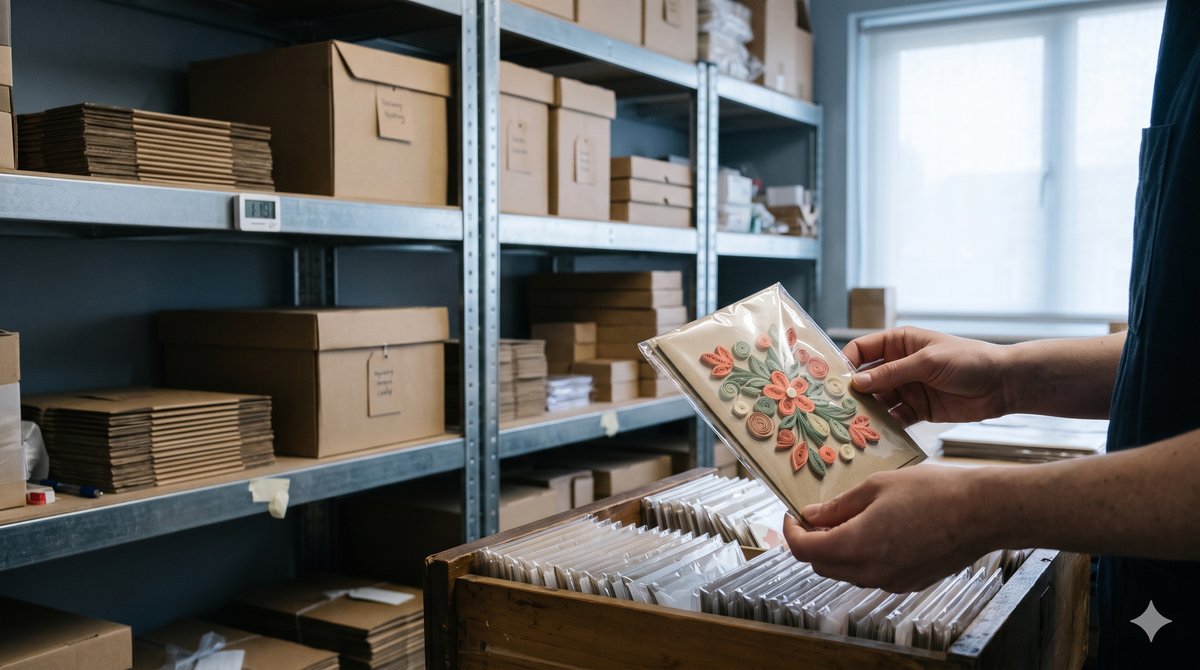
Why do quilling cards need different storage from printed cards?
A printed or embossed card is essentially flat. You can stack a few hundred in a box and the worst that happens is a scuffed corner. A quilling card carries a relief design: strips of paper rolled into coils, teardrops, scrolls and petals, then glued edge-on to the card face. If you are new to the craft, our guide to quilling techniques explains how those shapes are made.
That construction creates three storage risks that flat cards do not have:
- Pressure. Coils are strong on their edge but can flatten or shift if heavy weight sits on them for a long time, for example under a stack of boxes.
- Moisture. Paper takes up and releases moisture from the air. The Canadian Conservation Institute notes that relative humidity above 60% accelerates chemical and biological deterioration of paper and promotes distortion. On a card with many glued elements, distortion shows up quickly as curling or lifting.
- Light. Coloured paper fades. The Library of Congress classes coloured papers as very light sensitive and stresses that light damage is cumulative and, in most cases, cannot be reversed.
What are the ideal conditions to store quilling cards?
Conservation bodies publish environmental guidance for paper. A gift shop does not need museum-grade control, but those figures are a useful ceiling and floor to aim for. The table below translates them into stockroom terms.
| Factor | Reference guidance | What it means in a stockroom |
|---|---|---|
| Relative humidity | Below 50% recommended for paper collections; above 60% accelerates deterioration (CCI) | Avoid basements, rooms next to kitchens or wash areas, and outside walls that get damp. A cheap hygrometer on the shelf tells you more than guesswork. |
| Stability | Keep levels constant; some variation is acceptable (CCI) | Do not store cards next to heaters, air-conditioning outlets or loading doors where conditions swing daily. |
| Temperature | A maximum of around 21°C where comfort and cost are a factor (CCI) | Normal room temperature is fine. Avoid lofts, sheds and the top shelf above a radiator. |
| Light | Damage is cumulative and largely irreversible; filter UV (Library of Congress) | Keep stock boxed and lights off when the room is not in use. Never leave open cartons under a window. |
| Pressure | Keep stacking of boxes to a minimum (CCI) | Store card boxes on shelves rather than in tall floor stacks, and never put heavy goods on top of card stock. |
One extra point from the same CCI note: at very low humidity paper becomes more brittle, so the goal is moderate and steady, not as dry as possible.
How to store quilling cards: upright or flat?
There are two good ways to hold quilled cards, and one bad one.
Upright, like files
Standing cards on their long edge in a box with dividers is the most space-efficient method for larger stock. Each card sits in its sleeve, the raised design faces the back of the card in front, and nothing rests on the coils from above. Never force a card into a tight row; that is where corners get bent.
Flat, in shallow layers
Laying cards flat works well for small quantities and for premium designs with deep relief. Keep layers shallow, keep the design facing up, and use a rigid board between layers if you must stack. Shallow drawers or flat boxes on a shelf are ideal.
The method to avoid
A deep box of loose cards laid flat and filled to the brim puts the weight of every card above onto the coils below. It is also how mixed designs end up rubbing against each other. If you receive stock packed this way for transport, re-house it when it arrives rather than storing it as delivered.
What should you check when a delivery of handmade cards arrives?
Storage starts the day the carton is opened. A careful receiving routine catches problems while they are still the supplier’s to solve, not yours.
- Inspect cartons before opening. Look for crushed corners, water marks or retaped seams, and photograph anything unusual.
- Count against the packing list. At Viet Farm Vision the final step of our four-step quality check is counting cartons and sending photos and video to the buyer before shipment, so you have a clear reference for what left the workshop.
- Spot-check designs. Open a sample of retail units from different cartons and check that coils are seated and nothing has shifted in transit.
- Re-house into storage. Move cards from shipping cartons into your own stockroom boxes, organised by design and season.
- Label and date. Write the arrival date on each storage box so first-in, first-out is easy to follow.
How cards are protected for the journey is a separate subject from how you store them afterwards. If you are planning an order, our article on packaging and protection for export shipping covers the transit side.
How long can quilling cards stay in stock?
There is no fixed shelf life for a well-stored paper card. What changes over time is not the card so much as the risk: every extra month in a stockroom is another month of light exposure if a box is left open, another season of humidity swings, and another chance of a box being crushed.
Practical rules most retailers settle on:
- First-in, first-out. Pull older stock to the shop floor before new arrivals.
- Close out seasonal designs properly. Christmas or Valentine’s leftovers go into a sealed, labelled box and a dry, dark spot until next year, not onto a back shelf in an open carton.
- Re-inspect before re-launch. Check carry-over stock design by design before putting it back on display.
- Order closer to the season where you can. Smaller, better-timed orders reduce the time cards spend in storage at all.
How do you care for quilling cards on the shop floor?
Display is where cards meet customers, and customers pick things up. A few habits keep cards sellable:
- Keep displays out of direct sun. A window display looks beautiful but is the fastest way to fade coloured paper. Rotate any window pieces regularly and treat them as display samples.
- Use sleeved samples. Many shops put one sleeved sample face-out and keep the rest of that design in a drawer or behind it, which limits handling of sale stock.
- Choose racks that support the card. Pockets should hold the card upright without pinching the design. Our post on greeting card display ideas goes into fixtures in more detail.
- Dust gently. A soft, clean brush is the method conservators recommend for loose dirt on paper. Never wipe a quilled design with a cloth.
Can care instructions be added to private label packaging?
Yes, and it is worth doing. End customers often keep a quilled card on a shelf or frame it, so a short care line helps the card last and reinforces that it is a handmade product. Because we offer private label packaging and custom printing, care wording can be added to the back of the card, an insert or the outer sleeve as part of your design brief. Something as simple as “Handmade from rolled paper. Keep out of direct sunlight and away from damp” is enough.
For buyers who are still building a range, our handmade greeting cards page shows the styles and options available.
Stockroom checklist for quilling card retailers
| Check | Done? |
|---|---|
| Hygrometer in the card storage area, reading checked weekly | ☐ |
| Storage away from windows, heaters, AC vents and damp walls | ☐ |
| Every card in its own sleeve | ☐ |
| Cards stored upright with dividers or flat in shallow layers | ☐ |
| No heavy goods stored on top of card boxes | ☐ |
| Boxes labelled by design, season and arrival date | ☐ |
| Seasonal leftovers sealed and stored dark until next season | ☐ |
| Window and display pieces rotated regularly | ☐ |
Frequently Asked Questions
Can quilling cards be stacked on top of each other?
Only in shallow layers with the design facing up, ideally with a rigid board between layers. Deep stacks put continuous weight on the coils below and can flatten or shift them. For larger quantities, storing cards upright in divided boxes is safer.
Does humidity damage quilling cards?
High humidity is the main environmental risk. Conservation guidance from the Canadian Conservation Institute recommends keeping paper below 50% relative humidity and notes that levels above 60% accelerate deterioration and distortion. On quilled cards, that usually shows as curling of the card or lifting of glued elements.
Will quilling cards fade in a shop window?
They can. Coloured paper is very light sensitive, and the Library of Congress points out that light damage is cumulative and generally irreversible. Treat window pieces as display samples, rotate them, and keep sale stock away from direct sunlight.
How should seasonal quilling cards be stored until next year?
Put each design in sleeves, seal the box, label it with the season and year, and store it somewhere cool, dry and dark with no weight on top. Re-inspect the cards before they go back on display.
Can you add care instructions to our private label cards?
Yes. Care wording can be printed on the card back, an insert or the retail sleeve as part of a private label or custom design order. Include it in your brief and it will be shown on the pre-production sample for approval.
Plan your next quilling card order
Good storage protects your margin, but it starts with cards made and checked properly before they ship. If you are planning a range for next season and want handmade quilling cards with custom designs, your logo and private label packaging, send us your request through our Request a Quote page. We reply within one business day.