
Bamboo has quietly become one of the most in-demand materials in the global home-and-kitchen category, and in 2026 Vietnam is one of its most competitive sources. For importers, wholesalers and private-label brands, bamboo offers a rare combination: a genuinely renewable raw material, a warm natural aesthetic that retails well, and a Vietnamese manufacturing base that has scaled both quality and capacity while the tariff gap with China keeps widening. This guide walks through what you actually need to evaluate before placing a bamboo kitchenware and houseware order — product range, material and food-safety standards, certifications, MOQ, pricing, and how to confirm genuine Vietnamese origin.
Why source bamboo kitchenware and houseware from Vietnam in 2026
Three forces are moving bamboo sourcing toward Vietnam. First, cost and tariffs: American buyers face roughly a 20% tariff on Vietnamese goods in 2026, against 100%+ on comparable Chinese products, while the Vietnam–UAE CEPA signed in February 2026 opens the Gulf market on preferential terms. Second, raw-material supply: Vietnam has vast, fast-renewing bamboo forests across its northern and central provinces — bamboo is technically a grass and can be harvested in three to five years — giving factories a stable, traceable feedstock. Third, capability: decades of woodworking and handicraft expertise let Vietnamese producers hold tight tolerances, deliver consistent finishes, and run RCEP-backed supply chains that keep landed costs predictable.
The bamboo product range: kitchen and home
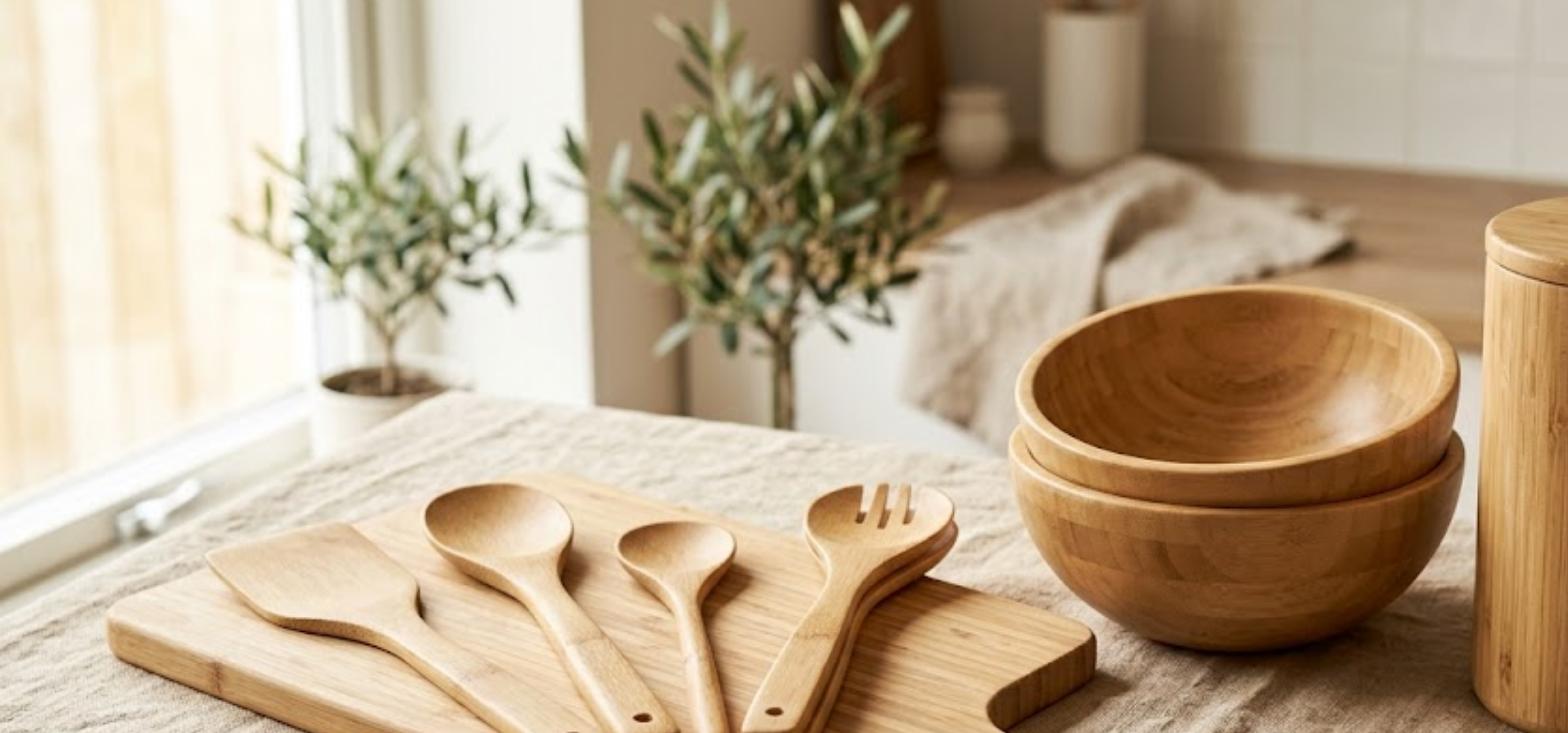
Vietnamese factories cover the full bamboo range. In the kitchen: cutting and serving boards, cooking utensils (spoons, spatulas, salad servers, tongs), mixing and salad bowls, trays, and storage canisters. In houseware: table centrepieces, desk and drawer organisers, coasters, bathroom accessories and natural décor. Many buyers pair these with a mill’s compostable and disposable lines to build a complete eco range from a single supplier — see our guide to eco-friendly and compostable products from Vietnam. For solid-wood alternatives, our acacia wood kitchenware guide and wooden kitchenware OEM guide are useful companions.
Material and food-safety standards to specify
The difference between a profitable bamboo program and a returns problem is moisture control and finish. Ask factories to kiln-dry stock to a stable 8–12% equilibrium moisture content, to use food-safe adhesives on any laminated or edge-glued boards, and to finish food-contact surfaces with food-grade mineral or natural oils rather than lacquers that chip. Request food-contact migration test reports for every item used with food. Our overview of moisture content and kiln-drying standards covers the technical detail buyers should hold suppliers to.
Certifications that matter
For customs clearance and retail listing, documentation is everything. Look for FSC chain-of-custody certification on the bamboo, ISO 9001 for quality management, BSCI or Sedex for social compliance, and food-contact safety testing (FDA, LFGB or EU 10/2011) for kitchen items. Our certifications and compliance page explains which documents each destination market expects.
MOQ, pricing and lead times
Typical MOQs start around one pallet per SKU and scale to mixed-container loads, with FOB Ho Chi Minh City or Hai Phong pricing quoted per piece. Lead times generally run 30–60 days depending on volume, custom tooling and packaging. Consolidating several bamboo SKUs into one order is the fastest way to reach efficient container fill and lower per-unit freight.
OEM and private-label programmes
Most items ship as private label or full OEM — custom shapes and dimensions, laser-engraved or printed logos, and retail-ready packaging carrying your artwork on sleeves and cartons. This is where Vietnamese factories add the most value for brands building a differentiated, eco-positioned home range.
Verifying genuine Vietnamese origin
Because the tariff and CEPA advantages are the whole point, confirm goods are genuinely made in Vietnam and not transshipped. Request a Form B or Form E Certificate of Origin, verify the registered factory address, and review process photos or a live factory walkthrough. Our guide on avoiding China-washing shows exactly how to check.
Start your bamboo sourcing programme
Whether you are launching a bamboo houseware line or adding kitchen SKUs to an existing catalogue, Viet Farm Vision manufactures and exports bamboo kitchenware and houseware to wholesale and OEM buyers worldwide. Request a quote, email info@vietfarmvision.com, or message us on WhatsApp at +84 931 791 703 to receive a catalogue, samples and FOB pricing.