
Vietnam has built one of Southeast Asia’s largest wooden kitchenware manufacturing bases, supplying private label brands and retail chains across North America, Europe, and Australia. But international buyers who source cutting boards, bowls, and utensils keep running into a failure mode that never shows up during sample approval: products that pass quality control in Vietnam crack, warp, or develop mold spots weeks after they reach a warehouse on the other side of the world.
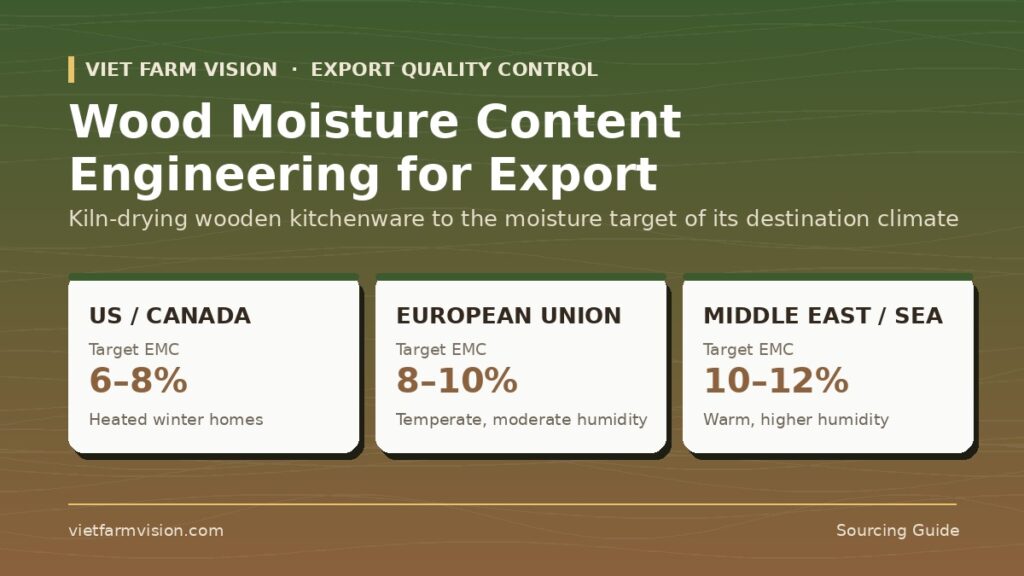
In short: Wood moisture content is the hidden spec that decides whether Vietnamese kitchenware survives its destination climate: US and Canadian buyers should specify 6-8% target MC, EU buyers 8-10%, and Middle East or Southeast Asian buyers 10-12%. A board dried only to 12-14% will keep releasing moisture in a heated North American winter home and crack along the grain. MOQ runs 500-1,000 pieces per SKU with a typical 3-8% premium for non-standard EMC targets.
The root cause is almost never the wood species or the craftsmanship. It is moisture content engineered for the wrong climate.
Why Moisture Content Determines Product Lifespan
Wood is hygroscopic: it continuously absorbs and releases moisture until it reaches equilibrium with the surrounding air, a level known as Equilibrium Moisture Content (EMC). A cutting board dried to 12-14% moisture content feels perfectly stable in humid Ho Chi Minh City. Shipped to a heated home in the northern US or Canada during winter, where indoor humidity can fall below 30%, that same board keeps releasing moisture until it reaches 6-8% EMC, shrinking and cracking along the grain in the process.
This is why a flawless pre-production sample and a climate-stable finished product are two different commitments. A factory can hand-select and season a single sample board with extra care, but a commercial kiln-drying schedule has to hit a specific target consistently, across thousands of units, for the product to survive its destination climate.
What Buyers Typically Miss About Kiln-Drying
Most sourcing conversations focus on wood species (Acacia, rubberwood, bamboo) and finish (mineral oil, beeswax, food-safe lacquer), but skip the variables that actually determine whether a product survives its destination climate.
- Target EMC by destination market: reputable factories kiln-dry to a moisture specification matched to the buyer’s shipping destination, not a generic “dry enough” standard. US and Canadian buyers with heated, low-humidity winters typically need 6-8% target MC; EU buyers usually need 8-10%; Middle Eastern and Southeast Asian buyers can generally accept 10-12%.
- Resting and stress-relief time: freshly kiln-dried wood carries internal stress. Skipping a resting period after drying, and again after gluing multi-piece boards, traps that stress inside the product, where it releases later as warping or cracking, often after the item has already been sold to an end customer.
- Container humidity swings: a sealed container can swing more than 20 degrees Celsius between day and night during a 30-45 day ocean transit, especially crossing the equator. Without adequate desiccant loading and moisture-barrier packaging, condensation can form inside the container and cause mold spotting on unfinished or semi-finished wood surfaces, even when the wood itself was dried correctly.
MOQ, Lead Time & Pricing for Moisture-Engineered Production
Moisture-engineered wooden kitchenware typically carries the same MOQ structure as standard OEM production: 500-1,000 pieces per SKU, though factories that maintain destination-specific kiln schedules often set slightly higher minimums to justify running a dedicated drying batch rather than mixing specifications in one kiln load. Pricing sits within the normal range for Vietnamese wooden kitchenware, generally 20-35% below equivalent China or Europe-sourced product, with a modest premium (typically 3-8%) for buyers who specify a non-standard EMC target or request third-party moisture verification.
Standard production lead time remains 45-60 days from artwork and specification approval, with 30 days achievable on repeat orders using existing molds and a proven kiln schedule. Buyers should add the resting/curing period into their timeline planning explicitly rather than assuming it happens inside the standard lead time; rushing this step to meet a shipping deadline is the single most common cause of post-shipment cracking.
Certifications & Documentation Buyers Should Request
Beyond the standard FSC, FDA, and LFGB/REACH paperwork most importers already ask for, buyers sourcing moisture-sensitive wooden kitchenware should also request:
- Kiln-drying charts or logs showing the target moisture content and drying schedule used for the specific order, not just a generic factory capability statement.
- Third-party or in-house moisture meter test reports on a sample from the actual production lot, taken at multiple points on each item, since edges dry faster than the core and inconsistent readings signal an unstable board.
- Packing list details for desiccant type and quantity per container, plus confirmation of moisture-barrier wrap or vapor-barrier cartons for high-humidity or long-transit destinations.
Working With a Sourcing Partner vs. a Single Workshop
A single small workshop can produce a beautiful one-off sample, but rarely operates its own kiln at the scale needed to run destination-specific drying schedules for a full container order. Workshops without in-house kilns typically outsource drying to a third party, which makes it harder to guarantee the exact moisture target the buyer needs, and adds a step where specifications can get lost.
Viet Farm Vision works with vetted wooden kitchenware manufacturers across Vietnam that operate destination-specific kiln schedules, verify moisture content lot by lot, and manage container packing and desiccant loading for the buyer’s specific shipping route and climate corridor.
Looking to add reliable, climate-engineered wooden kitchenware to your supply chain? Get in touch with our team to discuss your destination market, volume, and moisture specifications.
Frequently Asked Questions
What wood moisture content should I specify for my market?
US and Canadian buyers with heated, low-humidity winters typically need 6-8% target MC; EU buyers usually need 8-10%; Middle Eastern and Southeast Asian buyers can generally accept 10-12%.
Why does moisture content matter for wooden kitchenware?
Wood keeps exchanging moisture until it reaches equilibrium with its environment. A board dried to 12-14% feels stable in humid Vietnam but will shrink and crack along the grain in a heated North American home where indoor humidity falls below 30%.
Does moisture-engineered production cost more?
Pricing stays 20-35% below equivalent China or Europe-sourced product, with a modest premium – typically 3-8% – for buyers specifying a non-standard EMC target. MOQ structure is unchanged at 500-1,000 pieces per SKU.
What documentation should buyers request beyond FSC and FDA/LFGB?
Kiln-drying records and lot-level moisture measurement documentation showing the target MC was actually achieved before packing – not just the standard certification paperwork.