
Coffee prices recover, exports expected to regain growth momentum.
Date: May 29, 2026
In the first few months of 2026, Vietnam’s coffee exports continued to increase in volume, but the value decreased due to a sharp decline in average export prices. Amidst market volatility, the coffee industry is expected to regain its growth momentum thanks to a price recovery trend in May 2026 and increased deep processing…
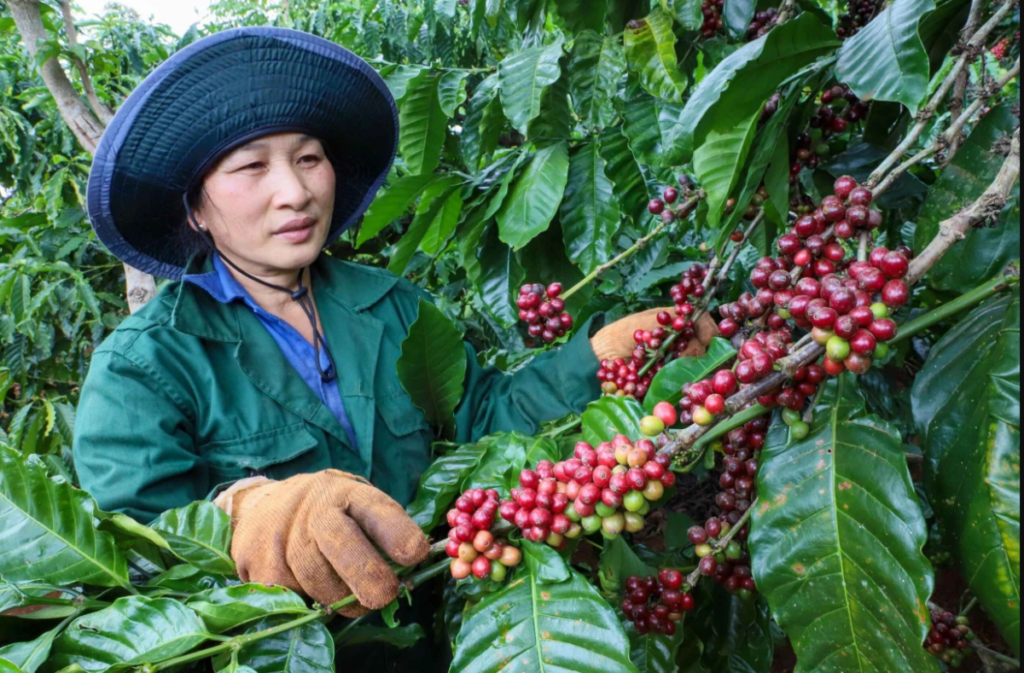
On May 27, 2026, the global coffee market saw a sharp increase across the New York and London exchanges, with robusta prices continuing their surge, officially surpassing the $3,500/ton mark due to supply concerns in key producing countries.
WORLD COFFEE PRICES RISE AGAIN
At the close of trading on the ICE Futures Europe London exchange on the night of May 26th, the price of robusta coffee futures for July 2026 delivery rose by $63 to $3,519 per ton. The September 2026 contract also increased by $67 to $3,377 per ton, with trading volume at a moderately high level.
On the ICE Futures US New York exchange, arabica coffee prices also recorded an upward trend. The July 2026 contract increased by 1.65 cents to 274.00 cents per pound; the September 2026 contract increased by 1.55 cents to 266.35 cents per pound.
According to analysts, the main driver of the coffee price increase is concerns related to global supply, especially in Vietnam and Brazil – two of the world’s largest coffee-producing countries.
In Vietnam, erratic weather patterns, the risk of drought, and the potential impacts of El Nino are raising concerns about the production outlook for the 2026-2027 crop year. Meteorological reports indicate uneven rainfall distribution in the Central Highlands, with localized droughts that could affect coffee yield and quality. These factors have led speculators to increase their long positions on the London exchange, contributing to a sharp rise in robusta prices.
Besides weather and supply factors, low coffee inventories on the ICE exchanges also contributed to supporting prices. Farmers’ hoarding behavior in many major producing regions slowed actual transactions, increasing concerns about short-term supply shortages in the international market.
Meanwhile, in Brazil, despite high expectations for this year’s coffee production, the actual harvesting progress is significantly slower than in previous years. According to a report by Safras & Mercado, as of May 20th, robusta harvesting in Brazil had only reached 13% of the projected yield, lower than the 20% of the same period last year and below the 5-year average of 22%. For arabica, harvesting progress reached only 7% of the projected yield, lower than the 9% of the same period last year. Brokerage firm StoneX estimates that only about 14% of the crop in Brazil has been harvested, lower than the historical average of 21% at the same time.
Domestically, coffee prices in the Central Highlands today (May 27th) increased by 700 VND/kg compared to yesterday (May 26th), bringing the price level back above 88,000 VND/kg.
Domestically, coffee prices in the Central Highlands today (May 27th) increased by 700 VND/kg compared to yesterday (May 26th), bringing the price level back above 88,000 VND/kg. According to experts, if the London exchange continues its upward trend driven by technical factors and recovering demand from export businesses, domestic coffee prices are likely to re-establish and consolidate firmly around 88,000 VND/kg in the coming sessions.
COFFEE EXPORTS INCREASE IN VOLUME, DECREASE IN VALUE
Vietnam’s coffee exports in April 2026 began to show signs of slowing down after a period of strong growth earlier in the year, amidst cooling global coffee prices and slower import demand in some major markets. Although export volume continued to increase, revenue decreased significantly due to a decline in average export prices.
According to data from the Vietnam Customs Department, in April 2026, Vietnam exported approximately 190,000 tons of coffee, earning nearly US$823 million. Compared to the same period last year, export volume increased by 9.2%, but value decreased by 17.9%.
Overall, in the first four months of 2026, Vietnam’s coffee exports reached approximately 782,000 tons, bringing in US$3.58 billion. Compared to the same period in 2025, export volume increased by 11.7%, but revenue decreased by 9.8%. This result shows that the coffee industry has maintained its growth momentum in terms of production, but export value is under significant pressure from the decline in coffee prices on the international market.
The main reason for the decline in export value is the sharp drop in average export prices. In the first four months of 2026, the average export price of Vietnamese coffee reached only about US$4,575 per ton, a decrease of 19.4% compared to the same period last year. After a prolonged period of rapid growth in 2025, world coffee prices entered a correction cycle due to gradually improving supply from major producing countries, while import demand in many markets has not recovered as strongly as expected.
Nevertheless, Vietnamese coffee still maintains its position in many key export markets. The EU continues to be the largest consumer region with positive growth in traditional markets such as Germany, Italy, and Belgium. This shows that Vietnamese coffee still maintains stable competitiveness in the European market, especially for robusta coffee.
In addition, coffee exports to China recorded a strong increase in both volume and value, reflecting the rapidly expanding coffee consumption trend in the Asian market. The increasing demand for coffee in China in recent years is seen as a significant opportunity for Vietnamese export businesses.
The US market also continues to maintain a positive import level. Although the growth rate is not exceptionally high, the volume of coffee exported to this market remains quite substantial, indicating stable coffee consumption demand in the United States.
In May 2026, the recovery of world coffee prices will help Vietnam’s coffee exports regain their growth momentum in value during the second and third quarters. However, promoting deep processing will be a crucial solution to increase the added value of coffee exports. Instead of relying primarily on exporting raw coffee, businesses need to increase the proportion of processed products such as roasted and ground coffee, instant coffee, and other high-value products.
Furthermore, the trend towards green and sustainable consumption in major markets also places new demands on the Vietnamese coffee industry. Experts suggest that businesses need to focus on developing high-quality coffee, green-certified coffee, clearly traceable products, and meeting sustainable development standards to enhance competitiveness in high-end markets.
In the context of a volatile global coffee market, shifting towards improving quality and increasing processing value is considered a crucial direction for the Vietnamese coffee industry to maintain sustainable growth in the future.
By Chu Khoi – vneconomy.vn