
A buyer planning a handmade card range usually starts with one question: quilling, pop-up or laser-cut? The three formats sit side by side on gift shop shelves and often carry similar retail prices, but they behave very differently once you look at the production line. Unit cost, minimum order, lead time, freight weight, breakage risk and how easily a design can be customised all change with the format. Picking the wrong one for your channel is one of the most common reasons a first handmade card order underperforms.
This guide compares quilling cards, 3D pop-up cards and laser-cut cards made in Vietnam from a buyer’s point of view. It is written for gift wholesalers, stationery importers, museum and hotel shops, corporate gifting buyers and online sellers in the Middle East, Asia and Europe who want to choose the right format, or the right mix, before they request samples.
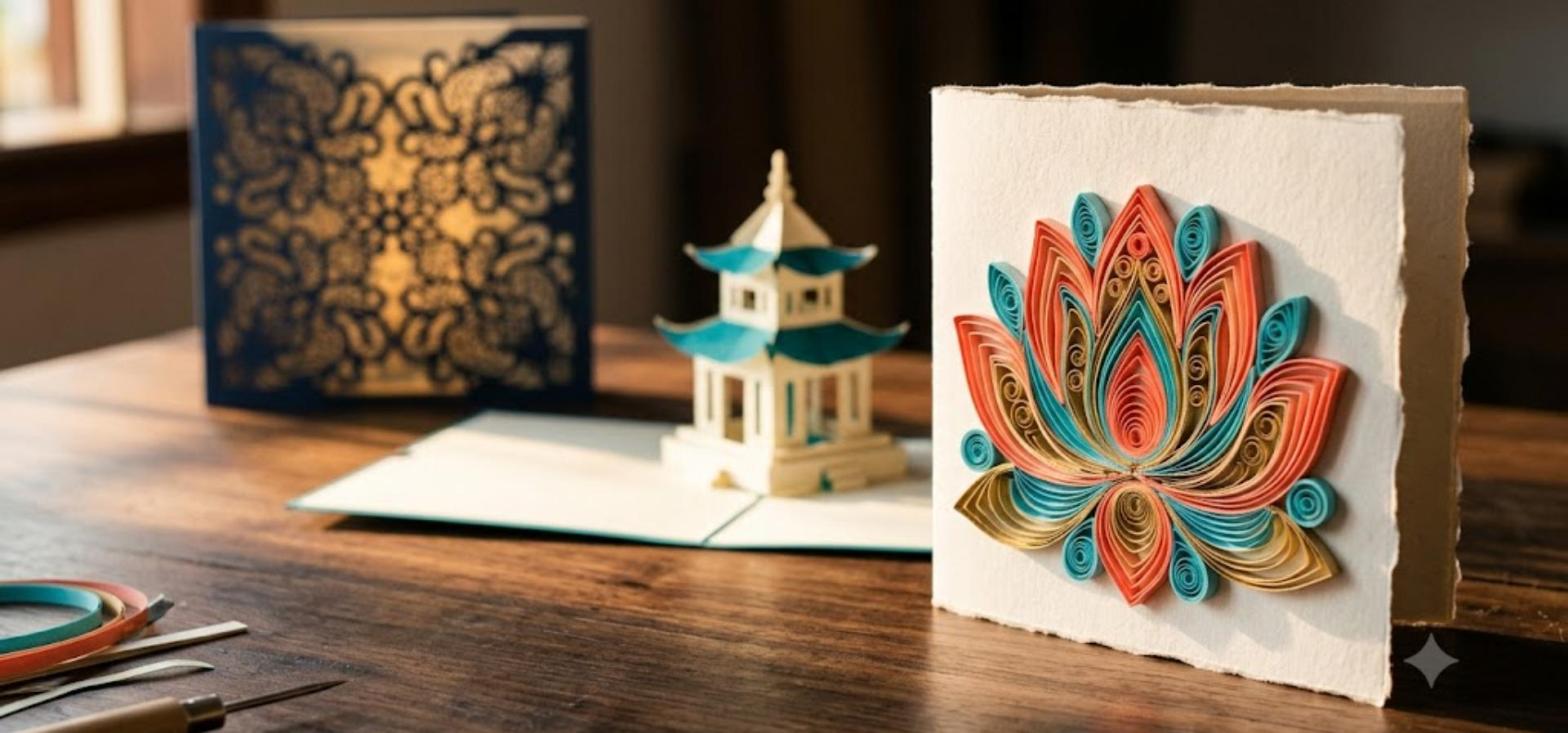
Three formats, three different production lines
The formats look similar in a catalogue, but they come from different skills and equipment. Understanding where the labour sits explains almost every difference in price and MOQ.
- Quilling cards are built by hand. Artisans roll, pinch and glue narrow paper strips into coils and shapes, then assemble them onto a card base. Labour is the main cost and output scales with the number of trained hands, not machines.
- 3D pop-up cards are engineered paper structures. A designer develops the folds, the parts are cut (often by laser or die), and workers fold and glue the layers so the structure rises when the card opens. The engineering is the hard part; assembly is semi-skilled.
- Laser-cut cards are machine-led. A laser cuts a pattern from one or a few sheets of card, followed by light hand finishing and folding. Once the file is set, output is fast and highly consistent.
Side-by-side comparison for buyers
| Factor | Quilling card | 3D pop-up card | Laser-cut card |
|---|---|---|---|
| Main cost driver | Artisan hand time per coil | Structural design plus folding and gluing | Machine time and card stock |
| Typical relative unit cost | Medium to high, rises with detail | Medium, high for complex structures | Low to medium |
| Customisation cost | Low tooling, new artwork is mainly a hand-sampling cost | Higher, each new structure needs paper engineering | Low, a new vector file is enough |
| Typical sampling time | Fast for colourways, moderate for new motifs | Longest, structure must be tested and adjusted | Fastest |
| Consistency between units | Handmade variation, controlled by golden sample | Good once the structure is fixed | Very high |
| Weight and volume | Heavier, relief needs protective sleeves or boxes | Flat when closed, light | Flat and light |
| Breakage and transit risk | Coils can crush without proper packing | Folds can tear if over-flexed | Fine bridges can snap |
| Perceived value at retail | Very high, visibly handmade | High, strong surprise effect | Medium to high, elegant and precise |
| Best story | Artisan craft, heritage, keepsake | Wow moment, children, travel souvenirs | Minimal design, weddings, corporate |
The table shows relative positions, not fixed prices. Actual quotes depend on size, design complexity, packaging and order volume. Our guide to handmade greeting cards from Vietnam explains the specification details that move a quote.
Which format fits which channel
- Museum, gallery and heritage shops: quilling leads. Shoppers pay for visible handwork and a craft story, and the higher unit cost is absorbed by premium shelf prices.
- Hotel boutiques and travel retail: a mix works best. Pop-up cards of landmarks sell as souvenirs because they ship flat in a suitcase, while quilling cards sit at the top of the price ladder.
- Corporate gifting and events: quilling for small, high-value runs with a logo motif or brand colours; laser-cut for larger volumes where every card must look identical, such as invitations or season’s greetings.
- Stationery chains and supermarkets: laser-cut and simpler pop-up cards hit lower price points and reorder quickly. Quilling can work as a small premium bay rather than the whole range.
- Online sellers: pop-up and laser-cut cards ship cheaply in flat mailers. Quilling sells well online thanks to strong photos and reviews, but packaging must be specified to survive parcel networks.
MOQ, lead time and capacity: what changes by format
Minimums follow the production logic. Quilling workshops set a minimum per design so artisans can settle into a rhythm, and capacity depends on how many trained hands are available in a season. Pop-up producers need enough volume to repay the time spent engineering a new structure, so minimums are usually higher for custom structures than for catalogue ones. Laser-cut lines can run small batches efficiently, but card stock and finishing such as foiling may carry their own minimums.
For seasonal orders, quilling needs the longest runway because output cannot simply be accelerated with more machine hours. Plan production well before peak seasons and account for the Tet holiday slowdown in Vietnam. Our RFQ pack guide lists the information that lets a workshop confirm capacity and dates in one quotation.
Building a mixed handmade card range
Many buyers get the best result by combining formats instead of choosing one. A practical structure is:
- Hero tier, quilling: a focused set of high-detail designs that carry the craft story and the highest margin per card.
- Volume tier, laser-cut: clean, consistent designs at accessible prices that drive reorders and fill the shelf.
- Gift and souvenir tier, pop-up: landmark, festive or children’s designs that create the surprise moment and travel well.
Keep sizes and envelope formats consistent across the three tiers so one display unit, one carton plan and one barcode system can serve the whole range. Consolidating the formats in a single shipment from Vietnam also keeps freight cost per card under control.
Questions to ask before you sample
- What price point and retail channel is this card for, and what margin does the channel need?
- Is the value in visible handwork, in a structural surprise, or in clean design?
- How much variation between units can your customers accept?
- How will the cards travel: palletised to a store, or as single parcels to consumers?
- How often will you change designs, and who owns the artwork?
- Do you need consistent volume all year, or seasonal peaks?
Common mistakes when choosing a card format
- Comparing a quilling quote directly with a laser-cut quote as if they were the same product.
- Ordering highly detailed quilling for a mass-market price point where shoppers will not pay for handwork.
- Commissioning a custom pop-up structure for a small first order, so engineering cost dominates the unit price.
- Choosing very fine laser-cut patterns without testing them in transit.
- Using different sizes for each format, which complicates packaging, displays and freight.
Sourcing handmade cards with Viet Farm Vision
Viet Farm Vision works directly with a handmade quilling card workshop in Vietnam and supplies custom handmade greeting cards to gift wholesalers, stationery brands, museum shops and corporate buyers across the Middle East, Asia and Europe. We help you match the format to your channel, prepare colourway tests and golden samples, and plan a production order with clear lead times. Tell us your channel, target price point and order volume, and we will recommend a format mix and quote it in one request. Contact our team to start.