
A quilling card that sells out in a Dubai gift shop can sit untouched on a stationery shelf in Osaka, and the card that flies in Seoul may look too loud for a Copenhagen museum store. The paper, the workshop and the craft are identical. What changes is the motif, the colour palette and the occasion the card is made for. Buyers who treat a quilling range as one global catalogue usually end up with slow stock in at least one market. Buyers who localise the design brief before sampling get faster sell through with the same unit cost.
This guide explains how to localise quilling card designs by market when you source from Vietnam: which motifs, colours and occasions tend to work in the Gulf, in East and Southeast Asia and in Europe, what to avoid, and how to brief a Vietnamese workshop so one production line can serve several regions. It is written for gift wholesalers, stationery importers, museum shop buyers and private label brands ordering handmade quilling cards from Vietnam.
Why localisation is a margin decision, not a design preference
In handmade paper art the cost of a card is mostly artisan time, and artisan time is the same whether the coils form a lotus or a tulip. That means localisation costs almost nothing per unit. What it changes is sell through. A card designed for the occasions your customers actually celebrate, in the colours they associate with luck, respect or celebration, turns faster, needs fewer markdowns and earns the reorder. A generic card has to compete on price, and handmade quilling will never win a price fight against printed cards.
The practical rule: keep the construction, sizes and packaging standard across markets, and localise only the front design, the palette and the occasion. That way you keep one costing structure and one quality standard, while each market gets cards that look like they were made for it.
Gulf and wider Middle East: geometry, gold and the gifting season
Gulf buyers typically sell cards as part of a gift, not as a standalone impulse item, so the card has to look premium next to dates, perfume or chocolate. Designs that tend to work well:
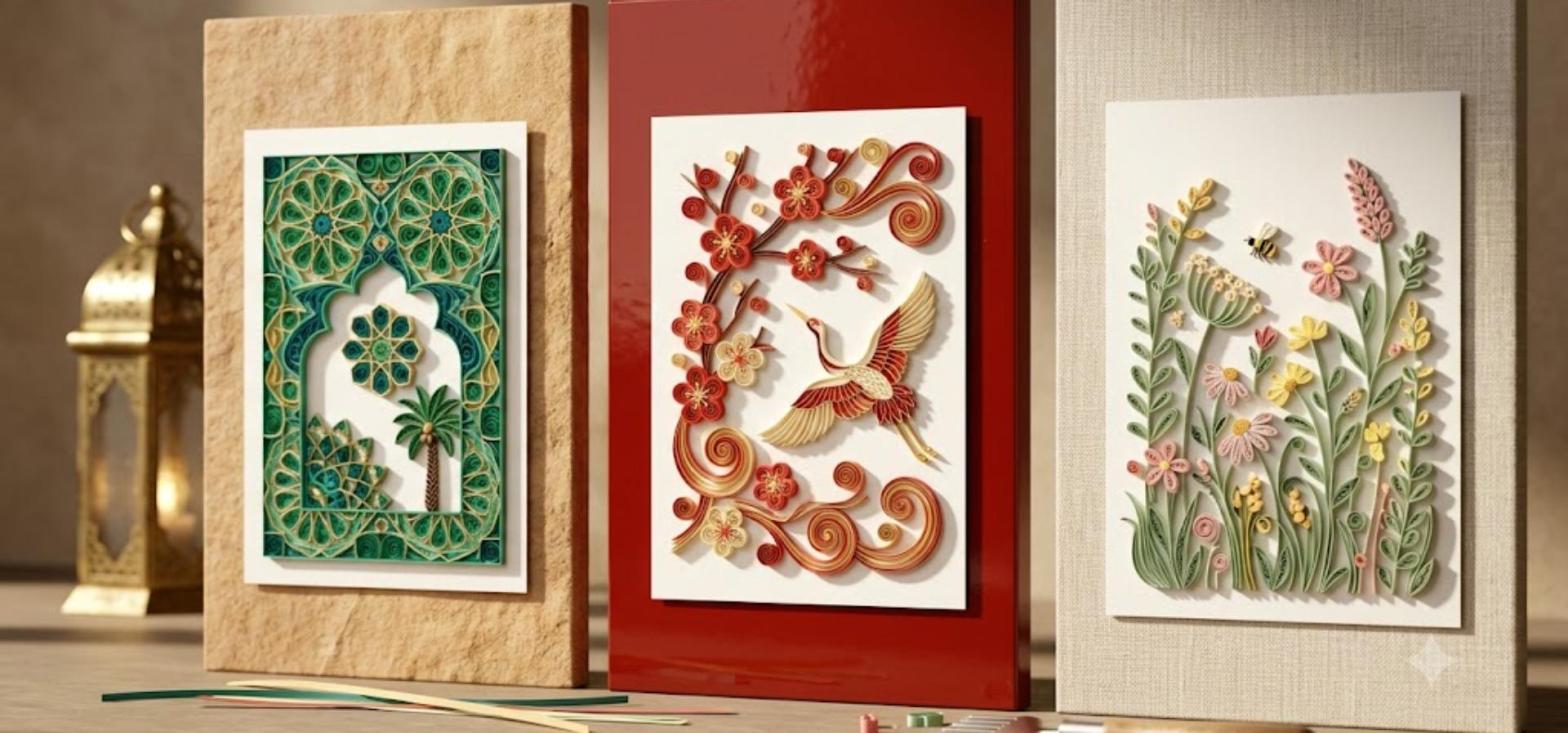
- Motifs: geometric star and arabesque patterns, crescent and lantern shapes for Ramadan, date palms, Arabian horses, falcons, roses and jasmine.
- Palette: emerald, deep teal, navy and burgundy grounds with gold or champagne coils; white and gold for weddings and newborn gifts.
- Occasions: Ramadan and Eid, weddings, new baby, graduation, national days and corporate greetings.
- Avoid: human figures and faces as the main motif, animals in religious contexts, and any religious text unless supplied and approved by your own team. Leave calligraphy to a printed insert rather than asking artisans to quill script.
Because the Islamic calendar moves about eleven days earlier each year, Gulf ranges need to be planned against the actual Ramadan date and the Vietnamese Tet shutdown, not the Western Q4 calendar. Our seasonal range planning guide covers the order windows in detail.
East Asia: red, gold and auspicious symbols
In China, Hong Kong, Taiwan, Singapore and the Chinese diaspora market, colour carries meaning. Red and gold signal luck and celebration; white and black are associated with mourning and should not dominate a celebration card. Lunar New Year is the dominant season, with the zodiac animal of the year as a strong seller. Plum blossom, peony, cranes, koi, lanterns and mandarin ducks for weddings are dependable motifs.
Japan and Korea behave differently. Japanese buyers often prefer restrained palettes, seasonal flowers such as cherry blossom, hydrangea and maple, generous white space and very precise finishing. Korean buyers respond well to soft pastels, cute animal characters of your own design and occasions such as Chuseok, Parents’ Day and Teachers’ Day. In both markets finishing quality is judged closely, so specify tighter tolerances on glue marks and coil symmetry.
Southeast and South Asia: festivals and bright colour
Southeast Asian markets combine several festival calendars: Lunar New Year, Hari Raya, Deepavali, Vesak and Christmas can all matter in one country. Bright, saturated palettes sell well, as do tropical flowers such as frangipani, orchid and lotus. For Indian and South Asian buyers, Diwali and wedding seasons drive volume, with marigold orange, magenta, peacock blue and gold, and motifs such as diyas, paisley, elephants and peacocks.
Europe: botanical, calm and sustainability first
European stationery and museum buyers usually favour natural botanical themes, muted or pastel palettes, birds, bees and wildflowers, and clear sustainability messaging on the back of card. Christmas, Easter, Mother’s Day and birthdays carry the volume, with sympathy and thank you cards as steady everyday lines. Expect questions about recycled or FSC paper, plastic free sleeves and water based glue, which our quilling card compliance guide explains.
Market design matrix at a glance
| Market | Strong motifs | Palette | Peak occasions |
|---|---|---|---|
| Gulf and Middle East | Geometric stars, lanterns, date palms, falcons, roses | Emerald, teal, navy, burgundy with gold | Ramadan, Eid, weddings, new baby |
| Greater China and diaspora | Plum blossom, peony, crane, koi, zodiac animal | Red, gold, ivory | Lunar New Year, weddings, birthdays |
| Japan and Korea | Seasonal flowers, own design characters | Soft pastels, restrained tones | Seasonal gifting, Chuseok, Parents’ Day |
| Southeast and South Asia | Orchid, lotus, frangipani, peacock, diya | Saturated brights, gold | Lunar New Year, Hari Raya, Diwali |
| Europe | Wildflowers, birds, bees, botanical | Sage, blush, cream, muted tones | Christmas, Mother’s Day, birthdays |
Treat the matrix as a starting point, not a rule book. Your own sell through data, and your customers’ feedback on samples, should always override it.
How to brief a Vietnamese workshop for a multi market range
- Fix the platform first. Agree two or three standard card sizes, the relief depth, envelope and sleeve. These stay the same in every market.
- Write a one page brief per market. List occasions, three to five motifs, the palette with Pantone or paper colour references, and the motifs to avoid.
- Send references, not finished artwork. Mood images and colour chips let artisans translate the idea into quilling. Flat graphic artwork often does not convert well into coils.
- Ask for a colourway test. One design in two or three palettes is a cheap way to see which market version works before full sampling.
- Approve a golden sample per design. Sign and seal one approved card per design and colourway as the production reference.
- Clarify design ownership. If the localised design is exclusive to you, put that in writing, as explained in our artwork and IP guide.
Building one range that serves several regions
Distributors who sell into several regions do not need a separate collection for each. A practical structure is a core of evergreen designs that travel well, such as florals, butterflies, birds and thank you cards, plus a smaller localised layer per market. Many buyers work with roughly two thirds core and one third local, then shift the balance once reorder data comes in. Colourways are the cheapest localisation lever: the same peacock design in gold and teal for the Gulf, in magenta and gold for India and in soft blue and cream for Europe.
Keep the localised layer within the workshop’s minimum per design, and combine designs in one shipment so freight stays efficient. Our RFQ pack guide shows how to quote a mixed range in one request.
Common localisation mistakes
- Translating a Western Christmas range into other markets by changing only the greeting.
- Using white and black as the main palette for East Asian celebration cards.
- Asking artisans to quill fine script or calligraphy instead of using a printed insert.
- Ignoring the moving Ramadan date and the Tet factory shutdown when setting order deadlines.
- Designing too many local SKUs at low quantities, which pushes every design under the workshop minimum.
- Skipping a colourway test and finding out after delivery that the palette reads wrong in the market.
Localising quilling cards with Viet Farm Vision
Viet Farm Vision works directly with a handmade quilling card workshop in the Mekong Delta, producing custom handmade greeting cards for gift wholesalers, stationery brands, museum shops and corporate buyers in the Middle East, Asia and Europe. We help you turn a market brief into colourway tests, golden samples and a mixed production order, with one costing structure across all regions. Tell us which markets you sell into and we will propose a starting range.
Email info@vietfarmvision.com or request a quote to start your localised quilling card range.