
The fastest way to sell handmade cards in a gift shop is to make the making visible: tell customers, in a few honest words at the shelf, the till and the product page, who made the card and how. Shoppers cannot see the hours of rolling and shaping inside a quilling card unless you show them, and a card whose story is invisible competes on price with every printed card on the rack.
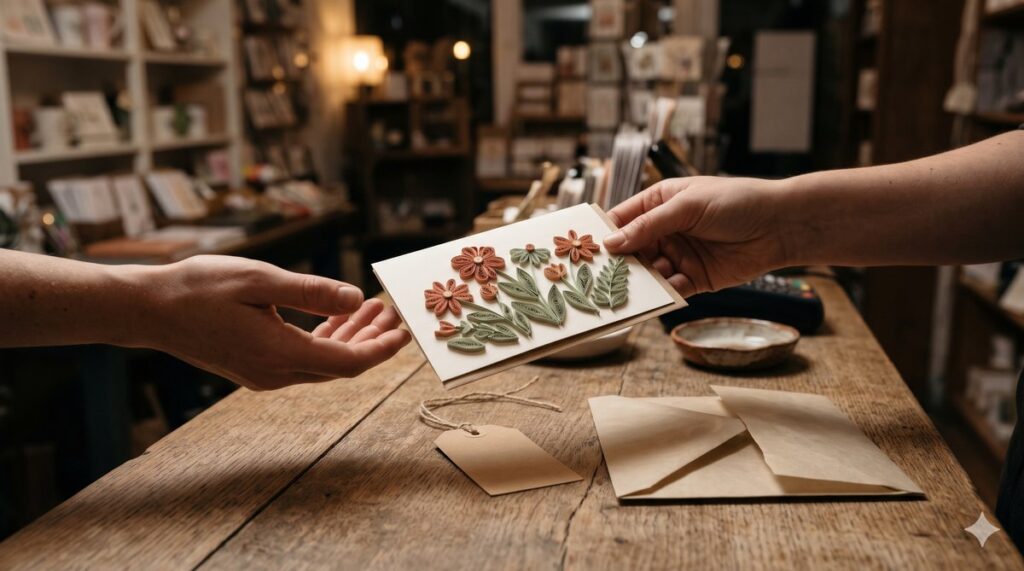
Why does the handmade story matter when you sell handmade cards?
Because “handmade” changes what a buyer thinks they are giving. Research by Christoph Fuchs, Martin Schreier and Stijn van Osselaer, published in the Journal of Marketing as “The Handmade Effect: What’s Love Got to Do with It?”, found that consumers see handmade products as symbolically containing the maker’s care, and that this preference is especially strong when the product is bought as a gift for someone close. Monash University’s retail researchers summarise the idea in “Made with love”.
A greeting card is almost always a gift, so it sits where this effect is strongest. But it only works if the shopper knows the card was made by hand, and on a crowded spinner a quilling card can pass for an embossed print. Your job is to close that gap in the few seconds a customer spends at the fixture.
What is the true story behind a quilling card?
Start with facts you can stand behind. For the cards Viet Farm Vision supplies, the honest version is short:
- Each card is made by hand in a partner workshop in Vietnam, by artisans who are mostly local women living near the workshop.
- Every flower, leaf and petal is formed from narrow strips of paper that are rolled, pinched and glued into shape one piece at a time. Our guide to quilling techniques explains the main coil and scroll shapes if you want to brief your staff.
- Each card is checked individually before packing, as part of a four-step quality process that runs from sample approval to a final carton count with photos and video.
That is enough for every touchpoint. Invented artisan stories are easy to spot and damage trust with exactly the customers who care most about craft.
Where should the story appear in your shop?
Size the story for each place it appears:
| Touchpoint | What the customer needs to learn | Suggested length | Example wording (illustration only) |
|---|---|---|---|
| Shelf talker or header card | That the cards are handmade, and what quilling is | One line, under 12 words | “Rolled by hand from paper strips, one petal at a time.” |
| Back of card or belly band | Where and how it was made | Two short sentences | “Handmade in Vietnam using the paper craft of quilling. Every shape is rolled and placed by hand.” |
| Staff conversation at the till | Why it costs more than a printed card | One or two spoken lines | “Each of those flowers is made from a rolled paper strip, so no two are quite identical.” |
| Product page online | Making process, size, care, occasion | 80 to 150 words plus close-up photos | A short paragraph on the craft, then bullet facts |
At the shelf: let the customer touch the craft
The single most persuasive thing about a quilling card is its texture. Keep one open “tester” of each bestselling design out of its sleeve, angled so light catches the coils. Customers who can see the edges of the paper strips understand immediately that this is not print. Pair the tester with a one-line shelf talker. For fixture layouts and lighting, see our greeting card display ideas for gift shops.
On the card: one honest sentence travels with the gift
A brief line on the card back or belly band means the recipient learns the story too. With private label packaging, we can print your own wording and logo on the card back, sleeve or band, so the story appears in your brand voice rather than ours.
At the till: give staff two sentences, not a script
Long scripts sound rehearsed. Give staff two facts to remember: the card is rolled by hand from paper strips, and it is made by artisans in a workshop in Vietnam. Let them say it in their own words when a customer picks up a card or asks about price.
How do you tell the handmade story online?
Online, photography carries the story. Use three images: the full card face, a side-lit close-up of the coiled paper edges, and the card in a gifting scene. Then keep the text factual:
- Lead with the craft: say “handmade paper quilling” in the first line so search engines and shoppers both understand what the product is.
- Explain the variation: tell buyers that small differences between cards are a sign of handwork, not a defect. This also reduces returns.
- Give practical details: size, blank inside or not, envelope colour.
- Match the occasion: link the design to a use, such as a thank-you, sympathy or birthday card. Flower symbolism helps here; see our guide to flower meanings on greeting cards.
What should you avoid when marketing handmade cards?
Overclaiming does more damage than saying too little:
- Do not invent people. If you do not have a verified artisan profile, describe the workshop and the technique instead.
- Do not make claims you cannot document. Avoid environmental, material or certification claims unless your supplier has given you written evidence for that exact product.
- Do not hide the origin. “Handmade in Vietnam” is a strength. Clear country-of-origin information is also a legal requirement in many import markets.
Frequently Asked Questions
Do customers really pay more for handmade greeting cards?
Academic research on the “handmade effect” shows that people value handmade products more, particularly when buying gifts for people they care about. In practice, the premium only holds when shoppers can see or are told that the card is handmade. Testers, shelf talkers and close-up photos are what turn that preference into sales.
Can my shop add its own story text to the cards?
Yes. With private label packaging, your wording, logo and brand style can be printed on the card back, sleeve or belly band. Send us your text and artwork with your enquiry, and we will confirm layout options during sampling.
Can you provide photos or video for my marketing?
Before each shipment we send buyers photos and video of the counted, packed cartons as part of our final check. If you need extra content for your own marketing, mention it in your quote request so we can discuss it.
How should I explain small differences between cards?
Tell customers plainly that each card is assembled by hand from rolled paper strips, so tiny variations in coil size or placement are normal. Every card is still checked individually against the approved sample before packing, so the design, colours and layout stay consistent.
Ready to stock handmade quilling cards with a story worth telling?
Browse our handmade greeting cards to see designs and customisation options, including your own designs, logo printing and private label packaging. When you are ready, send us a request for quotation with your target market, occasions and packaging needs, and we will reply within one business day.