
To import quilling cards into Switzerland, you need a Swiss importer of record, a commercial invoice and packing list from the supplier, and a customs declaration lodged with the Federal Office for Customs and Border Security (FOCBS/BAZG). Since Switzerland abolished industrial tariffs on 1 January 2024, handmade paper greeting cards generally enter duty-free; the main cost at the border is Swiss import VAT at the standard 8.1% rate. The real work for a Swiss buyer sits elsewhere: multilingual greetings, a calendar that starts with Advent, and packaging that survives a long journey to a premium shelf.
Why does Switzerland suit handmade quilling cards?
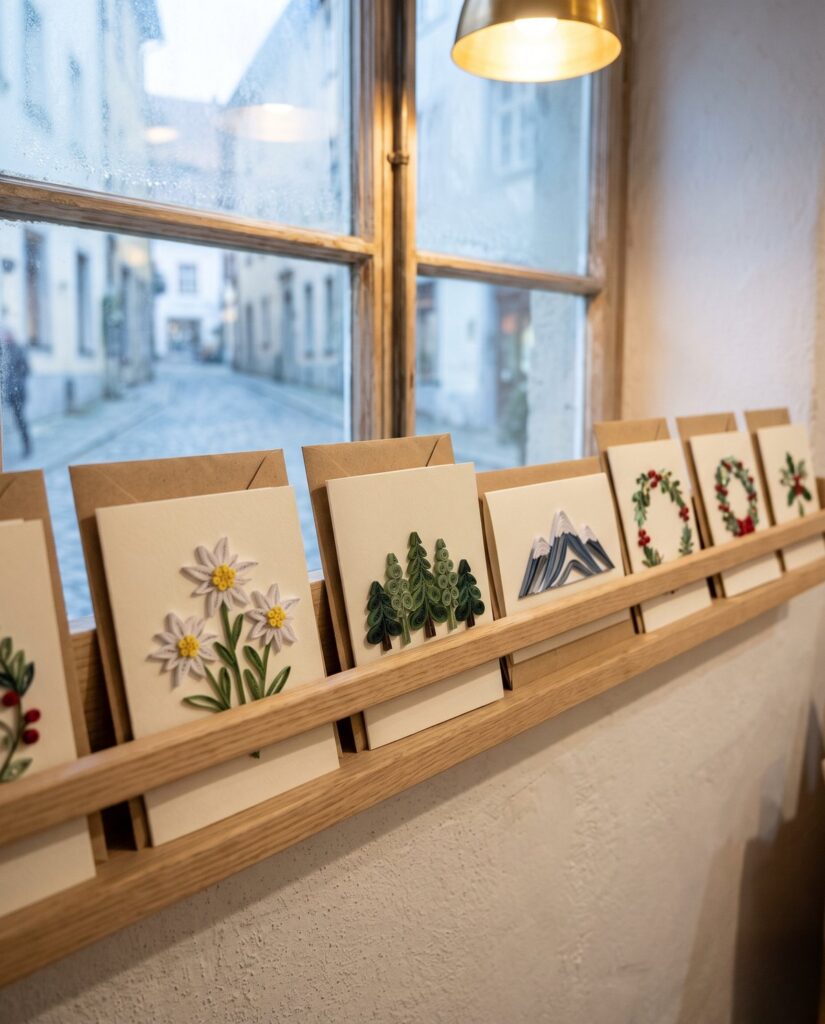
Swiss gift and stationery buyers tend to reward visible craftsmanship and are comfortable paying for it. A quilled card, built by hand from coiled and shaped paper strips, has the tactile quality that sets it apart from a flat print on a crowded rack. That matters in a market where many independent shops, museum stores and tourist-area boutiques compete on curation rather than volume.
The second reason is practical. Because Switzerland removed customs duty on most industrial goods, the landed cost of a carton of cards from Vietnam is driven mainly by freight, VAT and broker fees. That makes it easier to plan a premium, small-batch range without guessing at tariff changes, which is a different picture from the one many buyers face in the United States today.
What paperwork do you need to import quilling cards into Switzerland?
The document set is close to what you would use for an EU shipment, with Swiss systems at the end of the chain. The FOCBS publishes an importation checklist for companies that is worth reading before your first order.
| Document or step | What it does | Who prepares it |
|---|---|---|
| Commercial invoice | Describes the goods, value, currency and Incoterm; the basis for the customs and VAT value | Supplier in Vietnam |
| Packing list | Carton-by-carton contents, weights and dimensions for customs and the receiving warehouse | Supplier in Vietnam |
| Certificate of origin (CO) | Records Vietnamese origin; useful for your records and for any future preference under the EFTA–Viet Nam agreement | Supplier, issued in Vietnam |
| Bill of lading or air waybill | Transport contract and title document for the cargo | Forwarder or carrier |
| Swiss import declaration | Lodged electronically with the commodity code, value and importer details | Your customs broker or forwarder |
| Import VAT | Assessed on import; VAT-registered businesses can normally reclaim it as input tax | Importer of record |
One system change is worth noting for 2027 planning. Switzerland is moving import declarations from the old e-dec platform to its new Passar system. According to Swissmem, e-dec Import accepts declarations until 30 September 2027, and from 1 October 2027 imports must be declared through Passar. If you clear goods through a broker, ask them now whether they are ready, so your autumn stock is not caught in the changeover.
Customs duty, the EFTA–Viet Nam FTA and Swiss import VAT
Is there customs duty on greeting cards entering Switzerland?
The FOCBS confirms that the abolition of industrial tariffs entered into force on 1 January 2024 and covers goods in chapters 25 to 97 of the Swiss customs tariff, with limited agricultural exceptions. Paper greeting cards fall within that range, so in most cases no customs duty is charged. Your broker still needs the correct tariff number for the declaration and statistics, so agree the classification with them before the first shipment rather than at the border.
What does the new EFTA–Viet Nam agreement change?
Viet Nam and the four EFTA states, Switzerland, Liechtenstein, Iceland and Norway, signed a free trade agreement in Hanoi on 18 October 2026, as reported by Vietnam Investment Review. VietnamPlus reports that Vietnam is aiming for the deal to take effect from early 2027, once ratification is complete. For greeting cards the direct duty saving is limited, because Swiss duty on these goods is already zero. The agreement matters more for the wider relationship: customs cooperation, rules on origin and a stable framework for buyers who also import other goods from Vietnam. Status as of 15 November 2026: signed, not yet in force.
How much VAT applies on import?
The FOCBS states that import VAT is charged at the same rates as domestic sales: 8.1% standard and 2.6% reduced for basic necessities. Greeting cards are normally taxed at the standard rate. Always confirm the final treatment of your specific product with your customs broker, as we cannot give tax advice for your business.
What product rules should Swiss buyers check?
Paper greeting cards are low-risk products, but Swiss retailers still carry a general duty to place safe products on the market under the Swiss Product Safety Act, overseen by SECO. In practice, buyers ask for three things: firmly fixed quilled elements that do not shed small parts, clean edges, and packaging labelled with the importer’s name and address. If a card includes extras such as ribbons or beads, mention it at the quotation stage so both sides agree on how they are attached and checked.
Switzerland is not in the EU, so EU-specific obligations do not apply automatically. Many Swiss shops also sell into the EU online, though, so it is sensible to keep your product information and labelling consistent with EU expectations if you plan cross-border sales.
Swiss card calendar: when to order quilling cards for 2027
Switzerland has its own seasonal rhythm. Samichlaus, Saint Nicholas, visits on 6 December, and the Swiss National Museum explains how Christkind and Samichlaus traditions differ across regions. Cards for Advent and Christmas therefore need to be on shelves by early November, not December.
| Season or occasion | On shelf by | Send design brief by | Popular quilled themes |
|---|---|---|---|
| Valentine’s Day 2027 | Mid-January | Already late; ask about reorders of approved designs | Hearts, red roses, paired birds |
| Easter 2027 | Early March | Late November 2026 | Spring bulbs, rabbits, painted eggs |
| Mother’s Day 2027 | Mid-April | December 2026 | Peonies, mixed bouquets, soft pastels |
| Summer and tourist season | May | January 2027 | Edelweiss, alpine meadows, mountain lakes |
| Advent, Samichlaus and Christmas 2027 | Early November | May to June 2027 | Fir trees, stars, candles, winter birds |
These are planning guides, not fixed production times. Lead time depends on design complexity, quantity and sea or air freight, which we confirm in each quotation.
Which quilled designs and greetings suit Swiss shelves?
The most important design decision is language. Switzerland has four national languages, and the Swiss Federal Department of Foreign Affairs notes that German is the main language for more than 60% of the population, with French in the west and Italian in Ticino. A shop in Lausanne and a shop in Zurich need different greetings on the same design.
- Keep the front wordless. Let the quilled artwork carry the card and put greetings inside, or on a printed insert, so one design works across regions.
- Order language variants by region. Split one design into German, French and Italian versions in the same order, with clear carton labels per variant.
- Lean into alpine motifs. Edelweiss, gentians, fir branches and mountain silhouettes sell well in tourist areas and as gifts to send abroad.
- Use restrained colour. Many Swiss buyers prefer refined palettes, such as white on kraft, deep green and red, or soft florals, over bright neon tones.
If you are also supplying shops across the border, our guides to importing quilling cards into Germany and importing quilling cards into France cover the EU side, where the EVFTA and EU VAT rules apply instead.
How do you order quilling cards from Vietnam for a Swiss store?
We work with partner workshops in Vietnam, where the cards are made by hand by skilled artisans, mostly local women living near the workshop. For a Swiss buyer, the process usually runs like this:
- Brief and samples. Share your designs, or choose from our handmade quilling greeting cards, plus language variants, sizes and packaging needs.
- Pre-production sample approval. You approve physical samples or detailed photos before production starts.
- Mid-production check at the workshop. We inspect work in progress for shape, colour and finish.
- Card-by-card inspection before packing. Every card is checked and packed with protective inserts.
- Carton count with photos and video. You receive photos and video of the packed cartons before dispatch, with a commercial invoice, packing list and CO.
Private label packaging, your shop logo printed on the back or on sleeves, and custom designs are all available. Ask us for language-specific inserts if you sell in more than one region.
Frequently Asked Questions
Is there customs duty on quilling cards imported into Switzerland?
Since 1 January 2024, Switzerland has abolished customs duty on industrial goods in chapters 25 to 97 of its tariff, which includes paper greeting cards. In most cases, no duty is charged. Import VAT and broker fees still apply, so check the full landed cost with your broker.
What VAT rate applies to greeting cards imported into Switzerland?
Import VAT follows Swiss domestic rates. Greeting cards are normally taxed at the standard rate of 8.1%, as of November 2026. VAT-registered businesses can usually reclaim it as input tax.
Does the EFTA–Viet Nam free trade agreement apply yet?
The agreement was signed on 18 October 2026, and Vietnam is targeting entry into force in early 2027, subject to ratification. For greeting cards the direct duty effect is small, because Swiss duty on them is already zero.
Can you make the same design in German, French and Italian?
Yes. We can keep one quilled design and change the greeting on the inside or on an insert for each language. Each variant is packed and labelled separately so your warehouse can sort stock by region.
How early should I order Christmas quilling cards for Switzerland?
Plan for cards to arrive by early November, ahead of Advent and Samichlaus on 6 December. That usually means sending your design brief by May or June. We confirm exact timing in the quotation.
Ready to bring quilled cards to Swiss customers?
Tell us your store type, language regions, designs and target season, and we will reply within one business day with samples, options and a clear quotation. Request a quote to start your Swiss card range.